Hello! Welcome to your first lesson.
I'm here to support you in mastering the "meta-skills" of JEE preparation. This course isn't about re-learning physics or chemistry; it's about building the mental framework and practical systems to study effectively and consistently, especially when you feel stuck. You've identified that the main challenge is not the subject matter, but overcoming "droughts of action" and study paralysis.
This first module, "A Philosophy for Action," is designed to give you a powerful mental toolkit to address this challenge head-on. Today, we begin with a core concept from the Bhagavad Gita that you were interested in exploring.
Today's Goal: By the end of this lesson, you will be able to explain Karma Yoga (action without attachment to outcomes) as a practical tool to overcome the paralysis you feel when faced with a mountain of study tasks.
Let's begin.
The Core Dilemma: Action vs. Outcome
At the heart of your struggle is a common conflict: the desire for a great result (a top JEE rank) and the overwhelming pressure that this desire creates. This pressure can lead to fear of failure, making the simple act of starting feel impossible. The Bhagavad Gita addresses this exact problem.
The philosophy of Karma Yoga, or the "Yoga of Action," provides a powerful solution.
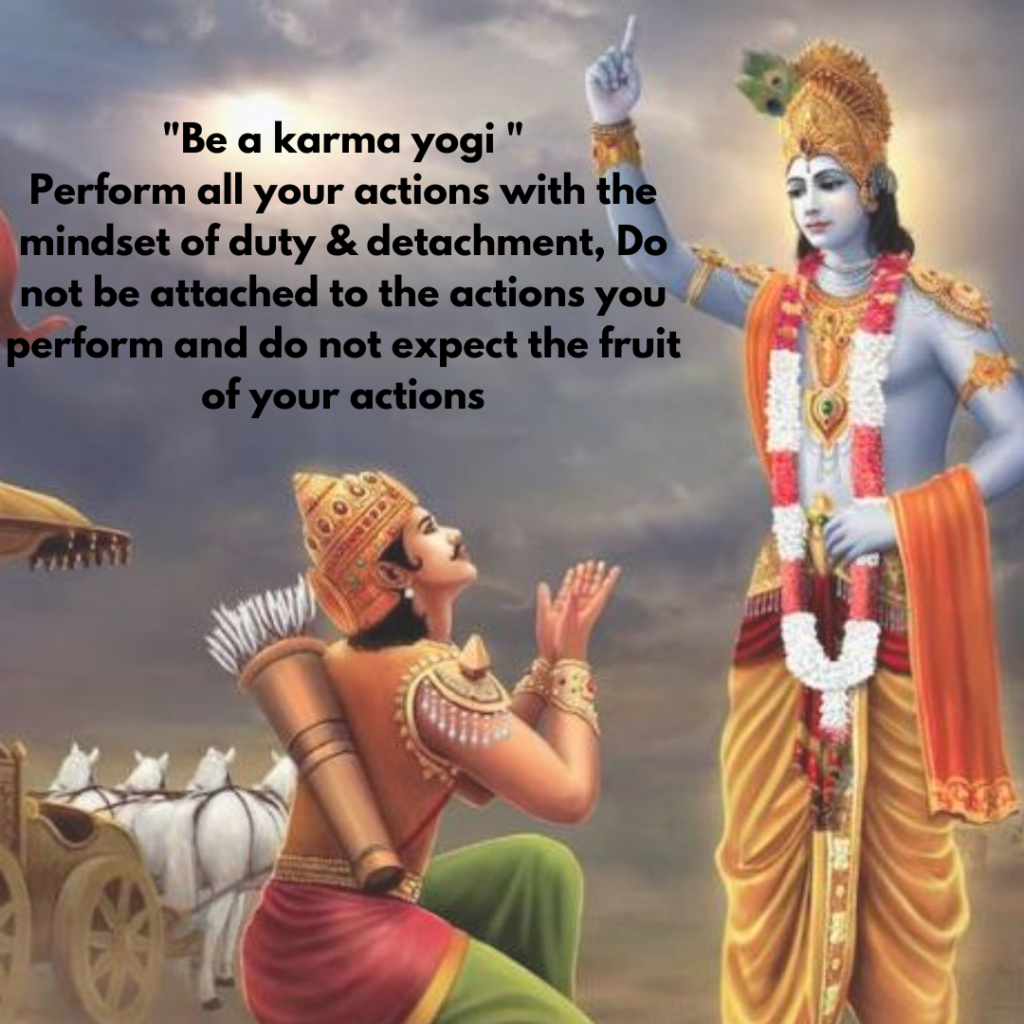
In simple terms, Karma Yoga is the path of performing actions with dedication and skill, while relinquishing your attachment to the outcomes or "fruits" of those actions.
To understand this better, let's start with a clear, modern interpretation.
What is Karma Yoga? | Eckhart Tolle Reads The Bhagavad Gita
Eckhart Tolle, a contemporary spiritual teacher, provides a very clear introduction to Karma Yoga. In this first clip, he explains it as the central teaching of the Bhagavad Gita and discusses why our modern habit of focusing on the 'next moment' creates stress and dissatisfaction.
Watch the video from the beginning until timestamp 04:50. Pay close attention to how he describes the state of always 'living for the next moment' and how this makes the present action merely a means to an end, leading to continuous discontent.
Why Attachment to Outcomes Causes Study Paralysis
You described feeling "stuck" and experiencing "droughts of action." This is often a direct consequence of being overly attached to the outcome of your studies. Let's break down the psychology of why this happens, using Arjuna's crisis on the battlefield as an analogy for the pressure of JEE preparation.
When your mind is fixated on the result (e.g., "I must get into this IIT," or "What if I fail after all this work?"), two powerful fears emerge:
- Fear of Failure: The stakes feel so high that the possibility of not achieving your goal is terrifying. This fear can be so paralyzing that your mind subconsciously chooses inaction as a defense mechanism. After all, if you don't truly try, you can't truly fail.
- Fear of Imperfection & Overwhelm: The desire for a perfect outcome leads to a need for a perfect process. You might feel that every study session must be flawless, and you must understand every concept perfectly. The sheer volume of the JEE syllabus, when viewed through this lens, becomes impossibly large and overwhelming, leading to a state of freeze.
This next reading explores how Arjuna's emotional overwhelm on the battlefield, stemming from his attachment to the outcomes of the war, is a perfect mirror for the decision paralysis many of us face today.
Bhagavad Gita Karma Yog: Practical Guide for Wisdom in Daily Work
This article, 'Bhagavad Gita Karma Yog: Practical Guide for Wisdom in Daily Work', draws a direct parallel between Arjuna's crisis and modern work-related stress. It explains the psychological process of how emotional overwhelm clouds judgment.
Please read the section titled 'Understanding the Root of Work-Related Stress', focusing on the subsections 'Why Arjuna's dilemma mirrors our modern confusion' and 'The role of emotional overwhelm in decision-making'. Notice how Arjuna's physical symptoms of stress are similar to what one might feel when facing a daunting task.
Now, let's return to Eckhart Tolle's video. He explains how this fear, born from dependence on a specific outcome, actually contaminates the quality of your action and makes success less likely.
What is Karma Yoga? | Eckhart Tolle Reads The Bhagavad Gita
In this next segment, Tolle explains the paradox of attachment: the more you depend on a desired outcome for your fulfillment, the more fear you introduce into your actions, diminishing their quality and making the outcome less likely.
Please watch from 06:30 to 09:06. Focus on his explanation of how fear contaminates the quality of your 'doing' and how, conversely, finding fulfillment in the action itself is the key.
The Solution: Devotion to the Process
If attachment to the result is the problem, then dedicated focus on the process is the solution. Karma Yoga asks you to make a fundamental shift in your attention.
Instead of your primary focus being on the future rank, you make your primary focus the present action: solving this one physics problem, reading this one chapter of chemistry, reviewing this one set of math formulas.
This doesn't mean you abandon your goal. Your goal gives you direction. But you stop letting it dominate your consciousness during the act of studying.
Sadhguru explains this with a powerful analogy.
An Invaluable Lesson From The Bhagavad Gita For Your Life | Sadhguru
In this clip, Sadhguru addresses the difficulty of working without obsessing over results. His core message is about being 'absolutely devoted to the process.'
Watch from 05:53 to 09:44. Listen carefully to his metaphor: 'If you have one eye on the goal, you have only one eye to find your way. It's inefficient.' This perfectly captures the essence of Karma Yoga in a practical sense.
This shift from outcome to process is the key to breaking study paralysis. When your task is not "Achieve a top rank" but "Spend the next 25 minutes concentrating on this worksheet," the action becomes manageable. The fear subsides because the immediate task is not threatening.

A Practical Framework for Action
The Bhagavad Gita gives us a precise instruction for this. The famous verse 2.47 is the cornerstone of Karma Yoga.
Karmanye vadhikaraste Ma Phaleshu Kadachana,
Ma Karma Phala Hetur Bhur Ma Te Sango Stvakarmani"You have a right to perform your prescribed duties, but you are not entitled to the fruits of your actions. Never consider yourself to be the cause of the results of your activities, and never be attached to not doing your duty."
This next resource breaks this down into a direct solution for procrastination.
Time Management Wisdom from the Bhagavad Gita
The article 'Time Management Wisdom from the Bhagavad Gita' directly connects Karma Yoga to procrastination, offering a clear, actionable summary.
Please read the sections 'Action Without Procrastination' and 'The Karma Yoga Solution'. This provides a concise summary and a practical mantra you can use.
Your First Tool: The Karma Yoga Mindset
To put this into practice today, try this simple mental exercise.
Think of one specific study task you have been putting off. It could be a chapter you find difficult or a set of problems you're afraid to get wrong.
Now, consciously reframe your objective using the principles of Karma Yoga:
- Old, Paralyzing Goal: "I need to master this chapter and get all the problems right." (Focus on outcome, high pressure).
- New, Actionable Goal: "My duty is simply to engage with this material for the next 45 minutes with full concentration. The outcome is not my primary concern. My focus is on the quality of my effort right now." (Focus on process, low pressure).
Try adopting the Anti-Procrastination Mantra from the article you just read:
"I will do this task as an offering, without attachment to its outcome. My duty is to act skillfully; results are not in my control. I begin now."
Say this to yourself before you start. Notice if it changes your internal resistance to beginning the task. The goal isn't to eliminate all resistance forever, but simply to lower it enough to get started.
Lesson Summary
Let's recap the key takeaways from today's lesson:
- Study paralysis is often caused by an intense attachment to the outcome (your JEE rank), which generates fear of failure and a sense of being overwhelmed.
- Karma Yoga offers a philosophical and psychological solution: shift your focus from the fruit of the action to the process of the action itself.
- Your goal provides direction, but your conscious attention should be on the present task—the page you're reading, the problem you're solving.
- By detaching your sense of self-worth from the result, you reduce the fear and pressure that cause inaction. This makes it easier to start and to perform your work with higher quality.
Preview of the Next Lesson
We have just explored the "how" of taking action—by focusing on the process. In our next lesson, we will explore the "why." We'll discuss the concept of Svadharma (one's personal duty) to help you frame your JEE preparation not as a burden, but as a meaningful and purpose-driven activity that is uniquely yours to perform right now. This will add another layer of strength to your resolve.