In our previous lesson, we revisited the core tenets of Situational, Transformational, and Servant leadership. Now, we shift our focus from "what are they?" to "how well do they hold up?" Your goal is to design leadership content, and a crucial aspect of that is helping leaders understand not just the strengths of a model, but also its potential weaknesses and blind spots. This lesson is dedicated to critiquing the practical limitations of these classic models in the complex, dynamic environments that define modern organizations. By the end of our session, you'll be equipped to analyze where these foundational theories fall short and why a more nuanced approach is often required.
1. The Modern Context: Leading in a VUCA World
Before we dissect the models themselves, it's important to establish the context in which today's leaders operate. You may be familiar from your MBA studies with the acronym VUCA, which originated in the U.S. Army War College to describe the post-Cold War world. It has since become a standard framework for understanding the business environment.

Modern organizations grapple with:
- Volatility: Rapid, unpredictable change (e.g., market fluctuations, supply chain disruptions).
- Uncertainty: A lack of information, where causes and effects are not fully understood.
- Complexity: A multitude of interconnected parts and variables (e.g., global operations, diverse stakeholder needs).
- Ambiguity: A lack of clarity or "unknown unknowns," where there is no precedent for what is happening.
It is against this backdrop of constant flux and complexity that we must evaluate the utility of our leadership models. Do these classic frameworks provide the agility and sophistication needed to navigate a VUCA world?
2. Critiquing the Classic Models
While foundational, each of the models we reviewed has practical limitations when applied rigidly in today's context. Let's examine them one by one.
Situational Leadership: Is it Too Simplistic?
The elegance of the Situational Leadership® model is its simplicity: diagnose follower readiness and adapt your style. However, this simplicity can also be its greatest weakness.
To explore this, please read the following article from Thinking Through Academy, which, after explaining the model, delves into its common criticisms.
What is the Hersey and Blanchard Situational Leadership ...
This article provides a balanced view, acknowledging the model's utility before highlighting its shortcomings in modern work environments.
Focus on the section titled "Challenges, criticisms and evolving contexts." Pay close attention to the subsections on limitations, which discuss weak empirical support and oversimplification, and adaptation challenges in remote environments.
As the article points out, the key critiques of Situational Leadership include:
- Difficulty in Diagnosis: Accurately assessing a follower's competence and commitment (readiness level) is subjective and challenging. A leader's misjudgment can lead to applying the wrong style—micromanaging a competent employee or under-supporting a struggling one.
- Oversimplification: The model can oversimplify complex human interactions. It presumes leaders can fluidly switch between styles, which can be taxing and may come across as inconsistent or inauthentic.
- Lack of Empirical Support: Despite its popularity, the model has received mixed results in academic studies, with some researchers questioning its core assumptions and predictive validity.
- Inadequacy for Modern Work: The model was developed in a pre-digital era. It offers little guidance on leading remote or hybrid teams, where assessing engagement and providing "supportive behavior" requires different skills and tools.
Transformational Leadership: The Risk of Charisma
Transformational leadership is powerful for driving change, but its reliance on a visionary, charismatic leader is not without risks. An overemphasis on the leader's personality can create dependencies and even lead to negative outcomes if not balanced with structure and ethics.
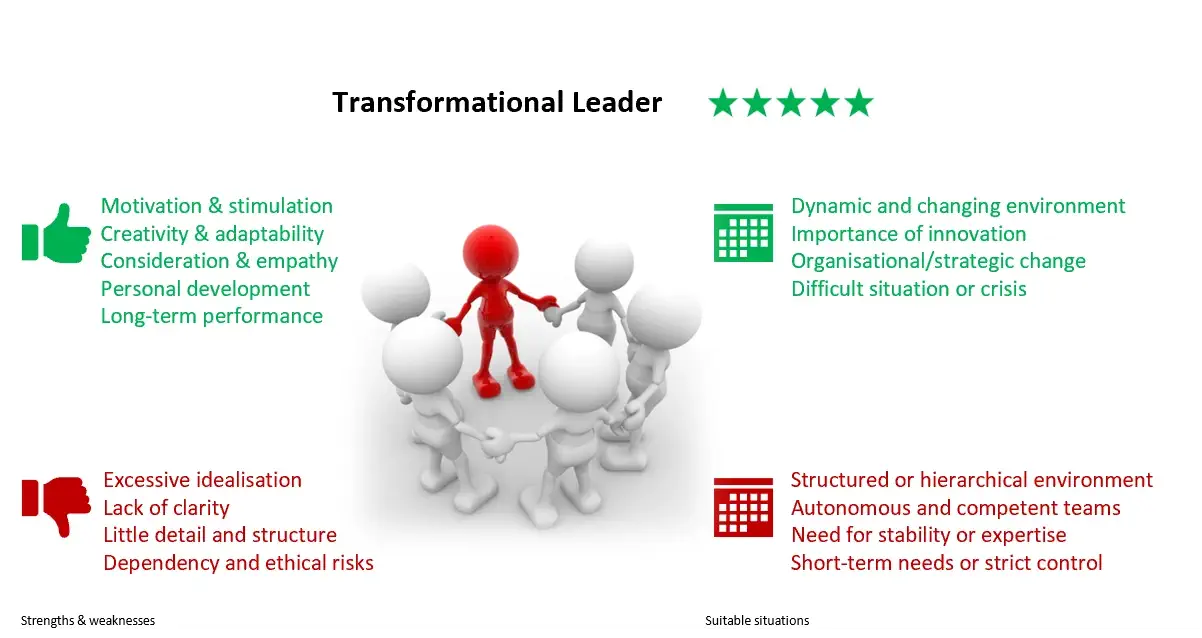
The following video and text offer a critical perspective on this widely admired style.
Transactional vs Transformational Leadership
In his video on leadership styles, Communication Coach Alexander Lyon provides a succinct critique of the Transformational model.
Watch the segment discussing the disadvantages of the style. He touches upon its complexity, whether it can be truly trained, and the potential pitfalls of charisma.
Critical analysis of four leadership theories and principles
This academic article provides a concise summary of the strengths and weaknesses of Transformational Leadership.
In the section on Transformational Leadership (3.1), read the final paragraph that begins The strengths.... It explicitly states the limitations related to decision-making speed and context.
Synthesizing these points, the main criticisms are:
- Dependency and Idealization: Followers can become overly dependent on a single, charismatic leader, potentially stifling their own initiative and critical thinking.
- Potential for Abuse: Charisma is a powerful tool that can be used for unethical ends. The same inspirational qualities that drive positive change can also be used to manipulate followers.
- Not a Universal Solution: As the article notes, this style is less effective in stable environments that require adherence to established processes or in situations demanding rapid, tactical decisions. It prioritizes vision over operational detail.
- Trainability Questions: A key debate is whether the core attributes of transformational leaders, particularly charisma and idealized influence, are innate personality traits or skills that can be systematically developed.
Servant Leadership: Idealistic or Impractical?
The philosophy of Servant Leadership—placing the needs of others first—is ethically compelling. However, its practical application in competitive, results-driven corporate environments can be challenging.
Critical analysis of four leadership theories and principles
This article continues its critique by examining the practical weaknesses of the Servant Leadership model.
In section 3.3 on Servant Leadership, focus on the final paragraph starting with The strengths.... It highlights the potential for this style to be perceived as weakness and its challenges in competitive settings.
The primary limitations include:
- Perception of Weakness: In some organizational cultures, a servant leader's focus on listening, consensus-building, and empowerment may be misconstrued as indecisiveness or a lack of authority.
- Conflict with Business Imperatives: The model's emphasis on long-term development and community well-being can sometimes conflict with short-term financial goals or the need for aggressive competitive strategies.
- Implementation Challenges: Shifting to a servant leadership culture requires a deep, organization-wide commitment. It is not a style that can be easily adopted by a single manager without broader systemic support.
3. Synthesis: The Limits of Fixed Frameworks in a Fluid World
The individual critiques reveal a broader theme: many classic leadership models, when treated as rigid recipes, are ill-suited for the ambiguity and complexity of modern work. They were often conceived in more stable, hierarchical times.
The Harvard Business Review video below argues that effective modern leadership requires a fundamental shift in mindset—from being a visionary who people follow, to being an architect who enables people to co-create the future.
In "What Makes a Great Leader?", Dr. Linda Hill of Harvard Business School discusses how the demands on leaders have evolved, requiring a move beyond traditional authority.
Watch two key segments: The first segment explains the shift from a leader providing a vision to one who must shape a culture where people can co-create. Then, jump to the discussion on influence. The part from "What they're really all about..." is crucial. It argues that leaders can no longer rely on formal authority to drive innovation; they must invite people to participate, which is a voluntary act built on commitment, not control.
This perspective crystallizes the core limitation of applying these models too literally. They often presume a leader-follower dynamic based on some form of authority or persuasion. However, in a world where innovation and agility are paramount, leadership is less about directing and more about creating the conditions for collective genius to emerge. You cannot command innovation; you can only foster it.
Conclusion
In this lesson, we have critically examined the practical limitations of Situational, Transformational, and Servant leadership. Our key takeaways are:
- No Perfect Model: Each classic model has inherent weaknesses, from the oversimplification of Situational Leadership to the dependency risks of Transformational Leadership and the practical hurdles of Servant Leadership.
- Context is King: The effectiveness of any leadership style is critically dependent on the context. The complex, volatile (VUCA) nature of modern business often exposes the rigidity of these models.
- Beyond Formal Authority: Effective modern leadership is shifting from a reliance on formal authority and top-down vision to an ability to influence, connect, and empower—to act as an architect of collaboration rather than just a director of action.
Recognizing these limitations is not a rejection of these foundational theories. Rather, it's an acknowledgment that they are starting points, not final destinations. They provide valuable language and concepts, but they must be adapted and blended to meet contemporary challenges.
In our next module, we will explore leadership models that were developed specifically to address this complexity. We'll begin by differentiating between Authentic and Adaptive leadership, two styles that focus on navigating uncertainty and fostering change from within.