Welcome to your first lesson. Given your goal of creating leadership development content, we will begin by revisiting three foundational leadership models you may recall from your MBA studies: Situational, Transformational, and Servant leadership. This session is designed as a high-level, analytical refresher. Our objective is to move beyond simple definitions and instead contrast the core assumptions and strategic applications of each model. By the end of this lesson, you will have a clear, comparative framework for understanding when and why each style is most effective, providing a solid foundation for the content you aim to create.
1. Situational Leadership®: The Adaptive Framework
We'll start with the Situational Leadership® model, developed by Paul Hersey and Ken Blanchard. Its central premise is that effective leadership is not about a single, fixed style but about adapting one's approach to the follower's development level for a specific task. The leader's primary job is to diagnose the situation and respond with the appropriate combination of directive and supportive behavior.
To refresh your understanding of this model's mechanics, please watch the following video, which provides a clear explanation of its core components.
Situational Leadership Model Explained
This video, "Situational Leadership Model Explained" from EPM, offers a concise yet thorough overview of the model.
Please watch the following segments: The core premise, which establishes that leadership style must match the situation. The model's axes, explaining directive (task) vs. supportive (relationship) behavior and the follower development levels (D1-D4). The four leadership styles: Directing (S1), Coaching (S2), Supporting (S3), and Delegating (S4). The four development levels, which detail the follower's journey from Enthusiastic Beginner (D1) to Self-Reliant Achiever (D4). How to match style to level, which provides a practical example of a leader adapting their style as a team evolves.
As the video notes, you may encounter different terminology for the styles (e.g., Telling, Selling, Participating, Delegating). The underlying concept remains the same, as visualized in the model below.
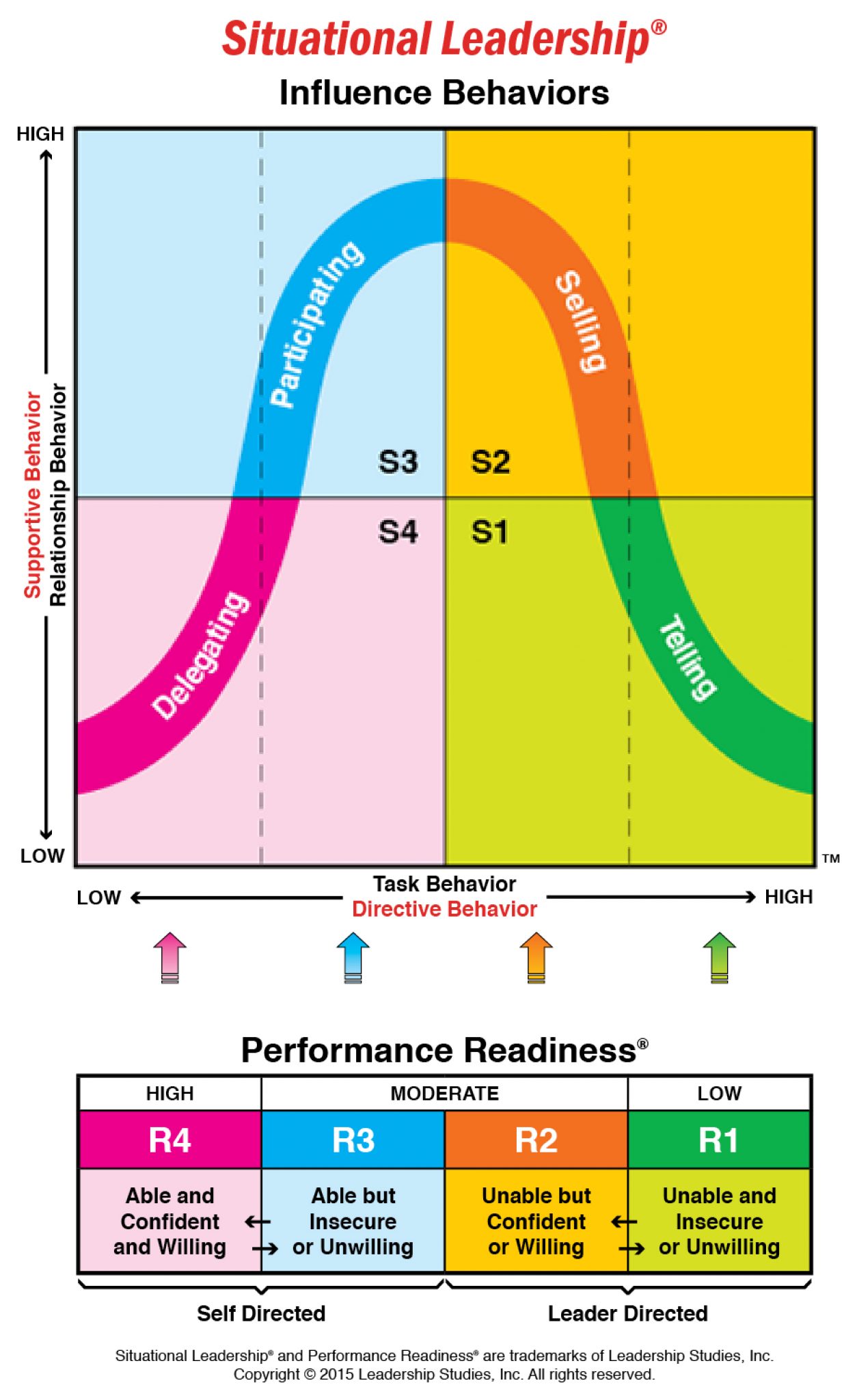
Core Assumption: The most effective leadership style is contingent on the follower's competence and commitment regarding a specific task.
Application: This model is highly practical for line managers, coaches, and anyone involved in team member development. It provides a clear roadmap for adjusting support and direction as an individual's skills and confidence evolve. For instance, a manager would use a highly directive "Telling" (S1) style with a new hire learning a critical process but would shift to a "Delegating" (S4) style once that employee becomes an expert.
2. Transformational Leadership: The Visionary Framework
Where Situational Leadership is tactical and adaptive, Transformational Leadership is strategic and inspirational. Coined by James MacGregor Burns and later developed by Bernard Bass, this model focuses on the leader's ability to create profound change in individuals and social systems.
The core of this model is to inspire followers to move beyond transactional exchanges (a fair day's work for a fair day's pay) and commit to a shared vision, thereby achieving extraordinary results.

To understand the specific behaviors that define this style, please read the following brief section from the article "Leadership Models: Essential Frameworks."
Leadership Models: Essential Frameworks for Effective ...
This excerpt details the 'Four I's' of Transformational Leadership, providing a clear structure for its components.
In the section on Transformational Leadership, focus on the description of the Four I's: Idealized Influence, Inspirational Motivation, Intellectual Stimulation, and Individualized Consideration. This will clarify how these leaders create such a powerful impact.
Core Assumption: Leaders can elevate followers' motivation, morale, and performance by connecting their sense of identity and self to the project and the collective identity of the organization.
Application: This style is most powerful in environments requiring innovation, revitalization, or a significant cultural shift. A CEO leading a company through a digital transformation or a startup founder like Elon Musk aiming to revolutionize an industry are classic examples where a compelling vision is essential to rally teams and overcome obstacles.
3. Servant Leadership: The Service-Oriented Framework
Servant Leadership, a concept articulated by Robert K. Greenleaf, offers a radical inversion of traditional leadership. Here, the leader's primary motivation is a deep-seated desire to serve others—their team, their customers, and their community. The leader's success is measured by the growth and well-being of the people they lead.
While a transformational leader inspires followers to serve the organization's vision, a servant leader's focus is on the follower's needs first. The assumption is that when people feel personally and professionally fulfilled, they will in turn do great work for the organization.
To explore the principles that differentiate this model, we'll turn back to the "Leadership Models" article.
Leadership Models: Essential Frameworks for Effective ...
This reading outlines the core principles of Servant Leadership and contrasts its philosophy directly with traditional leadership approaches.
Find the section on Servant Leadership. Read the list of ten core principles, paying attention to concepts like stewardship and commitment to growth. Then, review the table that contrasts the servant approach with traditional, top-down leadership.
Core Assumption: A leader's primary purpose is to serve and develop their followers, empowering them to reach their full potential. The organization's goals are achieved as a byproduct of this focus on individual growth and well-being.
Application: This style is exceptionally effective for building high-trust, ethical cultures with strong employee loyalty and engagement. It is often found in non-profits, education, and healthcare. Herb Kelleher, the co-founder of Southwest Airlines, famously built a legendary corporate culture by putting his employees first, embodying the servant leadership philosophy.
Contrasting the Frameworks
Now, let's synthesize these three models to highlight their fundamental differences.
| Dimension | Situational Leadership | Transformational Leadership | Servant Leadership |
|---|---|---|---|
| Primary Focus | The task and the follower's readiness level. | The organization's vision and long-term goals. | The follower's growth and well-being. |
| Leader's Role | Diagnostician and adapter. | Visionary and motivator. | Steward and facilitator. |
| Source of Influence | Flexible application of task and relationship behavior. | Charisma, inspiration, and intellectual stimulation. | Trust, empowerment, and ethical behavior. |
| Time Horizon | Short-term to medium-term (task-specific). | Long-term (organizational change). | Long-term (people development). |
| Key Question | "What does this person need from me right now to succeed at this task?" | "How can I inspire my team to achieve this collective vision?" | "How can I help my people grow and thrive?" |
Conclusion
In this lesson, we have refreshed and contrasted three classic leadership models.
- Situational Leadership is a pragmatic, adaptive style focused on matching leader behavior to follower readiness for a specific task.
- Transformational Leadership is a visionary style aimed at inspiring followers to transcend self-interest for a greater organizational cause.
- Servant Leadership is a service-oriented style that inverts the traditional hierarchy, prioritizing the growth and well-being of followers as the primary path to organizational success.
Understanding these distinct philosophies is the first step toward building effective leadership content. Each model offers a different lens for viewing a leader's responsibilities and provides a unique toolkit for different contexts.
In our next lesson, we will move from understanding these models to evaluating them. We will critique their practical limitations and discuss the challenges of applying these classic frameworks in the complexity of modern organizations.