Hello! Welcome to our new module on the Analysis of Financial Statements.
In our previous lessons, we concluded our deep dive into Company Accounts by mastering how to prepare financial statements, specifically focusing on the presentation of debentures in the Balance Sheet. We learned how to construct these reports. Now, we shift our focus to learning how to use them. The financial statements you've learned to create are rich with information, and analysing them is the key to unlocking valuable insights about a business's health and performance.
Today, we will begin this journey by addressing a fundamental question: why do we analyse financial statements, and what are their shortcomings? This lesson will explain the core objectives and the inherent limitations of financial statement analysis. Understanding both is crucial for making well-informed business and investment decisions.
1. What is Financial Statement Analysis?
At its core, financial statement analysis is the process of critically evaluating the financial information in the statements to understand a company's performance and financial position. It's not just about looking at numbers; it's about establishing relationships between them and interpreting what they mean for the business.
Think of it like a doctor's visit. The financial statements (Balance Sheet, Statement of Profit & Loss) are like a patient's medical reports. The analysis is the process the doctor uses to examine these reports, identify trends (is the condition improving or worsening?), and diagnose the patient's health.
The process involves two key, complementary parts:
- Analysis: This is the simplification of complex financial data. It involves classifying items, rearranging them, and calculating things like percentages and ratios to make the data more manageable.
- Interpretation: This is where we explain the meaning and significance of the analysed data. What does a high-profit margin actually mean? Why is the company's debt increasing? Interpretation turns the numbers into a narrative.
Let's start with a short video that provides a quick and clear overview of this concept.
Financial Statements Analysis - One Shot | Chapter 2 | Accountancy | Class 12
This clip from a video by Rajat Arora provides a concise introduction to the purpose of financial analysis.
Please watch the segment from 00:56 to 03:18. Focus on the three main functions of analysis mentioned: simplifying complex data, classifying items into rational groups, and enabling easy comparisons.
2. Objectives of Financial Statement Analysis
So, why do we go through this effort? The primary goal is to provide crucial information to various stakeholders, each with their own questions and interests. Financial analysis helps answer these questions.
The NCERT textbook offers an authoritative and structured view on the significance and objectives of this process.
Analysis of Financial Statements
Let's turn to the NCERT textbook to understand the 'why' behind financial analysis. It details the specific objectives and explains why different groups of people are so interested in a company's financial story.
Please read Sections 4.2 ('Significance of Analysis of Financial Statements') and 4.3 ('Objectives of Analysis of Financial Statements'). As you read, pay special attention to: The main list of objectives in Section 4.3, such as assessing profitability and judging the ability to repay debt. How the needs of different users (like lenders, investors, and management) drive the analysis, as explained in Section 4.2.
From the reading, we can summarize the main objectives of financial analysis as follows:
- To assess profitability: To measure the earning capacity of the business and determine if it's generating adequate returns on the capital invested.
- To assess solvency: To judge the firm's ability to meet its short-term obligations (liquidity) and long-term debts.
- To assess financial strength and operational efficiency: To evaluate how effectively the management is using the company's resources to generate sales and profits.
- To facilitate comparative study: To compare the firm's performance over different time periods (intra-firm comparison) or against other companies in the same industry (inter-firm comparison).
- To aid in forecasting and decision-making: To use past performance to help predict future results and make crucial decisions about investments, operations, and financing.
Here’s a quick summary of who uses this analysis and what they are looking for:
| Stakeholder | Primary Interest | Key Question(s) |
|---|---|---|
| Management | Performance & Efficiency | Are our policies working? Where can we improve? Are we using resources efficiently? |
| Investors | Profitability & Safety | Is my investment safe? Will I get a good return (dividends, share price growth)? |
| Lenders / Creditors | Solvency & Liquidity | Can the company repay its loans and interest on time? Is it safe to lend money to them? |
| Employees | Stability & Profitability | Is my job secure? Can the company afford to pay higher wages or bonuses? |
| Government | Compliance & Taxation | Is the company paying the correct amount of tax? Is it complying with regulations? |
Test your understanding!
A bank is evaluating an application from a manufacturing company for a 10-year loan to build a new factory. Which two objectives of financial statement analysis would be most important to the bank's loan officer, and why?
Show answer
The two most important objectives for the bank would be:
- To assess long-term solvency: The loan is for 10 years, which is a long-term commitment. The bank needs to be confident that the company will be able to make interest payments regularly and repay the principal amount over the entire loan period. Analysing long-term solvency helps determine this repayment capacity.
- To assess profitability: A consistently profitable company is more likely to generate sufficient cash to service its debt. The bank would analyse the company's past and projected profitability to ensure it has a stable and sufficient income stream to cover the loan obligations without financial distress.
3. Limitations of Financial Statement Analysis
While financial analysis is an extremely powerful tool, it is not without its flaws. An analyst who is unaware of these limitations can be easily misled. The insights from analysis are only as reliable as the data they are based on.
This fishbone diagram provides an excellent visual summary of the key limitations.
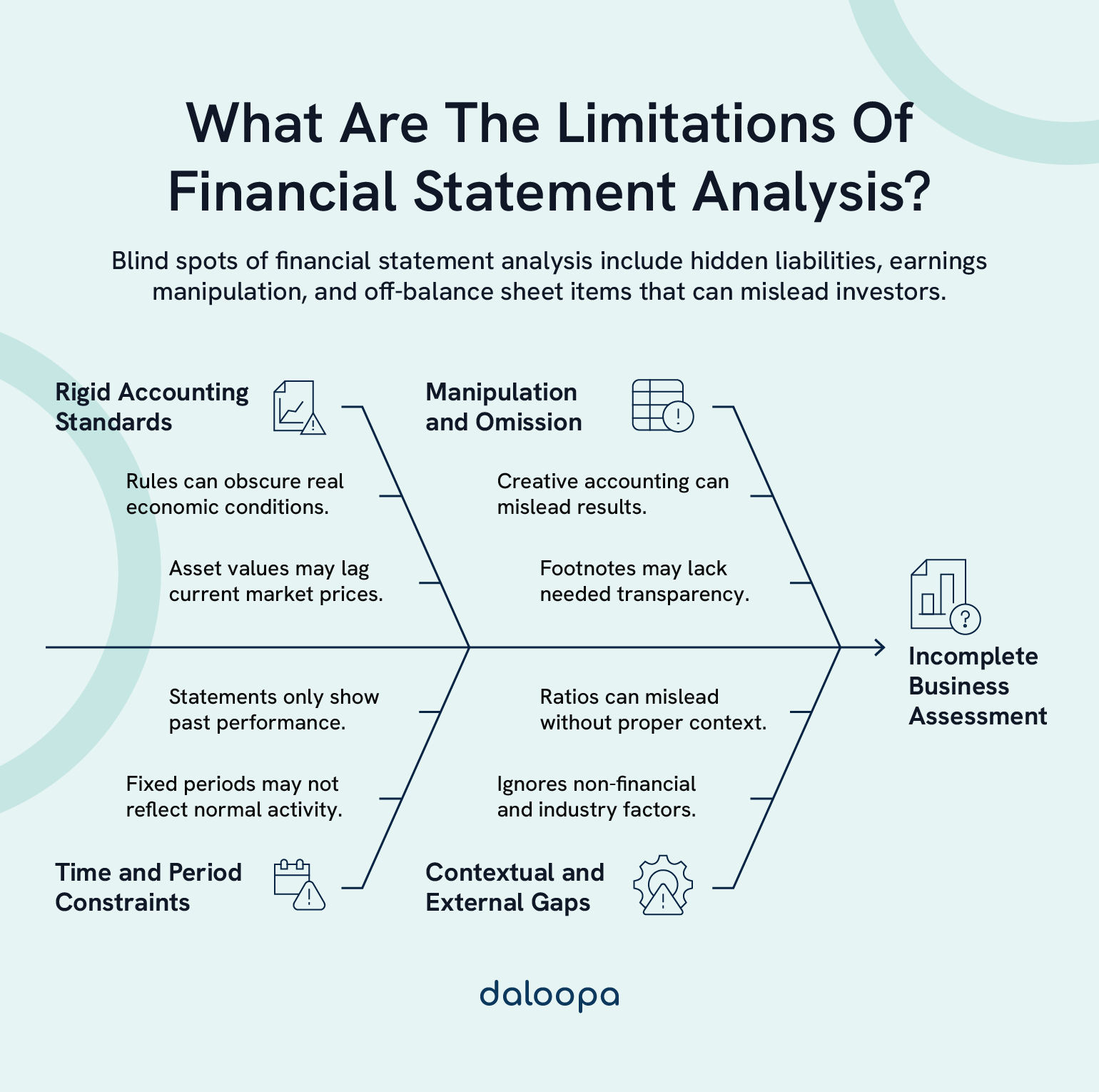
Let's explore these limitations in more detail.
- Historical Analysis: Financial statements report on what has already happened. In a rapidly changing business environment, past performance is not always a reliable predictor of the future.
- Ignores Price-Level Changes: Financial statements are prepared at historical cost and do not account for the effects of inflation. A machine bought ten years ago for ₹1 lakh is still shown at its depreciated historical cost, even if its replacement cost today is ₹5 lakhs. This can distort the true financial picture.
- Ignores Qualitative Aspects: Analysis is purely quantitative. It cannot measure crucial non-monetary factors like the quality of management, brand reputation, employee morale, or customer satisfaction, all of which significantly impact a company's long-term success.
- Vulnerable to "Window Dressing": Companies can legally manipulate their financial statements to present a better picture than what is real. For example, they might delay purchases at year-end to show a better cash position or overvalue closing stock to boost profits. This is a significant limitation.
- Lack of Comparability due to Different Accounting Practices: If two firms use different accounting policies (e.g., one uses the Straight-Line Method of depreciation and another uses the Written Down Value Method), their reported profits are not directly comparable. This makes inter-firm analysis difficult.
- Subjectivity and Personal Bias: Interpretation of financial data is not purely scientific. It requires judgment, and the personal beliefs or biases of the analyst can influence the conclusions drawn.
To hear a clear explanation of these points, especially concepts like "window dressing", please watch the following video.
Financial Statements Analysis - One Shot | Chapter 2 | Accountancy | Class 12
Let's review the main limitations you need to be aware of. This clip from Rajat Arora's video provides an exam-focused summary of these critical points.
Watch the video from 15:33 to 18:51. As you watch, listen for the explanations of how 'window dressing' works, why ignoring price level changes can be misleading, and the problem of comparing firms with different accounting policies.
Test your understanding!
When the management of a business tries to present its financial statements in a way that depicts a better financial position than the actual one, this is known as:
a. Personal Bias
b. Price level changes
c. Window dressing
d. Intra-firm comparison
Show answer
The correct answer is (c) Window dressing. This term refers to the manipulation of financial statements to make the company's performance and position appear more favorable.
Conclusion
In this lesson, we've laid the groundwork for our entire module on financial analysis. You now understand the fundamental purpose of this process and the critical cautions you must keep in mind.
Key Takeaways:
- Financial Statement Analysis is the process of evaluating financial data to make informed decisions.
- Its main objectives are to assess a firm's profitability, solvency, and efficiency, which helps various stakeholders like investors, lenders, and management.
- However, analysis has significant limitations. It is based on historical data, ignores non-monetary factors and price changes, and can be misled by manipulations like "window dressing".
Preview of the Next Lesson:
Now that we understand the 'why' and the 'what to watch out for' in financial analysis, our next step is to learn the 'how'. In the next lesson, we will begin exploring the practical tools of analysis, starting with the preparation of Comparative Statements (Comparative Balance Sheet and Comparative Statement of Profit & Loss).