Hello! In our last lesson, we focused on the crucial first step in accounting for a partner's retirement: calculating the new profit-sharing ratio and the gaining ratio. You learned that the gaining ratio represents the proportion in which the continuing partners absorb the outgoing partner's share of profits.
Today, we will put that knowledge into practice. This lesson is dedicated to achieving the learning outcome: Account for the outgoing partner's share of goodwill by adjusting it through the continuing partners' capital accounts. This is a cornerstone of retirement accounting, ensuring that the departing partner is fairly compensated for their contribution to the firm's reputation.
The Logic of Goodwill Adjustment
When a partner retires, they are giving up their right to the future profits of a business they helped build. The firm's goodwill—its reputation, brand value, and customer loyalty—is a direct result of the collective efforts of all partners, including the one who is leaving.
Therefore, it is only fair that the retiring partner receives their share of this goodwill. Who pays for it? The partners who will benefit from it in the future: the gaining partners. The adjustment ensures that the gaining partners compensate the retiring (or sacrificing) partner for the share of future profits they are acquiring.
To see a clear explanation of this principle and the main accounting entry, let's start with a video.
Retirement of a Partner | Treatment of Goodwill | Part 2
This segment from a video by Rajat Arora clearly explains why the retiring partner is compensated and introduces the fundamental journal entry for this adjustment.
Watch from 01:00 to 04:31. Focus on understanding the logic that the partners who gain must compensate the partner who is sacrificing their share of future profits.
The Core Journal Entry
As you saw in the video, the accounting treatment for goodwill (when it doesn't already appear in the books) is handled through a single adjustment entry that affects the partners' capital accounts directly.
The journal entry is:
| Date | Particulars | L.F. | Debit (₹) | Credit (₹) |
|---|---|---|---|---|
| Gaining Partners' Capital A/c (Individually) | XXX | |||
| To Retiring Partner's Capital A/c | XXX | |||
| (Being retiring partner's share of goodwill adjusted in the capital accounts of gaining partners in their gaining ratio) |
The key steps to execute this are:
- Calculate the Gaining Ratio: As you learned in the previous lesson, this is
New Share - Old Share. - Calculate the Retiring Partner's Share of Goodwill: This is
Total Goodwill of the Firm × Retiring Partner's Profit Share. - Distribute the Debit: The retiring partner's share of goodwill is debited to the gaining partners' capital accounts in their gaining ratio.
Two Scenarios for Goodwill
When dealing with goodwill upon retirement, you'll encounter two main situations:
- Goodwill does not appear in the books: This is the most common case, where goodwill is valued at the time of retirement, and the adjustment entry above is passed.
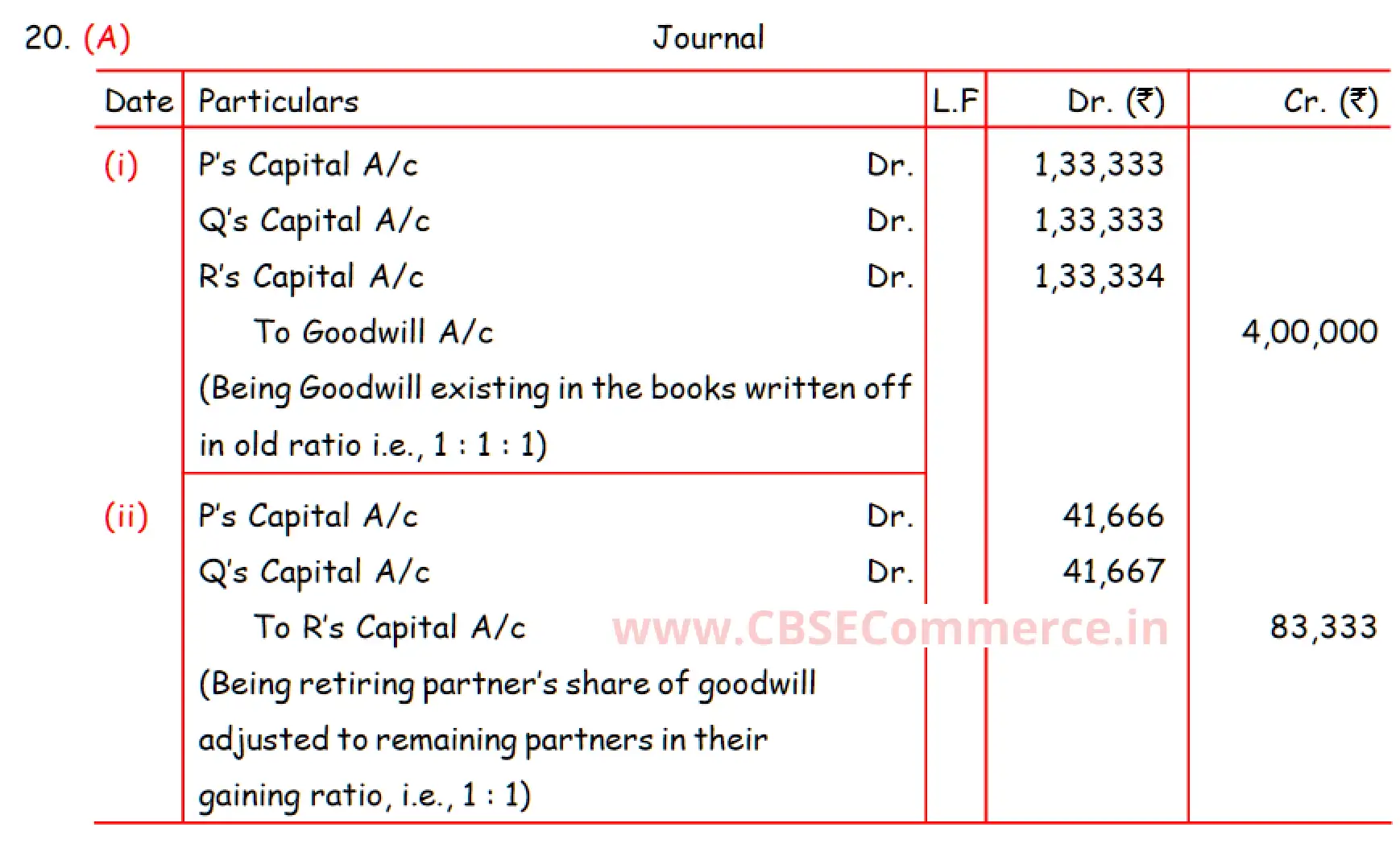
- Goodwill already appears in the books: If a Goodwill account already exists in the Balance Sheet, it must be written off before making any new adjustments.
Let's look at how to handle the second, more complex scenario.
Handling Existing Goodwill
If goodwill is already on the asset side of the Balance Sheet, it must be removed. This is done by debiting all partners' capital accounts in their old profit-sharing ratio.
The entry to write off existing goodwill is:
| Date | Particulars | L.F. | Debit (₹) | Credit (₹) |
|---|---|---|---|---|
| All Partners' Capital A/c (Individually) | XXX | |||
| To Goodwill A/c | XXX | |||
| (Being existing goodwill written off in the old profit-sharing ratio) |
After this entry, you would then proceed to pass the standard adjustment entry for the newly valued goodwill.
The following resource provides a clear text-based explanation and illustrations for both scenarios.
Accounting Treatment of Goodwill in case of Retirement ...
This article from GeeksforGeeks neatly summarises the accounting treatment for both when goodwill appears in the books and when it doesn't. Pay attention to the illustrations provided.
Read 'Case 1: When goodwill does not appear in the books' and 'Case 2: When Goodwill Account appears in the books'. Study the journal entries and the two illustrations under each case. This will solidify your understanding of the two-step process: write off old goodwill, then adjust for new goodwill.
This image shows a complete example with both entries: writing off the existing goodwill and then adjusting for the retiring partner's share.
Dealing with Special Cases
While the "Gaining to Retiring" rule is standard, there are a few important variations you must be prepared for.
Case 1: A Continuing Partner Also Sacrifices (Negative Gain)
Sometimes, when you calculate the gaining ratio (New Share - Old Share), you might find that one of the continuing partners has a negative result. This means they are not gaining; they are also sacrificing a share of their future profit.
In this situation, the gaining partner(s) must compensate both the retiring partner and the sacrificing continuing partner.
The journal entry becomes:
Gaining Partner's Capital A/c Dr.
To Retiring Partner's Capital A/c
To Sacrificing Continuing Partner's Capital A/c
The amounts are calculated by multiplying the firm's total goodwill by each partner's respective gain or sacrifice share.
Treatment of Goodwill in Retirement | DAY 14 | 3 Marks fixed | Class 12 Accounts Board Exam 2026
This scenario is a common point of confusion. Let's watch an excellent explanation from Sunil Panda that breaks down how to handle a negative gaining ratio.
Watch from 11:06 to 16:57 and then from 18:53 to 21:50. The instructor provides two detailed examples. Pay close attention to how he identifies the sacrificing partner, changes their side in the journal entry from debit to credit, and calculates their compensation based on the full firm's goodwill.
Here is an image showing the journal entry for this exact scenario.

Case 2: Hidden Goodwill
Sometimes, the problem will not state the value of goodwill. Instead, it will say that the firm agreed to pay the retiring partner a lump-sum amount in final settlement, and this amount is greater than the balance in their capital account (after all other adjustments like reserves and revaluation are made).
The excess amount paid is the retiring partner's share of goodwill. This is called Hidden Goodwill.
Hidden Goodwill = Lump-sum amount paid - Retiring Partner's Adjusted Capital Balance
Once you calculate this hidden goodwill amount, you treat it just like any other goodwill adjustment, passing the entry: Gaining Partners' Capital A/c Dr. To Retiring Partner's Capital A/c.
You have learnt that retirement or death of a
Your NCERT textbook has a concise section explaining the concept of hidden goodwill.
Read section 3.4.2 Hidden Goodwill on page 119. Focus on the example of P, Q, and R to see how the excess payment of ₹15,000 is identified as R's share of goodwill and then adjusted.
Test your understanding!
A, B, and C are partners sharing profits 3:2:1. B retires. On the date of retirement, the firm's goodwill is valued at ₹1,80,000. The new ratio between A and C is 5:3. Goodwill of ₹60,000 already appears in the books.
Pass the necessary journal entries for the treatment of goodwill.
Show answer
Step 1: Write off existing goodwill.
This is done in the old ratio (3:2:1) for all partners.
| Particulars | Debit (₹) | Credit (₹) |
|---|---|---|
| A's Capital A/c Dr. | 30,000 | |
| B's Capital A/c Dr. | 20,000 | |
| C's Capital A/c Dr. | 10,000 | |
| To Goodwill A/c | 60,000 |
Step 2: Calculate Gaining Ratio.
Gaining Ratio = New Share - Old Share
- A's Gain = 5/8 - 3/6 = (15 - 12) / 24 = 3/24
- C's Gain = 3/8 - 1/6 = (9 - 4) / 24 = 5/24
- Gaining Ratio = 3:5
Step 3: Calculate B's (retiring partner's) share of goodwill.
B's Share = ₹1,80,000 × (2/6) = ₹60,000
Step 4: Pass the adjustment entry.
Distribute B's share of ₹60,000 to A and C in their gaining ratio (3:5).
- A's Debit = 60,000 × (3/8) = ₹22,500
- C's Debit = 60,000 × (5/8) = ₹37,500
| Particulars | Debit (₹) | Credit (₹) |
|---|---|---|
| A's Capital A/c Dr. | 22,500 | |
| C's Capital A/c Dr. | 37,500 | |
| To B's Capital A/c | 60,000 |
Conclusion
In this lesson, you've learned the complete accounting treatment for goodwill upon a partner's retirement. This is a critical adjustment that ensures fairness among all partners.
Key Takeaways:
- The Principle: Gaining partners compensate the retiring partner for their share of goodwill in the gaining ratio.
- The Main Entry:
Gaining Partners' Capital A/c Dr. To Retiring Partner's Capital A/c. - Existing Goodwill: If goodwill exists in the books, it must be written off against all partners in the old ratio before any new adjustment.
- Negative Gain: If a continuing partner also sacrifices, they are credited along with the retiring partner. Their compensation is calculated on the total firm goodwill.
- Hidden Goodwill: The excess of a lump-sum settlement over the retiring partner's adjusted capital is treated as their share of goodwill.
Preview of the Next Lesson:
Goodwill is just one of several adjustments required when a partner leaves. The assets and liabilities of the firm also need to be revalued to their current worth. In our next lesson, we will focus on how to prepare a Revaluation Account on retirement/death and distribute the resulting profit or loss. This is the next logical step in determining the final amount due to the outgoing partner.