Hello! Welcome to our next lesson.
In our last session, we worked through the accounting treatment for goodwill, ensuring the retiring partner is compensated for their contribution to the firm's reputation. That was one of the major adjustments needed when a partner leaves. Today, we'll tackle the next crucial step in this process.
This lesson is designed to help you master the following learning outcome: Prepare a Revaluation Account on retirement/death and distribute the resulting profit or loss.
Over time, the value of a firm's assets and liabilities as shown in the Balance Sheet can differ significantly from their current market values. When a partner retires, it's only fair that these assets and liabilities are "revalued" so that the outgoing partner receives their share of any increase in net asset value (or bears their share of any decrease) that occurred during their time with the firm. The Revaluation Account is the tool we use for this purpose.
1. The 'Why' and 'What' of Revaluation
Before we jump into preparing the account, it's essential to understand its purpose and nature. A partner's retirement reconstitutes the firm, and it's the perfect time to bring the book values of assets and liabilities in line with their current economic reality. This ensures that the financial effects of these value changes are shared by all partners who were present when those changes happened, including the one who is leaving.
To get a clear conceptual overview, let's watch a short video.
Retirement One shot | Class 12 | All basics covered
This clip from Rajat Arora provides an excellent explanation of why a Revaluation Account is necessary and its basic principles.
Watch from 23:39 to 27:02. Pay close attention to the explanation of the account's 'nominal' nature and the logic behind what is debited (losses) and what is credited (gains).
As the video explained, the Revaluation Account is a nominal account, which means it follows the rule: Debit all expenses and losses, and Credit all incomes and gains.
Here's how this applies:
- Gains (Credit Side):
- An increase in the value of an asset (e.g., land value goes up).
- A decrease in the value of a liability (e.g., a creditor agrees to accept less).
- An unrecorded asset is found and brought into the books.
- Losses (Debit Side):
- A decrease in the value of an asset (e.g., machinery depreciates).
- An increase in the value of a liability (e.g., a new claim against the firm arises).
- An unrecorded liability is discovered and needs to be accounted for.
2. Preparing the Revaluation Account
Now that we understand the logic, let's look at the mechanics. The Revaluation Account is a simple T-account ledger.
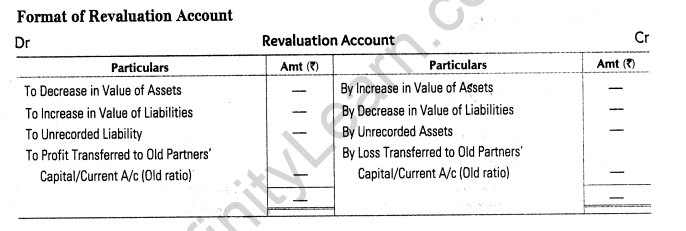
The journal entries that correspond to these postings are fundamental to the process. Your NCERT textbook provides a definitive guide to these entries.
You have learnt that retirement or death of a
Please read the following section from your NCERT textbook. It lists every journal entry you'll need for revaluation and explains how the final profit or loss is transferred.
Read section 3.5 Adjustment for Revaluation of Assets and Liabilities (starts on page 120). Focus on the 7 journal entries listed, from 'For increase in the value of assets' to 'For distribution of profit or loss on revaluation'.
Summary of Journal Entries
| Transaction | Journal Entry |
|---|---|
| Increase in Asset Value | Asset A/c Dr.To Revaluation A/c |
| Decrease in Asset Value | Revaluation A/c Dr.To Asset A/c |
| Increase in Liability Value | Revaluation A/c Dr.To Liability A/c |
| Decrease in Liability Value | Liability A/c Dr.To Revaluation A/c |
| Recording an Unrecorded Asset | Asset A/c Dr.To Revaluation A/c |
| Recording an Unrecorded Liability | Revaluation A/c Dr.To Liability A/c |
3. Distributing the Profit or Loss
Once all adjustments are posted to the Revaluation Account, you balance it:
- If the Credit side total > Debit side total, the balancing figure is a Profit on Revaluation.
- If the Debit side total > Credit side total, the balancing figure is a Loss on Revaluation.
This resulting profit or loss is then transferred to the Capital Accounts of ALL partners (including the retiring/deceased partner) in their OLD profit-sharing ratio. This is a critical rule to remember.
- Journal Entry for Profit:
Revaluation A/cDr.
ToAll Partners' Capital A/cs (individually) - Journal Entry for Loss:
All Partners' Capital A/cs (individually)Dr.
ToRevaluation A/c
4. Walkthrough: A Practical Example
Let's see this in action. The following video solves a full problem, but we will focus only on the preparation of the Revaluation Account.
Ch- 6 Retirement of a partner. Part 4 Questions of Revaluation A/c, P`s Capital A/c & Balance sheet
This video by Sunil Panda walks through a board exam question. Watching him prepare the Revaluation Account will help solidify your understanding of the process.
Watch from 05:42 to 09:37. The instructor prepares a Revaluation Account based on the adjustments given in the problem. Notice how he identifies the gains (increase in Fixed Assets and Stock) and posts them to the credit side, calculates the total profit, and then shows the calculation for distributing it among all three partners in their old ratio.
As you saw, the process is systematic:
- Read each adjustment.
- Calculate the increase or decrease in value.
- Post the amount to the debit (for a loss) or credit (for a gain) side of the Revaluation Account.
- Total both sides, find the difference (profit or loss), and distribute it among all partners in their old ratio.
5. Example with Both Gains and Losses
Let's look at another example, this time involving both gains and losses on revaluation. This is a more typical scenario.
Study "Illustration 12" from your NCERT textbook. Here are the relevant adjustments:
- Stock was valued at ₹1,72,000 (book value was ₹1,85,000).
- Furniture and fittings were valued at ₹80,000 (book value was ₹77,000).
- A provision of ₹10,000 for a doubtful debt was required.
Now, let's look at the solution.
You have learnt that retirement or death of a
Please study the Revaluation Account prepared in Illustration 12 of your textbook. This demonstrates how to handle multiple adjustments, including both debits and credits, in the same account.
Find Illustration 12 (starts on page 129). Focus only on the 'Revaluation Account' in the solution. Trace each adjustment to the account: - See how the decrease in stock value (13,000) and the new provision (10,000) are debited. - See how the increase in furniture value (3,000) is credited. - Finally, observe how the net loss of ₹20,000 is calculated (23,000 Dr - 3,000 Cr) and distributed to the partners' capital accounts.
Test your understanding!
X, Y, and Z are partners sharing profits in the ratio of 3:2:1. Y retires from the firm. On the date of retirement, the following revaluations were agreed upon:
- Land and Building (Book Value ₹5,00,000) to be appreciated by 20%.
- Plant and Machinery (Book Value ₹2,00,000) to be depreciated by 10%.
- A provision for doubtful debts is to be created at 5% on Sundry Debtors (Book Value ₹80,000).
- Creditors of ₹5,000 are not likely to be claimed and should be written off.
Prepare the Revaluation Account and show the distribution of profit or loss.
Show answer
Revaluation Account
Dr. Cr.
| Particulars | Amount (₹) | Particulars | Amount (₹) |
|---|---|---|---|
| To Plant and Machinery A/c (2,00,000 x 10%) | 20,000 | By Land and Building A/c (5,00,000 x 20%) | 1,00,000 |
| To Provision for Doubtful Debts A/c (80,000 x 5%) | 4,000 | By Sundry Creditors A/c | 5,000 |
| To Profit transferred to: | |||
| X's Capital A/c (3/6) | 40,500 | ||
| Y's Capital A/c (2/6) | 27,000 | ||
| Z's Capital A/c (1/6) | 13,500 | ||
| 1,05,000 | 1,05,000 |
Calculation:
- Total Gains (Credit side) = 1,00,000 + 5,000 = ₹1,05,000
- Total Losses (Debit side) = 20,000 + 4,000 = ₹24,000
- Profit on Revaluation = 1,05,000 - 24,000 = ₹81,000
- Distribution (3:2:1):
- X's Share = 81,000 × 3/6 = ₹40,500
- Y's Share = 81,000 × 2/6 = ₹27,000
- Z's Share = 81,000 × 1/6 = ₹13,500
Conclusion
Well done! You've now learned how to revalue the firm's assets and liabilities upon a partner's retirement or death. This is a fundamental skill that ensures the partnership's books reflect the true financial picture at the moment of reconstitution.
Key Takeaways:
- Purpose: To adjust asset and liability values to their current market worth and distribute the resulting gain or loss among the partners who were present during that period.
- Mechanism: A nominal account where losses are debited and gains are credited.
- The Golden Rule: The final profit or loss on revaluation is always distributed among ALL partners (including the outgoing one) in their OLD profit-sharing ratio.
Preview of the Next Lesson:
While most adjustments for retirement and death are similar, the death of a partner introduces a unique complication: calculating their share of profit from the beginning of the financial year up to the date of their death. In our next lesson, we will focus on how to calculate the deceased partner's share of profit up to the date of death on a time or turnover basis.