Hello! Welcome to the final lesson in our Cash Flow Statement module.
In our previous lessons, we broke down the Cash Flow Statement into its three core components: Operating, Investing, and Financing activities. You've learned how to calculate the cash flow for each of these sections individually. Now it's time to put it all together.
Today, your goal is to prepare a complete Cash Flow Statement in the prescribed format from comparative balance sheets and additional information. We will integrate the three activities and, most importantly, learn how to verify our final answer by reconciling it with the company's cash balances. This lesson will equip you with a systematic method to tackle any comprehensive Cash Flow Statement problem you might encounter in your exams.
1. The Anatomy of a Complete Cash Flow Statement
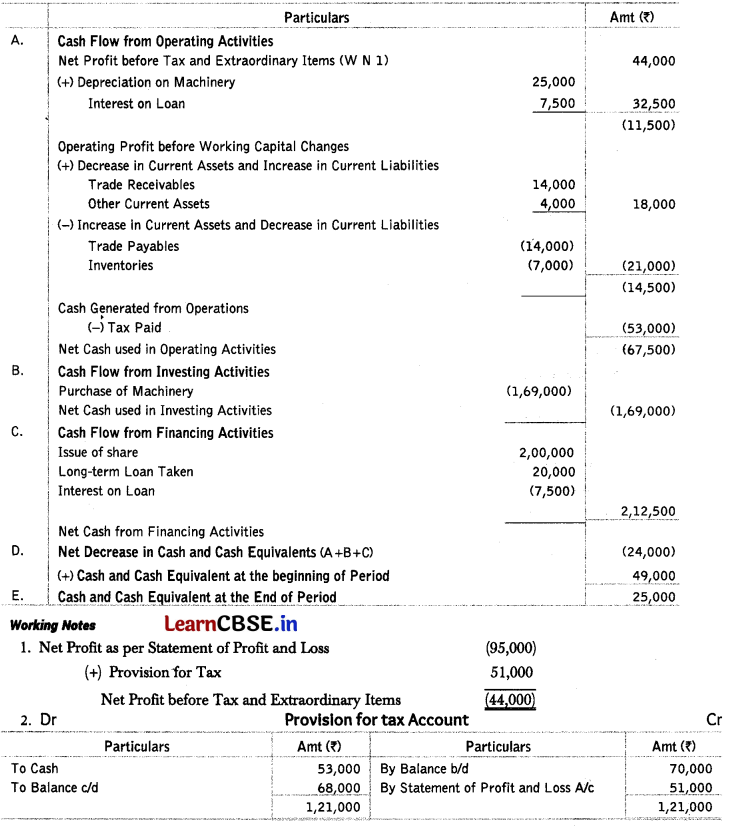
A complete Cash Flow Statement is more than just the sum of its parts. It follows a specific structure designed to provide a clear picture of a company's cash movements over a period.
The final statement consolidates the net cash flow from each of the three activities and reconciles the total change with the opening and closing cash balances shown on the balance sheet.
The structure is as follows:
- Cash Flow from Operating Activities (A)
- Cash Flow from Investing Activities (B)
- Cash Flow from Financing Activities (C)
- Net Increase/Decrease in Cash and Cash Equivalents (A + B + C)
- Add: Cash and Cash Equivalents at the beginning of the year
- Equals: Cash and Cash Equivalents at the end of the year
The final figure must match the closing balance of Cash and Cash Equivalents provided in the balance sheet. This self-checking mechanism is one of the most useful features of preparing a full statement.
Here is an example of what a finished Cash Flow Statement looks like. This is the format and level of detail you should aim for.
2. A Strategic Approach to Comprehensive Problems
Tackling a full Cash Flow Statement question can seem daunting due to the amount of information. A systematic approach is key. Here is a six-step strategy you can follow:
- Set Up the Format: Begin by drawing the basic structure of the Cash Flow Statement with the three main headings (Operating, Investing, Financing) and space for the final reconciliation.
- Calculate Net Profit Before Tax (NPBT): This is the starting point for operating activities. You'll typically calculate this by taking the difference in the Surplus (Balance in Statement of P&L) and adjusting for items like Provision for Tax, Proposed Dividends, and Transfers to Reserves.
- Prepare Working Notes (Ledger Accounts): Scan the additional information. If there are adjustments related to Fixed Assets, Accumulated Depreciation, or Provision for Tax, it's best to prepare their ledger accounts. This will help you uncover "hidden" information, such as the purchase or sale of an asset, the amount of depreciation for the year, or the tax paid.
- Item-by-Item Analysis: Go through every single item in the comparative Balance Sheet and the additional information. As you address each item, decide where it belongs:
- Is it part of NPBT calculation?
- Is it a non-cash/non-operating adjustment?
- Is it a working capital change?
- Is it an investing activity?
- Is it a financing activity?
Place it in your format or ledger account immediately. This ensures nothing is missed.
- Complete Each Activity: Once all items are posted, calculate the net cash flow for Operating (A), Investing (B), and Financing (C) activities.
- Reconcile and Verify: Sum the totals from the three activities (A + B + C) to find the net change in cash. Add the opening balance of Cash and Cash Equivalents. The result must equal the closing balance. If it matches, your statement is correct!
3. Guided Practice: Solving a Comprehensive Problem
The best way to master this is through practice. We'll use a detailed video that walks through the entire process, from understanding the format to solving complex problems.
First, let's get a complete overview of the format and some crucial adjustments you'll need for your CBSE exams.
Cash Flow Statement Class 12 Accountancy | One Shot Full Chapter | CBSE 2025-26 | Vishwaas Batch🎯
This video from PW Commerce Wallah provides a comprehensive review of the Cash Flow Statement format and discusses several important adjustments. Watching this will set a strong foundation before we tackle a full problem.
Please watch from 21:53 to 50:52. This portion covers: The detailed format for all three activities. Key adjustments for items like Proposed Dividend and Provision for Tax, which are very important. Critical assumptions regarding Current Investments and Bank Overdraft.
Now that you have the complete framework and key adjustments fresh in your mind, let's apply them. We will now walk through a full-fledged problem from start to finish.
Cash Flow Statement Class 12 Accountancy | One Shot Full Chapter | CBSE 2025-26 | Vishwaas Batch🎯
Let's continue with the same video. The instructor will now solve a comprehensive problem step-by-step. Follow along closely and observe how the six-step strategy is applied.
Watch the first solved example from 50:52 to 01:11:41. Pay close attention to: How the instructor reads the question and plans the solution. The calculation of Net Profit Before Tax and adjustments for depreciation and proposed dividend. The adjustments for Working Capital changes. How the 'Sale of Plant and Machinery' is calculated as a balancing figure. The treatment of Bank Overdraft and Loan Repayment under Financing Activities. The final reconciliation of cash balances.
By following that detailed walkthrough, you can see how a systematic approach breaks a large problem into manageable steps, leading to the correct and fully reconciled final statement.
Test your understanding!
In the example you just watched, the opening balance of Plant & Machinery was ₹1,50,000 and the closing balance was ₹90,000. Additional information stated that depreciation of ₹10,000 was charged. There was no information about profit or loss on sale. How was the 'Proceeds from Sale of Plant & Machinery' of ₹50,000 calculated?
Show answer
The calculation is done by preparing a simple reconciliation or a mental ledger account for Plant & Machinery:
- Opening Balance: ₹1,50,000
- Less: Depreciation for the year: (₹10,000)
- Book Value before sale: ₹1,40,000
- Less: Closing Balance (as per Balance Sheet): (₹90,000)
- Balancing Figure (Proceeds from Sale): ₹50,000
Since there was no information on profit or loss, it's assumed the asset was sold for its book value, and this balancing figure represents the cash inflow from the sale, which is an investing activity.
Conclusion
Congratulations! You have now learned how to assemble a complete Cash Flow Statement, which is a major topic in your Grade 12 syllabus.
Key Takeaways:
- A complete Cash Flow Statement integrates Operating, Investing, and Financing activities.
- A systematic, six-step approach is crucial: Format -> NPBT -> Working Notes -> Analyze -> Calculate -> Verify.
- Preparing ledger accounts for fixed assets and provisions is essential for finding hidden figures like purchases, sales, depreciation, and tax paid.
- The final reconciliation of opening and closing cash balances is a built-in check to verify the accuracy of your statement.
Preview of the Next Lesson:
This lesson concludes our deep dive into the Analysis of Financial Statements. We've covered the tools of analysis, accounting ratios, and now, the complete Cash Flow Statement.
In the next module, we will shift our focus back to partnership accounting and begin with the Dissolution of a Partnership Firm. You will learn about the distinction between the dissolution of a partnership and the dissolution of a firm, and the accounting procedures required to close the books of a firm, starting with the preparation of a Realization Account.