Hello! Let's dive into the final component of the Cash Flow Statement.
In the previous lessons, you mastered calculating cash flows from Operating and Investing activities. We saw how operating activities relate to the principal revenue-producing activities, while investing activities concern the acquisition and disposal of long-term assets.
Today, we'll complete the picture by focusing on Cash Flow from Financing Activities. This lesson will teach you how to calculate the cash generated from or used in transactions with the owners (shareholders) and lenders of the company. Understanding this section is crucial to see how a company funds its operations and growth.
1. What are Financing Activities?
Financing activities are transactions that result in changes in the size and composition of the owner's capital and borrowings of the enterprise. In simpler terms, these activities are all about how a company raises money (from shares, debentures, loans) and how it pays that money back (redemption, loan repayment, dividends, interest).
To begin, let's get a formal definition and see a list of items that fall under this category.
Cash Flow from Financing Activities
This article from GeeksforGeeks provides a concise definition of financing activities and a clear list of the transactions involved.
Please read the section 'What are Financing Activities?'. Pay special attention to the 'Note' which lists non-cash transactions that are excluded, such as the issue of bonus shares.
As you've just read, the main sources of cash flows in this section are:
- Cash Inflows (+):
- Proceeds from the issue of Equity or Preference Shares.
- Proceeds from the issue of Debentures, Loans, Bonds.
- Increase in short-term borrowings like Bank Overdraft or Cash Credit.
- Cash Outflows (-):
- Redemption (repayment) of Preference Shares.
- Redemption of Debentures, Loans, Bonds.
- Buy-back of Equity Shares.
- Payment of dividends (Interim and Final/Proposed).
- Payment of interest on borrowings.
- Decrease in Bank Overdraft or Cash Credit.
The format for presenting these activities is a straightforward list of these inflows and outflows.
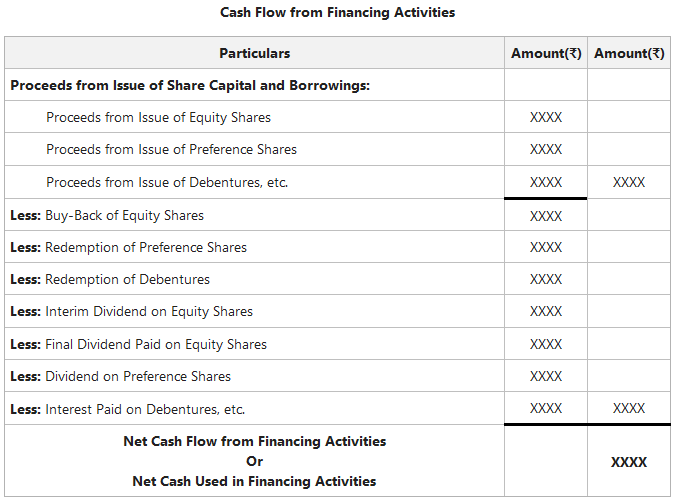
2. Calculating Cash Flow from Financing Activities
The calculation process involves analyzing the 'Shareholders' Funds' and 'Non-Current Liabilities' sections of the comparative Balance Sheet, along with any relevant additional information.
The best way to understand the mechanics is to see them in action. This video will walk you through the key items and then solve a comprehensive problem.
Cash flow statement | Accountancy | Class 12 | Part 5 | Financing Activity
Rajat Arora explains each component of financing activities and demonstrates how to prepare the statement with a detailed example.
First, watch from 01:01 to 06:25. The instructor introduces the concept and breaks down the treatment of transactions related to shares and debentures. This will build on the list you saw earlier.
Important Considerations:
- Dividends: A very important point to remember for your CBSE exam is the treatment of dividends.
- Interim Dividend: This is a dividend declared and paid during the year. The amount paid is shown as a cash outflow.
- Proposed Dividend (or Final Dividend): You will often be given figures for the previous year and the current year. Always treat the Previous Year's Proposed Dividend as the outflow for the current year. The current year's proposed dividend is only a contingent liability at the balance sheet date and does not result in a cash flow until it is approved and paid in the following year.
- Non-Cash Transactions: As mentioned in the GeeksforGeeks article, transactions like issuing bonus shares or converting debentures into shares do not involve cash and are therefore excluded from the Cash Flow Statement.
3. A Worked Example
Now, let's apply these rules to solve a problem. The same video continues with a practical example that covers many common adjustments you will encounter.
Cash flow statement | Accountancy | Class 12 | Part 5 | Financing Activity
Let's continue with the same video to see how to apply the concepts to a problem.
Watch the solved example from 06:25 to 14:16. Observe how the instructor analyzes the balance sheet changes and incorporates adjustments for premium, discount, underwriting commission, and dividends to calculate the final 'Cash Used in Financing Activities'.
Let's summarize the steps from the video's example:
- Equity Shares: The capital increased from ₹6 lakhs to ₹8 lakhs, indicating an inflow of ₹2 lakhs. The additional information stated they were issued at a 15% premium (inflow of ₹30,000) and an underwriting commission was paid (outflow of ₹10,000). Net inflow = ₹2,20,000.
- Preference Shares: The capital decreased from ₹2 lakhs to nil, indicating a redemption. They were redeemed at a 5% premium (outflow of ₹10,000). Total outflow = ₹2,10,000.
- Debentures: The balance increased from nil to ₹1 lakh, indicating an issue. They were issued at a 1% discount, so the cash inflow was ₹99,000.
- Dividends & Interest: Dividend on preference shares (₹24,000), interest on debentures (₹14,000), and the previous year's proposed dividend (₹90,000) were all paid, resulting in cash outflows.
- Final Calculation: Summing up all inflows and outflows gives the 'Net Cash Used in Financing Activities' of ₹19,000.
Test your understanding!
From the following information, calculate the Cash Flow from Financing Activities:
| Particulars | 31.03.2023 (₹) | 31.03.2024 (₹) |
|---|---|---|
| Equity Share Capital | 5,00,000 | 7,00,000 |
| 10% Debentures | 3,00,000 | 2,00,000 |
| Bank Overdraft | 50,000 | 40,000 |
| Securities Premium | 20,000 | 70,000 |
Additional Information:
- Interest paid on debentures was ₹30,000.
- Dividend paid during the year was ₹50,000.
Show answer
Calculation of Cash Flow from Financing Activities
| Particulars | Details (₹) | Amount (₹) |
|---|---|---|
| Cash Inflows: | ||
| Proceeds from Issue of Equity Shares | 2,00,000 | |
| (₹7,00,000 - ₹5,00,000) | ||
| Proceeds from Securities Premium | 50,000 | |
| (₹70,000 - ₹20,000) | ||
| Total Inflows | 2,50,000 | |
| Cash Outflows: | ||
| Redemption of 10% Debentures | (1,00,000) | |
| (₹3,00,000 - ₹2,00,000) | ||
| Repayment of Bank Overdraft | (10,000) | |
| (₹50,000 - ₹40,000) | ||
| Interest paid on Debentures | (30,000) | |
| Dividend Paid | (50,000) | |
| Total Outflows | (1,90,000) | |
| Net Cash Flow from Financing Activities | 60,000 |
Conclusion
Excellent work! You have now learned how to analyze and calculate cash flows for all three activities: Operating, Investing, and Financing.
Key Takeaways:
- Financing activities involve transactions with owners (shareholders) and lenders (debtholders, banks).
- The primary sources of information are the Shareholders' Funds and Non-Current Liabilities sections of the Balance Sheet, along with additional information.
- Inflows come from issuing shares and debentures or taking on new loans.
- Outflows go towards repaying capital (redemption, buy-back), repaying loans, and servicing capital (paying interest and dividends).
- Always remember to use the previous year's proposed dividend as the current year's outflow.
- Non-cash transactions like the issue of bonus shares are excluded.
Preview of the Next Lesson:
You've built all the individual components. The next logical step is to assemble them. In our next lesson, we will learn how to prepare a complete Cash Flow Statement. We'll integrate the calculations for Operating, Investing, and Financing activities, and finally, verify our result by reconciling it with the opening and closing balances of Cash and Cash Equivalents.