Hello! Welcome to the final major topic in your Grade 12 syllabus: the Cash Flow Statement.
In our previous module, we explored various accounting ratios. Those ratios provided a static snapshot of a company's performance and financial position by analyzing figures from the Profit and Loss Statement and Balance Sheet. Now, we shift our focus from a static picture to a dynamic movie. The Cash Flow Statement tells the story of how cash moves in and out of a business over a period.
You might wonder, "If the P&L statement already shows a profit, why do we need another statement about cash?" That's an excellent question. As you know from your Grade 11 studies, the P&L statement is prepared on an accrual basis, meaning it records revenues when earned and expenses when incurred, regardless of when cash is actually received or paid. A company can be highly profitable on paper but face a severe cash crunch if its customers don't pay on time.
The Cash Flow Statement bridges this gap by focusing exclusively on the inflows and outflows of cash and cash equivalents.
In this first lesson, our goal is to master the foundational concept of the Cash Flow Statement, as per Accounting Standard 3 (AS-3): to classify all business activities into three distinct categories: Operating, Investing, and Financing. Understanding this classification is the essential first step to preparing the entire statement.
1. What is a Cash Flow Statement?
A Cash Flow Statement is a financial statement that summarizes the movement of cash and cash equivalents that come into and go out of a company.
- Cash: This includes cash in hand and demand deposits with banks.
- Cash Equivalents: These are short-term, highly liquid investments that are readily convertible into known amounts of cash and which are subject to an insignificant risk of changes in value. Think of marketable securities or current investments.
The entire statement is structured around three types of activities. Let's get a high-level overview.

To begin, let's watch a video that introduces the Cash Flow Statement and explains why it's necessary by contrasting it with the accrual-based P&L statement.
GnG Day 1 | Cash Flow Statement | Accountancy | Class 12
This video from Rajat Arora provides an excellent, story-based explanation for why the Cash Flow Statement is crucial. It highlights the difference between accrual-based profit and actual cash in hand.
Watch from 03:28 to 15:12. Focus on understanding the story of 'Chintu' and how it demonstrates that profit does not equal cash. This will solidify the purpose of the statement in your mind.
2. The Three Pillars of Cash Flow: A Simple Guide
According to Accounting Standard 3 (AS-3), all cash flows must be classified into one of three categories. Before we dive into the details, here is a powerful and simple rule of thumb to classify most transactions:
- Transactions related to Non-Current Assets and Investments are generally Investing Activities.
- Transactions related to Shareholders' Funds (Share Capital) and Non-Current Liabilities (Long-term Loans, Debentures) are generally Financing Activities.
- Everything else, primarily related to the main revenue-producing operations of the business, falls under Operating Activities.
This mental model will help you quickly categorize items as we explore each activity in more detail. Let's use a video to walk through each category with specific examples. We'll start with Investing and Financing, as they have more clearly defined boundaries, and then cover Operating activities.
Cash flow statement | Basics Part 1 | Class 12 Accounts | 8 Marks | Session 2023-24
This video by Sunil Panda provides a very clear and structured breakdown of what goes into Investing and Financing activities. This systematic approach aligns well with building a strong foundation.
Watch from 08:18 to 21:06. Pay close attention to the specific examples provided for both inflows (cash coming in) and outflows (cash going out) in each category.
Let's summarize and solidify what you just learned.
A. Investing Activities
These activities relate to the acquisition and disposal of long-term assets and other investments not included in cash equivalents. Think of this as cash spent on or generated from items that will help the business generate profits in the future.
-
Cash Inflows (Sources of Cash):
- Sale of Fixed Assets (e.g., machinery, buildings)
- Sale of Non-current Investments (e.g., shares or debentures of other companies)
- Interest received on investments or loans given
- Dividends received on shares held in other companies
- Rent received from property held as an investment
-
Cash Outflows (Uses of Cash):
- Purchase of Fixed Assets
- Purchase of Non-current Investments
- Purchase of Intangible Assets like Goodwill
B. Financing Activities
These are activities that result in a change in the size and composition of the owner's capital and borrowings of the enterprise. Essentially, this category tracks how the business raises funds to operate and how it repays its providers of funds.
-
Cash Inflows (Sources of Cash):
- Issue of Equity or Preference Shares for cash
- Issue of Debentures, Loans, Bonds for cash
- Increase in Bank Overdraft or Cash Credit
-
Cash Outflows (Uses of Cash):
- Redemption of Preference Shares or Debentures
- Repayment of long-term loans
- Payment of dividends to shareholders
- Payment of interest on debentures and loans
- Decrease in Bank Overdraft
C. Operating Activities
These are the principal revenue-producing activities of the enterprise. They are the cash effects of transactions that determine the net profit or loss of the business. If an activity is not classified as Investing or Financing, it is treated as an Operating Activity.
-
Cash Inflows (Sources of Cash):
- Cash sales of goods and services
- Cash received from Trade Receivables (Debtors)
- Cash received from Royalties, Fees, and Commissions
-
Cash Outflows (Uses of Cash):
- Cash purchases of inventory
- Cash paid to Trade Payables (Creditors)
- Payment of operating expenses like salaries, wages, and rent
- Payment of income taxes
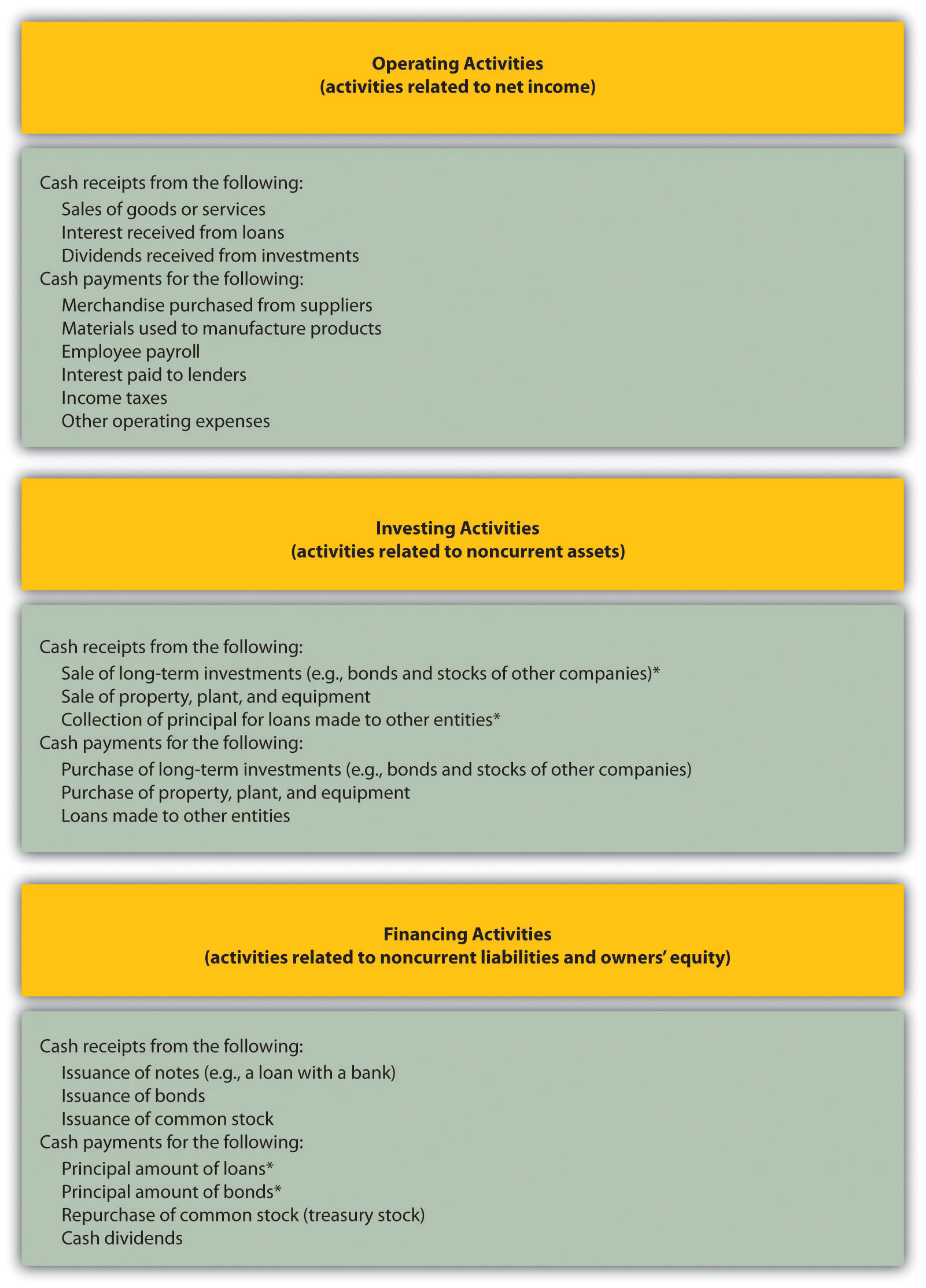
The following table provides a great visual summary of this classification.
Test your understanding!
A common point of confusion is the treatment of interest and dividends. Based on what you've learned, classify the following:
- Interest paid on a bank loan.
- Interest received on an investment made in another company.
- Dividend paid to shareholders.
- Dividend received on shares held in another company.
Show answer
- Interest paid is a cost of borrowing funds, so it's a Financing Activity.
- Interest received is a return on an investment, so it's an Investing Activity.
- Dividend paid is a return given to the owners (shareholders) who provided capital, so it's a Financing Activity.
- Dividend received is a return on an investment made in another company, so it's an Investing Activity.
3. An Important Caveat: Financial vs. Non-Financial Companies
The classification of an activity can depend on the nature of the business. An activity that is "Operating" for one company might be "Investing" for another. The distinction lies in what the company's principal revenue-producing activity is.
For a deeper look at this crucial distinction, please read the following notes.
Cash Flow Statement notes for CBSE Class 12 Accountancy
These notes from Topperlearning clearly explain the classification of activities and, most importantly, highlight the differences in classification for Financial and Non-Financial companies. This is a key concept for your exams.
Read the section titled 'Classification of Cash Flows for Cash Flow Statement'. Focus specifically on the bullet points under 'Operating Activities' that differentiate between 'Financial Companies' and 'Non-Financial Companies'.
To summarize the key point from the reading:
- For a Non-Financial Company (e.g., a car manufacturer):
- Buying shares in another company is an Investing Activity.
- Receiving interest on these shares is an Investing Activity.
- Paying interest on a loan is a Financing Activity.
- For a Financial Company (e.g., a bank or a mutual fund):
- Buying and selling securities (shares, debentures) is their main business, so it's an Operating Activity.
- Receiving and paying interest is also part of their core business, making it an Operating Activity.
Conclusion
Excellent work! You've successfully learned the fundamental framework of the Cash Flow Statement. Mastering this classification is crucial, as every transaction involving cash must be correctly placed into one of these three buckets to build the final statement.
Key Takeaways:
- A Cash Flow Statement tracks the movement of Cash and Cash Equivalents.
- All cash flows are classified into three categories as per AS-3: Operating, Investing, and Financing.
- Operating Activities are the main day-to-day, revenue-producing activities.
- Investing Activities relate to the purchase and sale of long-term assets and investments.
- Financing Activities relate to changes in the capital structure (equity and long-term debt).
- The classification of certain items (like interest and dividends) can differ between financial and non-financial companies.
Preview of the Next Lesson:
Now that we have the structure, we can begin constructing the statement. In our next lesson, we will start with the first and most detailed section: Cash Flow from Operating Activities. We will learn the first step in the indirect method (which is in your syllabus): calculating the Net Profit before Tax and Extraordinary Items.