Welcome to your first lesson in prompt engineering for HR professionals. Based on our conversations, you're looking to move beyond basic AI interactions to become more creative, efficient, and precise in your work. This course is designed to get you there quickly, focusing on practical techniques you can apply immediately across the full spectrum of your HR responsibilities.
In this introductory lesson, we'll tackle the most fundamental step in crafting effective prompts. You'll learn how to assign a specific role and provide relevant context to the AI. This is the difference between asking a random stranger for directions and consulting a seasoned local guide with a map. By the end of this hour, you will be able to transform your simple prompts into powerful instructions that generate targeted, high-quality HR outputs.
From Generic to Strategic: Why Your Instructions Matter
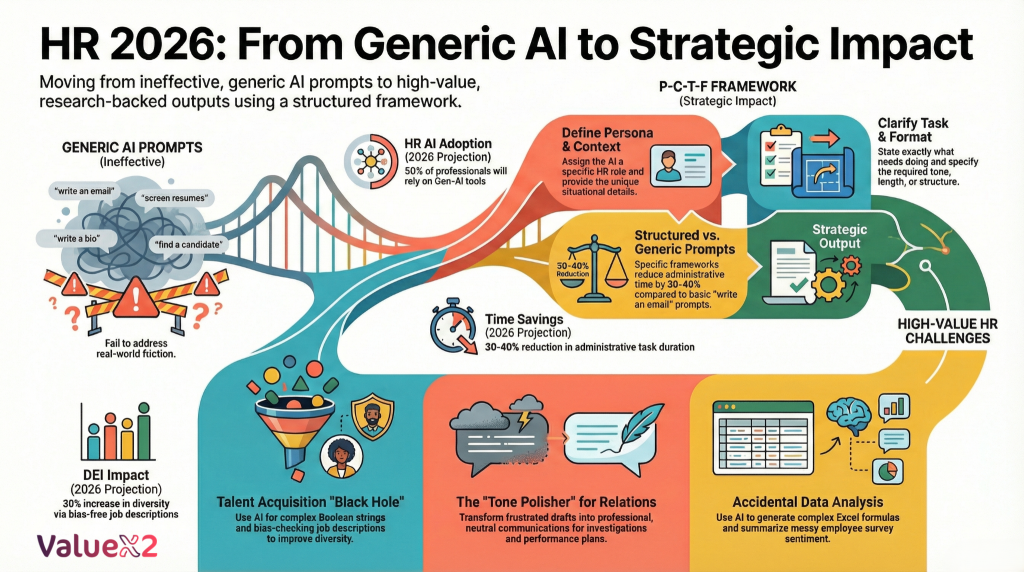
You already use AI for tasks like drafting emails and job descriptions, which is a great start. However, you've likely noticed that simple prompts such as "write an email" or "screen resumes" often produce generic or unhelpful results. This is because the AI lacks two crucial pieces of information: who it should be and what it needs to know.
Think of an AI model as an incredibly knowledgeable but inexperienced new hire. If you give it a vague task, it will make its best guess, drawing on a vast but undifferentiated pool of public information. To get expert-level work, you need to provide the same guidance you would give a human colleague: you must define their role and give them the necessary context for the task.
Today, we will focus on mastering these two core components: Persona (the role you assign the AI) and Context (the background information you provide).
The Power of Persona: Tell the AI Who to Be
The first step in elevating your prompts is to assign the AI a specific persona or role. Instead of letting it be a generic chatbot, you instruct it to act as an expert with a specific title, experience level, and perspective.
Why does this work? AI models are trained on immense datasets that include text written by millions of people in specific roles—doctors, lawyers, programmers, and, importantly for us, HR professionals. When you assign a persona, you are essentially telling the AI to filter its knowledge and communication style through the lens of that specific role, dramatically increasing the relevance and quality of its response.
The video below offers a quick, clear explanation of the core components of a great prompt, including the concept of Persona.
Master the Perfect ChatGPT Prompt Formula (in just 8 minutes)!
Watch this segment from the video "Master the Perfect ChatGPT Prompt Formula" by Jeff Su. It introduces the key building blocks of a prompt and then focuses specifically on the "Persona" component.
Please watch from the introduction to the six components, noting where Persona fits. Then, watch the detailed explanation of the Persona component, where the presenter explains how to think about choosing a role for the AI.
To see how this applies directly to HR, the following reading provides excellent, practical examples.
AI Prompting Mastery Guide for HR Teams
This guide from Workleap details several powerful prompting techniques. We will focus on "Role Assignment." Pay close attention to the different dimensions you can add to a persona to make it more specific and effective.
Start by reading the section titled "Role Assignment." Notice the three dimensions it suggests adding: Business Context, Behavioral Lens, and Tone. Next, review the four HR-specific examples. Think about how each prompt creates a very different kind of HR expert, from one focused on fast-growing tech companies to another specializing in large, matrixed organizations.
As you can see from the examples, a strong persona goes beyond a simple title. A prompt like Act as a seasoned HR Business Partner... is far more powerful when enriched with details about industry experience, company size, and specific responsibilities.
Providing Context: The 'Who, What, Where, and Why'
Once you've set the persona, the next step is to provide all the relevant context the AI needs to complete the task successfully. Context is the surrounding information that frames the request. Without it, the AI is forced to make assumptions, which often leads to inaccurate or irrelevant outputs.
The table below, from an article by OrangeHRM, clearly illustrates the essential components of a well-structured prompt. For this lesson, we are focusing on the first and third items: Role and Context.
What AI Prompts Should HR Teams Be Using in 2026?
This table clearly breaks down the four key components of a strong HR prompt. Source: OrangeHRM, 2026.
A good way to think about providing context is to answer the key questions: Who? What? When? Where? How? and Why? The more relevant details you provide, the more tailored the output will be.
The following video explains this well, demonstrating how adding just a few details transforms a vague request into a specific, actionable one.
Google's 9 Hour AI Prompt Engineering Course In 20 Minutes
This video, which summarizes a Google course on prompt engineering, highlights the importance of context and gives a concrete HR-related example.
First, watch the brief segment explaining the importance of providing context. Then, skip ahead and watch the section on designing an AI agent for HR. This example of creating a "career development training simulator" is a perfect illustration of how combining a detailed persona and rich context can create a highly specific and useful tool.
Context Stacking and Knowledge Blocks
For more complex tasks, you can use a technique called Context Stacking, where you layer multiple pieces of information to build a complete picture for the AI. This is particularly useful for tasks like drafting policies or designing onboarding plans.
To make this process even more efficient—a key goal for you—you can create Knowledge Blocks. These are pre-written, standardized blocks of context about your company that you can save and reuse in different prompts.
AI Prompting Mastery Guide for HR Teams
Let's return to the Workleap guide to explore these two advanced, yet highly practical, context-providing techniques.
First, read the section on Context Stacking. Note the HR example for creating a 'Work from Anywhere' policy. Then, read about Knowledge Blocks. Pay special attention to the examples for "Company Context," "Performance Review Standards," and "Compliance Requirements." Creating your own library of these blocks is a powerful way to ensure consistency and save significant time.
Putting It All Together: A Practical Example
Let's see how this works in practice. Imagine you need to create a job description.
Generic Prompt:
Write a job description for a Senior Recruiter.
This prompt lacks both a specific persona and any meaningful context. The result will be a generic template that could apply to any company.
Strategic Prompt (with Persona and Context):
**Persona:** You are an expert Talent Acquisition Partner with over 10 years of experience in the enterprise software industry.
**Context:** Our company is a 5,000-employee global SaaS provider specializing in financial technology. We have a fast-paced, collaborative culture that values innovation and data-driven decisions. We are hiring a Senior Recruiter to join our engineering recruitment team. This role is fully remote (U.S. based) and reports to the Director of Talent Acquisition. The primary focus will be on sourcing and hiring senior and principal-level software engineers with expertise in cloud computing (AWS, Azure) and machine learning.
**Task:** Based on this, write a comprehensive and compelling job description.
This second prompt, by clearly defining the persona and providing rich context, will produce a far more specific, relevant, and useful job description that reflects your company's unique needs and culture.
Your Turn: Practice Exercise
Now, it's your turn to apply what you've learned. Read the scenario below and draft a prompt in a text editor or directly in an AI tool like ChatGPT. Focus on defining a clear persona and providing all the necessary context.
Scenario: Your company is a 350-employee marketing agency known for its creative and collaborative culture. Recently, feedback from exit interviews has shown that new hires in the creative department feel disconnected and overwhelmed during their first month. You need to draft an email to the three Creative Directors to announce a new, mandatory workshop for them on "Leading Effective Onboarding for Creative Teams." The goal is to get their buy-in and ensure they attend.
Your Task: Write a prompt to an AI assistant to draft this email. Don't just ask it to "write the email." Instead, construct a prompt that includes a specific persona and detailed context.
(Take about 5-7 minutes to complete this.)
Example Solution Components:
To help you evaluate your prompt, here are the key elements it should have contained:
- Persona: Something like, "Act as a Senior HR Business Partner," "You are the Head of People Operations," or "You are an internal communications specialist at a marketing agency." The key is to give the AI an expert role within the company.
- Context:
- Company: 350-employee creative marketing agency.
- Culture: Creative, collaborative.
- Problem: High turnover/poor feedback from new hires in the creative department, who feel disconnected.
- Audience: The three Creative Directors (your peers or senior leaders).
- Goal: To announce a mandatory workshop and, crucially, to persuade them of its importance and get their buy-in, not just command them to attend.
- Topic: "Leading Effective Onboarding for Creative Teams."
Your final prompt should have woven these elements into a clear set of instructions for the AI.
Conclusion and Next Steps
In this lesson, you've taken the first and most critical step toward mastering prompt engineering. You learned that the quality of AI output depends directly on the quality of your input.
Here are the key takeaways:
- Move Beyond Generic: Simple prompts lead to simple, often unusable, results.
- Assign a Persona: Tell the AI who to be by giving it a specific role, title, and expertise. This focuses its knowledge and style.
- Provide Rich Context: Give the AI the necessary background information—the who, what, where, when, and why—to understand the full scope of the task.
- Combine for Power: A prompt that combines a clear persona with detailed context is the foundation for generating strategic, high-value HR work.
You are now equipped with the foundational technique for all effective prompting. In our next lesson, we will build directly on this by learning how to specify the output format, length, and tone, giving you even more granular control over the AI's final response.