Welcome to the first lesson in your journey toward becoming a fiction writer! This course is designed to build your reading and analysis skills from the ground up, as strong readers make strong writers. In this initial lesson, we'll tackle a fundamental skill that will make your reading in English smoother and more effective: figuring out the meaning of unfamiliar words without constantly reaching for a dictionary.
Your goal is to become a writer, and to do that, you'll need to read widely across different authors and genres. You will inevitably encounter words you don't know. The ability to infer meaning from the surrounding text—using what we call "context clues"—is what allows you to stay immersed in the world of a story, build your vocabulary naturally, and read with greater confidence and speed.
Today, we will cover:
- What context clues are and why they are so important.
- A simple, systematic process for making an educated guess about a word's meaning.
- The most common types of context clues you'll find in fiction.
By the end of this lesson, you will be able to identify unfamiliar vocabulary in fiction passages and use the surrounding text to understand it.
What are Context Clues?
When you encounter an unknown word while reading, the sentence and paragraph it sits in are filled with hints about its meaning. These hints are context clues. Think of yourself as a detective. The unknown word is a mystery, and the rest of the text provides the clues you need to solve it.
This is not just a trick for language learners; it's a skill that all proficient readers use. To see it in action, let's start with a short video that walks through a practical example.
Using context clues to determine the meaning of a word | Reading | Khan Academy
Watch this video from Khan Academy, "Using context clues to determine the meaning of a word." It provides an excellent demonstration of how a reader can piece together information from a short paragraph to understand a completely unfamiliar word.
Please watch the entire video. Pay close attention to how the presenter identifies clues related to climbing and safety to figure out the function of a 'carabiner' before even seeing one. This process of gathering evidence from the text is exactly what we'll be practicing.
As the video explains, using context clues isn't about guessing perfectly every time. It's about creating a "basis of understanding" that allows you to continue reading without breaking your flow. This is a crucial skill for tackling the complex and beautiful language you'll find in fiction.
A Three-Step Technique for Word Detectives
While it might seem like intuition, guessing from context can be a systematic process. Having a clear method helps, especially when you're just starting to build this skill. The following video offers a simple but powerful three-step technique.
Understand ANY English Word (No Dictionary Needed!)
Now, let's watch parts of the video "Understand ANY English Word (No Dictionary Needed!)" from Canguro English. It breaks down the process of guessing a word's meaning into three manageable steps.
First, watch the section on Step 1: Parts of speech from the beginning. This step is about figuring out the word's grammatical role (is it a noun, verb, adjective?). This immediately narrows down what the word could mean. Next, watch the segment on Step 2: Helper vocabulary from the next section. This is where you look at the words around the mystery word. Do they suggest something positive or negative? Look for signal words like and, but, or because, which can reveal relationships between ideas. Finally, watch the clip on Step 3: Guess and check from the last part. This step emphasizes that after making an educated guess, you can often confirm it by asking a question or simply seeing if your guess makes sense in the context of the story.
This three-step process—(1) identify the part of speech, (2) analyze the surrounding words, and (3) make an educated guess—is your core framework. Now, let's get more specific about the kinds of "helper vocabulary" you can find.
The Different Types of Clues
Context clues come in several common patterns. Learning to recognize these patterns will make you a much more efficient "word detective."
The image below gives a great visual summary of some of the most common types. Notice how it points out "Signal Words" that can tip you off to the type of clue being used.
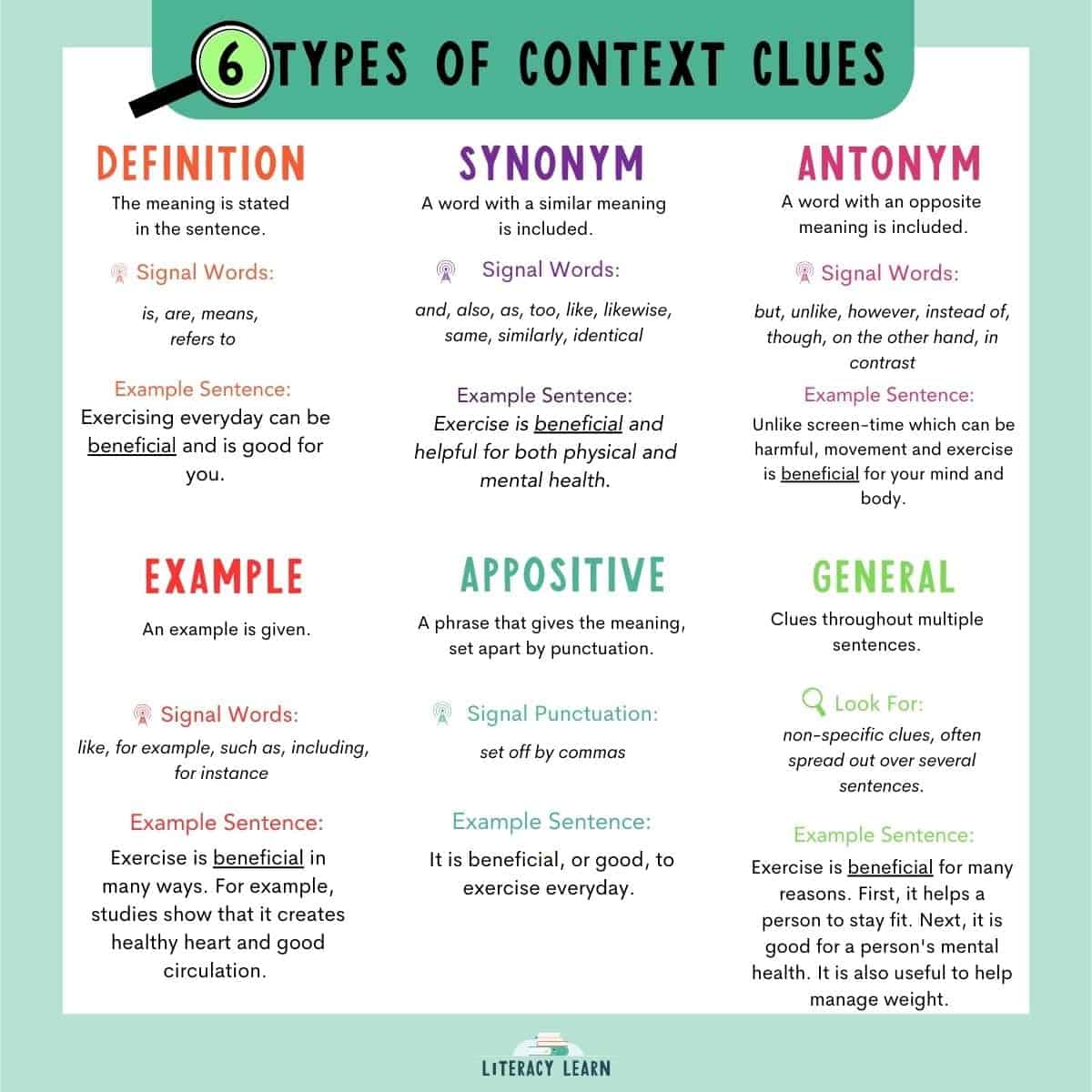
To explore these types in more detail, we'll turn to a helpful article from Grammarly.
What Are Context Clues? Definition and Examples
This article provides clear explanations and excellent examples for the most common types of context clues. We will focus on the four most direct and useful types for now.
Please read the following sections from the article: Start with "Types of context clues: In-text definitions" to learn about the most straightforward clue, where the text provides the definition directly. Next, read the section on "Examples," which shows how you can infer a word's meaning from the examples given. Then, read about "Synonyms," where the text provides a word with a similar meaning as a clue. Finally, review the section on "Antonyms or contrast," which explains how you can use a word with an opposite meaning, often signaled by words like but or although.
As you can see, authors often provide these clues intentionally to help the reader. As an aspiring writer yourself, this is also a technique you will one day use to guide your own readers.
Let's Practice
Now it's your turn to be the detective. Read the sentences below. Try to guess the meaning of the bolded word using the context, and think about which type of clue is being used.
- The instructions for the assignment were ambiguous, which left the students confused about what they were supposed to do.
- The desert is mostly arid, but the oasis is a verdant patch of green, full of life.
- She was known for her loquacity; she could talk for hours on any subject.
- Celestial bodies, such as the sun, moon, and stars, have fascinated humans for centuries.
Take a moment to think about each one before reading the explanations below.
Explanations:
- Ambiguous: The clue here is one of inference or cause-and-effect. Because the students were "confused," we can infer that the instructions were unclear or had more than one possible meaning.
- Verdant: The clue is an antonym or contrast. The sentence contrasts the "arid" (dry) desert with the oasis. The word "but" is the signal. If the desert is dry, the oasis must be the opposite, so verdant likely means green, lush, or full of plants.
- Loquacity: The clue is a synonym or restatement. The second part of the sentence explains what loquacity is: the quality of being able to "talk for hours." So, loquacity means talkativeness.
- Celestial: The clue is an example. The phrase "such as" introduces examples of celestial bodies: the sun, moon, and stars. From these examples, we can understand that celestial relates to things in the sky or space.
Key Takeaways
Congratulations on completing your first lesson! You've taken a significant step toward becoming a more confident and analytical reader.
Here are the main points to remember:
- Reading smoothly is the goal: Using context clues allows you to understand new words without interrupting your reading to use a dictionary.
- Use the three-step process: First, identify the word's part of speech. Second, look for clues in the surrounding text. Third, make an educated guess.
- Recognize the patterns: Be on the lookout for common clue types like definitions, synonyms, antonyms, and examples. They are your signposts to meaning.
This skill is not about achieving perfection. It's about building a working understanding so you can stay engaged with the narrative. The more you read and practice, the more intuitive this process will become.
In our next lesson, we will continue building your reading foundation by exploring the difference between literal and figurative language. This will take your vocabulary skills a step further, showing you how writers use words in creative and non-literal ways to create powerful images and emotions.