Welcome back! In our last lesson, we focused on the central figures of a story: the protagonist and the antagonist. We learned that their conflicting goals are what ignite the story's central conflict. Today, we're going to zoom out from the characters and their actions to explore the deeper meaning behind the story itself. This lesson tackles one of the most important distinctions for any reader and writer: the difference between topic and theme.
Your learning outcome is to distinguish between theme and topic in a story. Understanding this will allow you to see not just what a story is about, but why it matters—a crucial step on your path to becoming an insightful writer.
What Is It About vs. What Does It Mean?
At its simplest, the difference between topic and theme is the difference between a subject and a message.
- A topic is the subject matter of a story. It can usually be expressed in one or two words. Examples: war, love, family, revenge, growing up.
- A theme is the author's message or statement about that subject. It is a complete thought or idea. Examples: War is a tragedy that destroys everyone involved. Unconditional love requires sacrifice. Family is more important than ambition.
Let's look at two infographics that visualize this distinction. They present the same core ideas in slightly different ways.

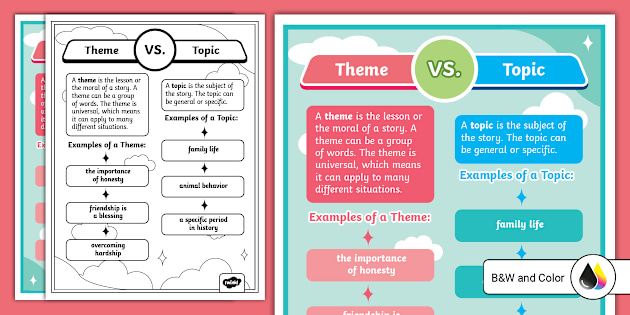
These visuals provide a solid foundation. Now, let's explore these concepts with more detail.
Formalizing the Definitions
The article "Theme vs. Topic: 5 Key Differences Explained" from YourDictionary offers a clear breakdown. It expands on the ideas from the infographics, particularly in its comparison chart.
Theme vs. Topic: 5 Key Differences Explained
This article will provide you with clear, formal definitions and a useful chart to help you remember the key differences.
First, read the introductory section, Theme vs. Topic Explained. Pay close attention to the chart that compares the two concepts. Next, read the sections What Is a Topic? and What Is Theme?. Notice how the article describes the topic as easy to find, while the theme is "buried snuggly within the pages" and must be figured out through the characters' actions and feelings.
The most important takeaway from this reading is that a topic is the subject, but a theme is an opinion or message about that subject. A story about the topic of "friendship" could have many possible themes: "friendship is a blessing," "true friendship requires honesty," or even "friendship can be a source of betrayal." The theme is what the author does with the topic.
Common Mistake: Confusing a Topic for a Theme
A very common mistake for new readers and writers is to state a topic and call it a theme. As you now know, "love" is not a theme; it is a topic. A theme must be a full statement that expresses an idea about love.
The following video explains this common pitfall clearly and provides a helpful way to think about building a theme from a topic.
This clip from the video "How To Find A Theme" by D4Darious directly addresses the mistake of using a single word as a theme.
Please watch the segment from 1:13 to 1:39. The creator makes a crucial point: single words like "love" or "friendship" are subjects or topics. A theme is an observation or opinion about that subject. For example, if the subject is "revenge," the theme could be "revenge destroys everyone, including the person seeking it."
Thinking of a theme as an observation or opinion about a subject is a powerful mental model. It helps you move from a simple word to a meaningful, complete sentence that captures the story's core message.
Topic as a Vehicle for Theme
For you as an aspiring writer, here is the most important concept to grasp: you use topics to explore themes. A story's events, characters, and setting (the topics or subject matter) are the tools you use to deliver your message (the theme).
The article "The Difference Between Topic and Theme" from DIY MFA, a website for writers, explains this relationship beautifully.
The Difference Between Topic and Theme - DIY MFA
This article is written for authors and explains the practical relationship between topic and theme in the writing process.
Please read the section starting with "What Is a Theme? And What Is a Topic?". This part introduces the idea of topic answering "What is this story about?" while theme answers "Why is this story important?" Then, read the very next paragraph, which begins "The most important difference...". This paragraph contains the key idea for you as a writer: Topic is a vehicle for illustrating theme.
Think of it this way: if you want to write a story with the theme "true courage is standing up for what is right, even when you are afraid," you need a vehicle to show this. Your story might be about a soldier in a war (topic: war), a child standing up to a bully (topic: bullying), or a scientist revealing an uncomfortable truth (topic: science and society). The topic is the specific context you create to explore your universal theme.
Seeing It in Action
Let's watch a final video that shows how to identify the topic and then derive the theme from it using examples from popular television shows and a poem.
Topic, Thesis, Theme, Claim, Main Idea: What’s the Difference?
This video provides excellent, concrete examples of moving from topic to theme.
First, watch from 1:24 to 3:26. The presenter analyzes the shows The Mandalorian and Superman & Lois. For each, she first identifies the topic (e.g., "duty," "conflicting responsibilities") and then explains the theme that the show expresses about that topic (e.g., "fulfilling your duty isn't always easy, but it's worth it anyway"). Next, watch the analysis of the poem from 4:32 to 7:02. This is a great exercise. The presenter reads the poem, identifies the topic ("a lost generation"), and then shows how re-reading and interpreting the poem reveals the deeper message, or theme: "even a lost generation can create positive change."
This process—identifying the subject matter (topic) and then asking what message the story conveys about that subject (theme)—is exactly the skill you are developing in this lesson.
Conclusion
Today, we've untangled two of the most fundamental concepts in storytelling. Mastering the distinction between topic and theme is a major step toward reading fiction with greater insight and, eventually, writing fiction with greater purpose.
Here are the key takeaways:
- Topic is the subject of a story, usually expressible in a word or short phrase (e.g., "love," "war," "justice"). It answers the question: What is this story about?
- Theme is the central message, opinion, or idea about that topic, expressed as a complete sentence (e.g., "Love requires sacrifice"). It answers the question: What is the author trying to say about this subject? or Why does this story matter?
- Topics are the vehicle for themes. A writer tells a story about specific people and events (topics) to explore a universal idea (theme).
With this lesson, we complete our exploration of the five core elements of fiction. You now have an initial understanding of plot, character, setting, conflict, and theme. In our next module, we will begin to look at how these elements are arranged to create a compelling narrative. We'll start by exploring the most common framework used in storytelling: the three-act structure.