Welcome back! In our last lesson, we defined the five essential building blocks of fiction: plot, character, setting, conflict, and theme. You learned the "what" of story analysis—the fundamental vocabulary for discussing any narrative.
Today, we transition from definition to application. The goal of this lesson is to practice identifying these five core elements within a short fiction passage. This is a crucial skill. By breaking a story down into its component parts, you begin to see the author's craft and understand how a narrative achieves its effect. Think of it as looking at the blueprints of a building after having learned to identify beams, walls, and foundations.
We will work through a classic fable together, step-by-step, to see how these elements come together to create a cohesive and meaningful story.
Putting Theory into Practice: Analyzing a Fable
To begin, we will analyze the short fable, "The Fox and the Crow." Fables are excellent for this kind of exercise because their structure is clear and their message is direct.
First, please read the story in the following resource. It's very short.
This resource contains the short story we will be analyzing for the rest of the lesson.
Please read the story from the beginning to the end. As you read, try to start thinking about our five key elements. Who is the story about? What do they want? What happens?
Now that you've read the story, let's look at a visual breakdown of its core elements. This will help you organize your initial thoughts.
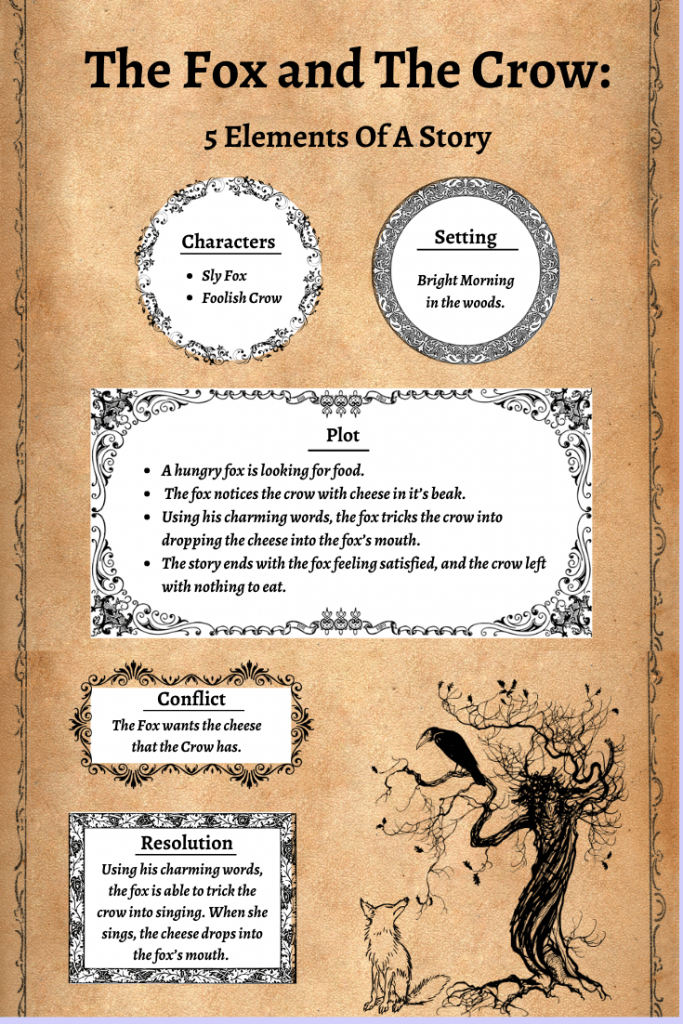
As you can see, this simple story contains all five elements we discussed:
- Characters: The "sly Fox" and the "foolish Crow." Their defining traits are central to the story.
- Setting: "Bright morning in the woods." This simple setting provides the stage for the action.
- Conflict: "The Fox wants the cheese that the Crow has." This is a clear, external conflict between two characters with opposing goals.
- Plot: The infographic summarizes the sequence of events: the hungry fox spots the crow, he flatters her, she sings and drops the cheese, and the fox eats it.
- Resolution: This is how the conflict is solved. The fox's trickery works, and he gets the cheese. The resolution directly leads to the story's theme.
What, then, is the theme? The infographic doesn't explicitly label it, but the resolution points directly to it. The crow loses her breakfast because she was tricked by flattery. Therefore, a likely theme is "Beware of flattery" or "Vanity can lead to your downfall."
A Deeper Analysis
The infographic gives us a great overview. Now, let's deepen our analysis by working through the story more formally, as if you were writing notes in your reading journal. The same resource that contained the story also has a set of questions and detailed explanations that provide a model for this kind of analysis.
This resource provides a guided analysis of the fable, showing how to derive conclusions about the story's elements from textual evidence. This is a model for the kind of thinking you should practice.
First, look at the numbered questions below the story text, from question 1 to question 5. Think about how you would answer them based on your reading. Next, scroll down to the "Explanation" section. Read the detailed explanations for each of the five questions. Pay close attention to how the answers directly reference the actions and descriptions in the story to support the analysis of character, conflict, and theme.
Reading through this guided analysis is a powerful exercise. It shows you that identifying story elements isn't about guessing; it's about finding evidence. For example, we know the Fox is "cunning" because the text shows him using "flattering words" specifically to trick the Crow. We know the Crow is "vain" and "gullible" because she "forgot her suspicion" and chose to sing the moment she was complimented. Every analytical claim should be supported by the text itself.
Seeing the Pattern in Other Stories
The process we just followed for "The Fox and the Crow" can be applied to any story. To reinforce this idea, let's watch a video from Khan Academy that breaks down another famous tale using the same core elements. The presenter gives the story of "The Three Little Pigs" a fun, futuristic update, but you will see that the underlying structure is exactly the same.
The elements of a story | Reading | Khan Academy
This video, "The elements of a story," demonstrates how to apply the concepts of exposition, conflict, rising action, climax, and resolution to a story.
Watch the section from 1:42 to 4:42. In this part, the presenter maps out their "Three Little Pigs in space" story. Notice how they clearly identify the setting and characters (exposition), the conflict (the space pirate wolf), the plot (the rising action, climax, and falling action), and the resolution (the pigs learn their lesson).
This example, though playful, confirms that these five elements form a universal framework for storytelling, whether in an ancient fable or a science-fiction reboot.
Conclusion
In this lesson, you took the theoretical knowledge of the five core elements of fiction and applied it to a concrete example. This is the fundamental work of literary analysis. By identifying these components, you move from being a passive reader to an active and analytical one.
Here are the key takeaways from our work today:
- Analysis is an active process: It involves reading closely, asking questions (Who? What? Where? Why?), and looking for answers within the text.
- The five elements are interconnected: The characters and their traits drive the conflict. The plot is the sequence of events that results from the conflict. The setting provides the context. The resolution of the conflict reveals the theme.
- Evidence is key: Every conclusion you draw about a story's elements should be supported by specific details from the passage.
In our previous lesson, we defined the elements. In this lesson, you identified them. In our next lesson, we will focus on how these five building blocks—plot, character, setting, conflict, and theme—work together and influence one another to create a rich and unified story.