Hello! Welcome to your first lesson in our basic physics course. I'm excited to get started and explore this fascinating subject with you.
Given your interest in understanding things from "first principles," we're going to begin at the very foundation of how the physical world works: Sir Isaac Newton's Laws of Motion. These three laws are the bedrock of classical mechanics, describing why objects move (or stay still) the way they do.
In this lesson, we'll focus on two of these fundamental rules:
- Newton's First Law (The Law of Inertia): Why objects tend to keep doing what they're already doing.
- Newton's Third Law (The Law of Action-Reaction): How forces always come in pairs.
Understanding these laws is the first step toward analyzing everything from the simple act of walking to programming the movement of a robot or launching a spacecraft.
Let's begin!
Newton's First Law: The Law of Inertia
At its core, Newton's First Law describes an object's natural resistance to changes in its state of motion. This resistance is a property called inertia.
The law is often stated in two parts:
- An object at rest will stay at rest...
- An object in motion will stay in motion with the same speed and in the same direction...
...unless acted upon by an unbalanced external force.
That last part is the key. Things don't just start or stop moving on their own; a force is required to change their motion. To get a quick and intuitive feel for this, let's watch a short video that uses the familiar example of riding a bicycle.
Newton's 3 Laws, with a bicycle - Joshua Manley
This clip from a TED-Ed video provides a great visual introduction to Newton's First Law.
Watch the section from 0:34 to 1:14. Notice how the concept of inertia is described as the tendency for an object to 'keep on doing what it's already doing'.
What Does "Unbalanced Force" Really Mean?
The video gives a good start, but let's dig deeper into two critical ideas: what it means for a force to be "unbalanced" and the common misconception about what forces actually do.
The next video from the Math and Science channel explains this brilliantly. It clarifies that forces don't cause motion itself—they cause changes in motion (acceleration).
Inertia & Newton's First Law of Motion - [1-5-4]
This video provides a very clear explanation of the subtleties of the First Law. We'll watch a few key segments.
Please watch the following three clips from the video: Forces Cause Acceleration (5:44 - 9:07): This is the most important part. Pay close attention to the distinction between causing motion and causing a change in motion (acceleration). This is a core 'first principle'. Inertia and Mass (12:34 - 15:00): This part explains what inertia is and how it relates to an object's mass. The thought experiment with a golf ball and a car in deep space is very helpful. Net Force (16:23 - 20:40): This section introduces the crucial concept of net force (or unbalanced force). It explains why an object doesn't move even if forces are acting on it, as long as those forces are balanced.
To summarize the key ideas from the video:
- Forces cause acceleration, not motion. An object moving at a constant velocity has zero net force acting on it, just like an object at rest.
- Inertia is an object's intrinsic property to resist acceleration.
- Mass is the measure of inertia. The more massive an object, the harder it is to change its state of motion.
- Net Force: The law refers to the total or net force. If all forces acting on an object cancel each other out (they are balanced), the net force is zero, and the object's motion will not change.
Let's look at a concrete example of an unbalanced force in action.
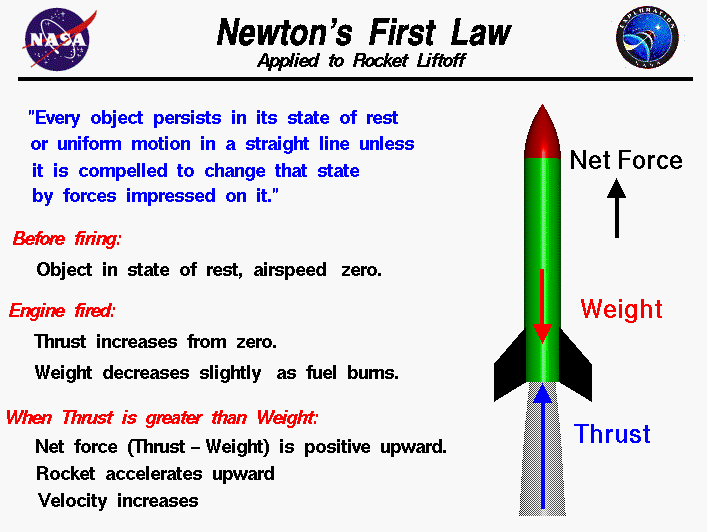
Newton's Third Law: Action and Reaction
Now let's move to Newton's Third Law. This law is famous for its elegant phrasing: "For every action, there is an equal and opposite reaction."
But what does this mean in practice? It means that forces are not isolated events; they are interactions between two objects. If you push on a wall, the wall pushes back on you with the same amount of force.
Let's return to the bicycle example to see how this works.
Newton's 3 Laws, with a bicycle - Joshua Manley
Let's watch the next segment of the TED-Ed video, which explains the Third Law.
Watch from 1:54 to 3:04. Notice how the forward motion of the bicycle is a 'reaction' to the tires pushing backward on the ground.
A Common Point of Confusion
A frequent question about the Third Law is: "If the forces are equal and opposite, why doesn't everything just cancel out? Why does anything move at all?"
This is a fantastic question, and answering it correctly is key to truly understanding the law. The answer lies in realizing that the "action" and "reaction" forces act on different objects.
Let's explore this with a reading that gives several clear examples and directly addresses this misconception.
Newton’s Laws of Motion Made Easy - With Daily Life Examples
This article from Uniboardhub gives several real-life examples and clarifies a common misunderstanding about the Third Law.
Read the section titled Newton’s Third Law of Motion - The Law of Action and Reaction. Pay close attention to the 'Misconception Alert' and the examples of jumping off a boat and walking.
Think about the walking example from the article:
- Action: Your foot pushes backward on the ground.
- Reaction: The ground pushes forward on your foot.
You move forward because the ground is pushing on you. The backward push on the ground has an effect on the Earth, but because the Earth's mass (and thus its inertia) is so enormous, its resulting acceleration is practically zero. The forces don't cancel because one acts on you and the other acts on the Earth.
Connecting the Laws to Your Interests
You mentioned an interest in robotics and programming. These foundational laws are not just abstract physics concepts; they are essential for these fields.
- A robot arm needs to apply a precise force to overcome an object's inertia (First Law) and move it.
- When a wheeled robot moves, its motors cause the wheels to push backward on the floor, and the floor's reaction force pushes the robot forward (Third Law).
- Game developers use physics engines that are built on these laws to make character movements, vehicle handling, and object interactions look realistic.
The Uniboardhub article you just looked at has a great section on this.
Newton’s Laws of Motion Made Easy - With Daily Life Examples
For a quick look at how these laws apply in the real world, check out this section from the same article.
Briefly read the section Practical Applications in Careers and Technology. It lists several fields, including robotics and game development, where these laws are applied daily.
Conclusion
In this first lesson, we've unpacked two of the most fundamental laws of nature.
Key Takeaways:
- Newton's First Law (Inertia): An object’s motion (its velocity) does not change unless a net external force acts on it. Inertia is the property of resisting this change, and mass is its measure.
- Newton's Third Law (Action-Reaction): Forces always occur in pairs. When object A exerts a force on object B, object B simultaneously exerts an equal and opposite force on object A. These forces act on different objects and therefore do not cancel each other out.
You've taken a great first step in building your understanding of physics from the ground up. These principles are the "why" behind motion.
Preview of the Next Lesson:
Now that we've established the conditions for changing motion, our next lesson will introduce kinematic equations. These are the mathematical tools that allow us to describe and predict an object's motion (like its position and velocity) when it's undergoing constant acceleration. We'll start connecting the "why" (forces) to the "how" (the resulting motion).