Introduction
Hello! In our last lesson, we established a foundational rule for all collisions in isolated systems: total momentum is always conserved. We saw that this is a direct consequence of Newton's Third Law—the equal and opposite forces between colliding objects ensure that any momentum lost by one object is gained by the other.
But what about kinetic energy? If you drop a rubber superball, it bounces back to nearly the same height. If you drop a ball of clay, it just splats on the ground. Both are collisions, and in both, momentum is conserved (between the ball and the Earth). However, the kinetic energy story is clearly different.
Today, we'll explore this difference. You will learn to distinguish between elastic and inelastic collisions based on whether kinetic energy is conserved. This is not just a classification exercise; it's a crucial distinction that allows us to predict the outcomes of collisions, from subatomic particles to the design of a robotic gripper.
1. The Core Distinction: Conservation of Kinetic Energy
The fundamental difference between collision types lies in what happens to the system's total kinetic energy.
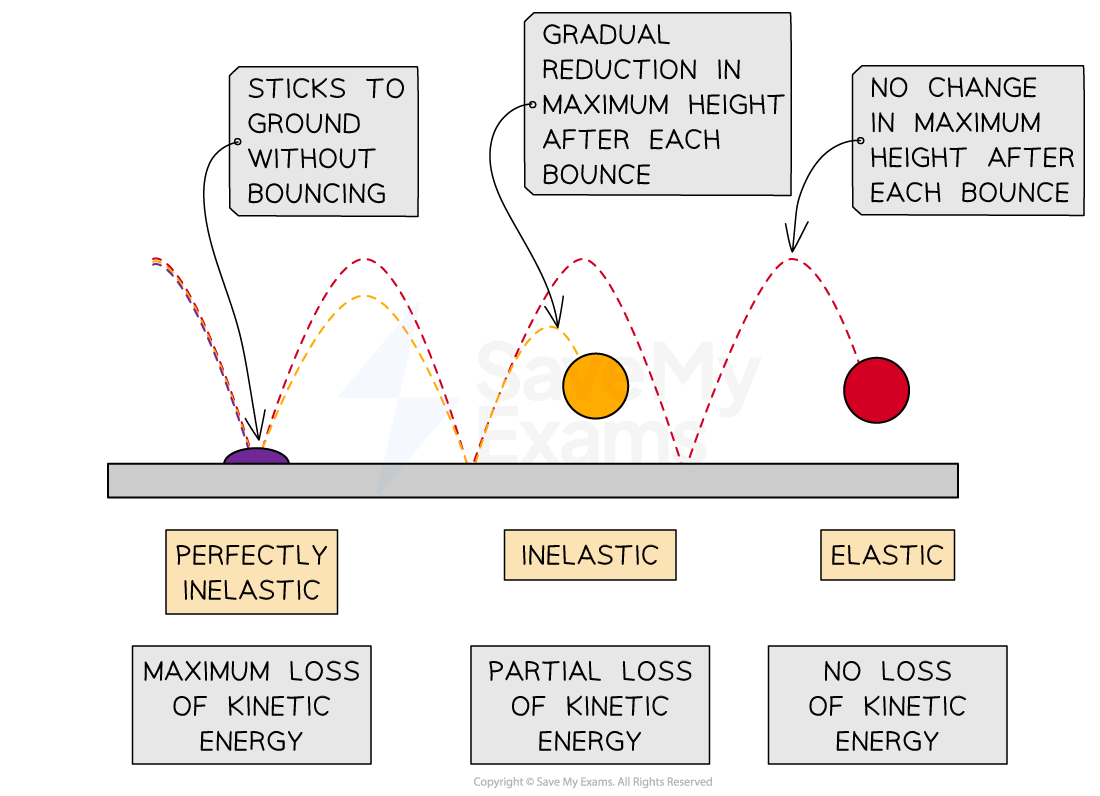
- An elastic collision is a collision where the total kinetic energy of the system is conserved. The total kinetic energy before the collision is equal to the total kinetic energy after the collision.
- An inelastic collision is a collision where the total kinetic energy is not conserved. Some kinetic energy is transformed into other forms of energy.
Let's watch a video that introduces these definitions clearly.
Elastic and inelastic collisions | Impacts and linear momentum | Physics | Khan Academy
This segment from Khan Academy Physics lays out the foundational definitions of elastic and inelastic collisions using a simple, clear example.
Please watch the first 2 minutes and 37 seconds of the video (0:00 - 2:37). Focus on the mathematical statement that defines an elastic collision: \sum KE_{initial} = \sum KE_{final}
To summarize the key point from the video:
For a two-object collision, the condition for it to be elastic is:
If this equality does not hold (specifically, if the final kinetic energy is less than the initial), the collision is inelastic.
The following images provide excellent visual representations of this concept.

2. Where Does the "Lost" Energy Go?
In an inelastic collision, kinetic energy isn't truly "lost"—it's transformed. The law of conservation of energy still holds true, but the energy changes from the macroscopic kinetic energy of the objects' motion to other forms.
Let's continue with the Khan Academy video to understand this transformation process.
Elastic and inelastic collisions | Impacts and linear momentum | Physics | Khan Academy
This next segment explains what happens to the kinetic energy in an inelastic collision. It provides a microscopic view of how energy is converted into thermal energy.
Watch from 2:37 to 6:09. Pay attention to the analogy of atoms being connected by springs. When the object deforms, this causes the 'springs' to vibrate, which is what we perceive as heat (thermal energy).
The main takeaway is that in an inelastic collision, macroscopic kinetic energy is converted into:
- Thermal Energy (Heat): The random vibration of atoms and molecules within the colliding objects increases.
- Sound Energy: The collision creates pressure waves in the air that we hear as sound.
- Permanent Deformation: Energy is used to bend metal, break bonds, and permanently change the shape of the objects (like the crumpled zones of a car).
A special type of inelastic collision is a perfectly inelastic collision, where the maximum possible amount of kinetic energy is lost. In this case, the objects stick together after the collision and move with a single, common final velocity.
3. Why is Momentum Conserved but Kinetic Energy Isn't?
This is a deep and important question that gets to the "first principles" you're interested in. We know momentum is conserved in all isolated collisions, but kinetic energy is not. Why the difference? The answer lies in the definitions of impulse (which changes momentum) and work (which changes kinetic energy).
Why is Energy Lost in Inelastic Collisions but Momentum is Conserved
This video from INTEGRAL PHYSICS gives a brilliant explanation by linking the concepts back to forces, time, and distance. It directly addresses why momentum conservation is more robust than kinetic energy conservation.
Watch the entire video (about 4 minutes). It's dense but very insightful. Focus on this key contrast: Impulse = Force × Time. The forces are equal and opposite (Newton's 3rd Law) and the interaction time is identical for both objects. Thus, the impulses are equal and opposite, and the total momentum change is zero. Work = Force × Distance. Even though the forces are equal, the distances over which those forces are applied during the collision are generally not equal. Therefore, the work done on each object is not equal and opposite, and there is a net change in the system's kinetic energy.
To add another perspective, consider the nature of momentum and energy themselves. Momentum is a vector, while kinetic energy is a scalar.
In an inelastic collision, when macroscopic kinetic energy is converted to microscopic thermal energy, the atoms vibrate randomly in all directions.
- The microscopic momenta are vectors pointing in random directions, so they tend to cancel each other out. There is no net change in the system's total momentum.
- The microscopic kinetic energies are scalars. They have no direction, so they simply add up. This new microscopic kinetic energy comes at the expense of the macroscopic kinetic energy of the objects.
This is why you can lose kinetic energy to heat without violating the conservation of momentum.
4. How to Tell the Difference: A Practical Check
So, how do you determine if a real collision is elastic or inelastic? You can't just assume that because objects bounce off each other, the collision is elastic. You have to check the numbers.
Elastic and inelastic collisions | Impacts and linear momentum | Physics | Khan Academy
Let's return to the Khan Academy video for a numerical example. This will show you how to calculate the total kinetic energy before and after a collision to definitively classify it.
Watch the segment from 6:09 to 10:44. Follow the calculation step-by-step. Note the important conclusion: even though the objects 'bounced' apart, the collision was highly inelastic because a large amount of kinetic energy was lost.
The Procedure:
- Calculate the total initial kinetic energy of the system: .
- Calculate the total final kinetic energy of the system: .
- Compare them.
- If , the collision is elastic.
- If , the collision is inelastic.
In the real world, no macroscopic collision is perfectly elastic. However, collisions between very hard objects, like billiard balls or steel bearings, come very close, and we can often model them as being perfectly elastic.
Conclusion
Today, you've learned the critical difference between elastic and inelastic collisions. This distinction isn't arbitrary; it's rooted in the conservation of kinetic energy and helps us understand the physics of everything from a bouncing ball to a car crash.
Key Takeaways:
- Collisions are classified based on the conservation of kinetic energy.
- Elastic collisions conserve both momentum and kinetic energy.
- Inelastic collisions conserve momentum but do not conserve kinetic energy. The "lost" kinetic energy is transformed into other forms like heat, sound, and deformation.
- Perfectly inelastic collisions are those where the objects stick together, resulting in the maximum loss of kinetic energy.
- Momentum is conserved in all isolated collisions because it's a vector and internal forces/impulses cancel out. Kinetic energy is a scalar and is not always conserved because the work done by internal forces does not necessarily cancel out.
Preview of the Next Lesson:
Now that we can classify collisions, our next step is to solve them. In the next lesson, we will focus on one-dimensional inelastic collisions. We'll start with perfectly inelastic collisions (where objects stick together), as they are the most straightforward to solve using the principle of momentum conservation. This will be our first step in applying these powerful conservation laws to predict the outcome of interactions.