Introduction
Hello! In our last lesson, we drew a clear line between elastic and inelastic collisions. The key difference, as we discovered, is what happens to kinetic energy. While momentum is conserved in any isolated collision, kinetic energy is only conserved in elastic ones. In inelastic collisions, some kinetic energy is transformed into heat, sound, or deformation.
Today, we'll put that knowledge into practice. We're going to focus on a specific, and very common, type of collision: the perfectly inelastic collision, where objects collide and stick together. Your goal for this lesson is to learn how to apply the principle of conservation of momentum to solve for the outcome of these one-dimensional collisions. This is a powerful "first principles" tool that allows us to predict how systems will behave after an impact, without needing to know the complex details of the collision forces themselves.
1. The Equation for Perfectly Inelastic Collisions
When objects collide and stick together, they move as a single unit with a common final velocity. This simplifies our analysis greatly.
Let's start with the general formula for conservation of momentum for a two-object system:
Here, represents mass, represents velocity, the subscripts 1 and 2 denote the two objects, and the subscripts and denote initial (before) and final (after) states.
In a perfectly inelastic collision, the objects merge. This means their final velocities are identical: . We can simply call this common final velocity .
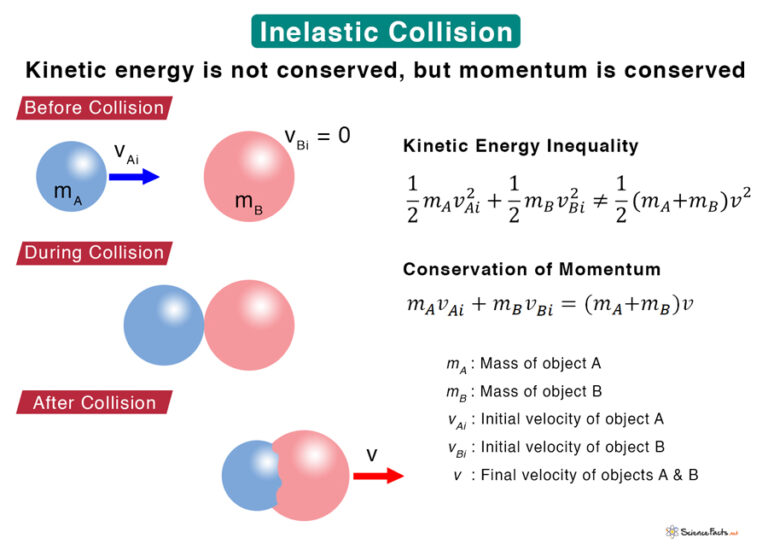
Because the final velocities are the same, we can rewrite the conservation of momentum equation.
8.3 Elastic and Inelastic Collisions
The following text from OpenStax Physics clearly explains how this shared final velocity simplifies the momentum equation for perfectly inelastic collisions.
Please read the section titled 'Inelastic Collisions'. Focus on how the general conservation of momentum equation is simplified for the case where objects stick together. You can stop reading at the 'Teacher Support' box.
As the text shows, by factoring out the common final velocity , the equation becomes:
This is the central equation we will use to solve one-dimensional inelastic collision problems. It directly relates the initial state of the system to the final state.
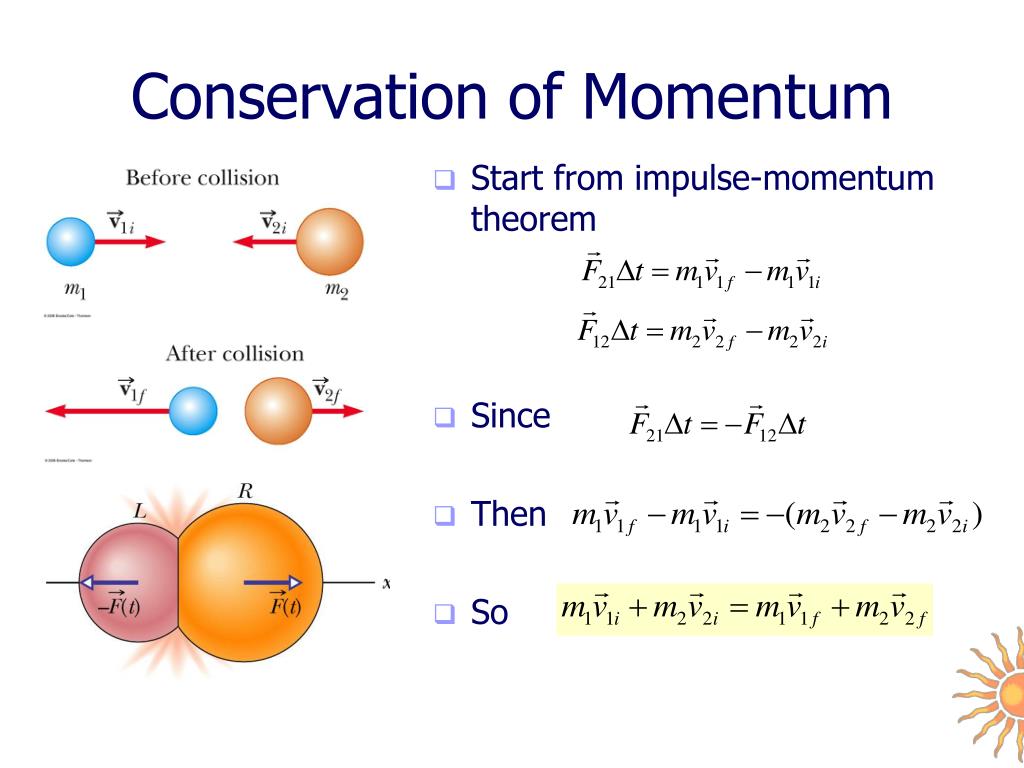
To quickly revisit the "first principles" question of why momentum is conserved, remember that it's a direct consequence of Newton's Third Law.
2. Worked Example 1: A Puck and a Goalie
Let's apply our equation to a classic scenario: a moving object colliding with a stationary one. This is a great starting point for seeing the problem-solving process in action.
Problem: An ice hockey goalie is at rest on the ice. A hockey puck is shot towards him. He catches the puck, and they both slide backward together. What is their velocity after the catch?
Calculating Velocity: Inelastic Collision of a Puck and a Goalie
This worked example from OpenStax provides a step-by-step solution to the hockey goalie problem. It's a perfect illustration of how to use our new equation.
Read the 'Worked Example' section about the puck and goalie. Pay close attention to how the known values are identified and substituted into the simplified momentum equation to solve for the final velocity, v'.
Let's break down the strategy used in the example:
-
Identify the system and collision type: The system is the {puck + goalie}. Since they stick together, it's a perfectly inelastic collision. We can assume the net external force is zero (friction is negligible for the brief moment of impact), so momentum is conserved.
-
Define a coordinate system: Let's say the initial direction of the puck is the positive direction.
-
List the knowns and unknowns:
- Puck mass () = 0.150 kg
- Puck initial velocity () = +35 m/s
- Goalie mass () = 70 kg
- Goalie initial velocity () = 0 m/s
- Final velocity () = ?
-
Apply the conservation of momentum equation:
Since , the equation simplifies to: -
Solve for the unknown:
-
Substitute and calculate:
The positive result confirms that the goalie and puck move in the same direction the puck was originally traveling.
3. Worked Example 2: A Head-On Collision
Now, let's consider a case where both objects are moving initially. This introduces the importance of correctly using positive and negative signs to represent direction.
Problem: Two football players are running directly towards each other. They collide and stick together. What is their velocity immediately after the collision?
[PDF] TOPIC: MOMENTUM & COLLISIONS
This document from the University of Waterloo provides another excellent worked example, this time involving a head-on collision. This will help you practice managing directional signs.
First, briefly review the section 'INELASTIC VS. ELASTIC COLLISIONS' to reinforce the definition. Then, carefully study 'PRACTICE PROBLEM #2' about the two football players. Focus on how a coordinate system is established (positive and negative directions) and how the negative initial velocity of the second player is used in the momentum equation. Also, notice the calculation of kinetic energy, which proves energy was lost.
The key step in this problem is setting up the coordinate system. Let's say Player 1 is moving to the right, which we'll define as the positive x-direction.
-
Define a coordinate system: Right is positive (+x), left is negative (-x).
-
List the knowns and unknowns:
- Player 1 mass () = 95 kg
- Player 1 initial velocity () = +3.75 m/s
- Player 2 mass () = 111 kg
- Player 2 initial velocity () = -4.10 m/s (crucial negative sign!)
- Final velocity () = ?
-
Apply the conservation of momentum equation:
-
Solve for the unknown:
-
Substitute and calculate:
The negative sign in the answer is significant. It tells us that after the collision, the combined mass of the two players moves to the left (in the negative x-direction), because the second, heavier player had more initial momentum.
4. Application to Robotics and Programming
You mentioned an interest in robotics and programming, and this concept is directly applicable.
-
Robotics: Imagine a robotic arm designed to catch a moving part on an assembly line. This is a perfectly inelastic collision. The robot's control system must use the conservation of momentum principle to calculate the force its motors need to apply to handle the combined momentum of the arm and the caught object. Similarly, when a drone or spacecraft docks with a station, engineers use these exact equations to predict the post-docking velocity and ensure a safe connection.
-
Programming: The equation is an algorithm. You could easily write a computer function that accepts the masses and initial velocities as input parameters and returns the final velocity. This is precisely how physics engines in games, simulators, and scientific modeling software would simulate an inelastic collision between two objects.
Conclusion
You have now learned how to analyze and solve one-dimensional, perfectly inelastic collisions. By applying the law of conservation of momentum, you can predict the final velocity of objects that collide and stick together.
Key Takeaways:
- In a perfectly inelastic collision, colliding objects stick together and move with a single common final velocity, .
- The primary tool for solving these problems is the conservation of momentum equation, simplified to:
- Establishing a coordinate system and being consistent with positive and negative signs for direction is essential, especially in head-on collisions.
- Kinetic energy is always lost in these collisions, being converted into other forms of energy.
Preview of the Next Lesson:
We've mastered the case where objects stick together. But what happens when they bounce off each other? In the next lesson, we will tackle one-dimensional elastic collisions. In these collisions, both momentum and kinetic energy are conserved. This will give us a system of two equations, allowing us to solve for the two different final velocities of the objects after they rebound.