Introduction
Hello! In our last lesson, we explored the Work-Energy Theorem, which states that the net work done on an object equals the change in its kinetic energy (). We saw this in action with examples like a falling ball (where gravity does positive work, increasing KE) and a braking car (where friction does negative work, decreasing KE).
This brought up a crucial question: when friction does negative work and an object's kinetic energy decreases, where does that energy go? It doesn't just vanish. To answer this, we need to understand that not all forces behave the same way when it comes to energy.
Today's lesson will address this by explaining the difference between conservative forces (like gravity) and non-conservative forces (like friction). Understanding this distinction is the key that unlocks one of the most powerful ideas in physics: the conservation of energy.
1. The Core Difference: Path Independence
The fundamental difference between these two types of forces lies in the work they do as an object moves from a starting point (A) to an ending point (B).
- A force is conservative if the work it does on an object is independent of the path taken between points A and B. It only depends on the start and end positions.
- A force is non-conservative if the work it does depends on the specific path taken.
This image provides a great visual summary of this core idea.
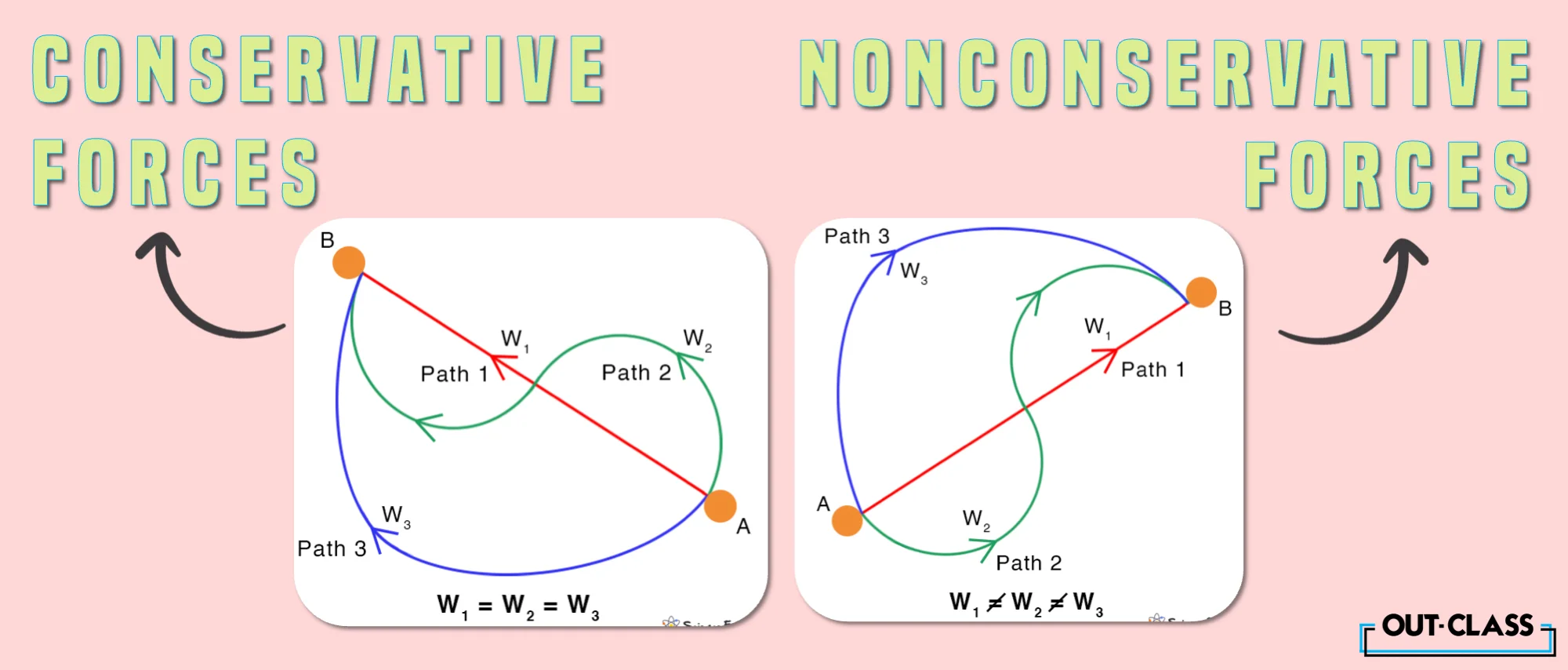
Let's watch a video that brings this concept to life with clear demonstrations.
8.01x - Module 14.04 - Conservative and Non Conservative Forces.
The legendary MIT physics professor Walter Lewin provides a fantastic, intuitive demonstration of conservative and non-conservative forces. Pay close attention to how he defines each type and illustrates them using gravity and friction.
Please watch the video from the beginning until 7:42. You'll see: A definition of conservative forces using gravity as an example (path independence). A definition of non-conservative forces using friction. A hands-on demonstration showing why the work done by friction is path-dependent.
As Professor Lewin demonstrated, the work done by gravity only depends on the change in height (), not the route you take. In contrast, the work done by friction depends directly on the length of the path. A longer path means more work done by friction, which always opposes the motion.
2. Why the Difference Matters: Storing vs. Losing Energy
So, the work is path-dependent for one type and not the other. Why is this so important? It comes down to what happens to the energy involved.
Conservative Forces and Potential Energy
When you do work against a conservative force, that energy is stored and can be fully recovered. This stored energy is called potential energy (PE).
- Example (Gravity): When you lift a book from the floor to a shelf, you do positive work against the conservative force of gravity. This work isn't lost; it's stored as gravitational potential energy. If the book falls, gravity does work on the book, converting that stored potential energy back into kinetic energy.
A key property of a conservative force is that the work it does around any closed path (starting and ending at the same point) is zero. Lifting a book 1 meter up and then placing it back down results in zero net work done by gravity.
Non-Conservative Forces and Energy Dissipation
When work is done by or against a non-conservative force, mechanical energy is dissipated—it is converted into other forms that are not easily recoverable, like heat or sound.
- Example (Friction): When you push a box across a rough floor, the work done by friction converts kinetic energy into heat. You can feel this if you rub your hands together quickly. That energy is lost from the mechanical system. If you push the box from A to B and then back to A, the work done by friction is not zero. Friction opposes the motion in both directions, so it does negative work on the way there and on the way back, continuously removing energy from the system.
Because the energy is dissipated, we cannot define a potential energy associated with non-conservative forces.
Let's watch a short video that formally connects these ideas.
Conservative and Non Conservative forces | Work, Energy & Power | Grade 11 | Physics | Khan Academy
This Khan Academy video clearly defines the link between conservative forces and potential energy, which is a concept you were interested in understanding from 'first principles'.
Watch the first segment from 0:00 to 1:45, which defines conservative forces and introduces their relationship to potential energy. Then, skip ahead and watch from 5:08 to 5:54 to see the corresponding definition for non-conservative forces.
3. Formal Definitions and Examples
To solidify your understanding, let's review the formal definitions and some key examples in a text format.
Conservative and Non-Conservative Forces
This webpage from University Physics provides a concise summary of the concepts we've discussed. It reinforces the definitions and the critical link between conservative forces and potential energy.
Please read the following parts of the text: The introductory paragraph (starting 'In Potential Energy...'). The section with the heading 'The work done by a conservative force is independent of the path...'. The section beginning with 'Before leaving this section, we note that non-conservative forces do not have potential energy...'. Focus on the conceptual explanation that the force can be found from the derivative of the potential energy (F_l = -dU/dl). This is the mathematical 'first principle' behind the relationship.
Here is a helpful summary table that pulls everything together.

4. Connection to Robotics
You mentioned an interest in robotics, and these concepts are crucial in that field.
-
Conservative Forces in Robotics:
- Gravity: When a robotic arm lifts a payload, its motors must do work against the conservative force of gravity. Engineers calculate this work to determine the necessary motor power. The energy is stored as potential energy in the payload.
- Springs: Many robots use springs in their joints or grippers. A spring force is conservative. Compressing a spring stores potential energy, which can be released to perform a task, like clamping onto an object.
-
Non-Conservative Forces in Robotics:
- Friction: This is a major concern. Friction in a robot's gears and joints is a non-conservative force that dissipates energy as heat. This reduces the robot's efficiency, as the motors must do extra work to overcome friction. It's also a reason why robotic components need cooling systems.
- Air Drag: For fast-moving robots or drones, air drag is a significant non-conservative force that the motors must constantly work against.
- Motor Inefficiency: The electrical motors themselves are not perfectly efficient. They convert some electrical energy into heat instead of useful work. This is another example of a non-conservative, dissipative process.
Understanding these forces allows a robotics engineer to design an energy-efficient system, calculate how much power it needs, and manage the heat it will generate.
Conclusion
Today, we've drawn a clear line between two fundamental types of forces, answering the question of where "lost" energy goes.
Key Takeaways:
- Conservative Forces (e.g., gravity, spring force) do work that is path-independent. The energy they act against is stored as potential energy and is recoverable. The work done over a closed path is zero.
- Non-Conservative Forces (e.g., friction, air drag) do work that is path-dependent. They dissipate mechanical energy, usually as heat, and this energy is not easily recovered. The work done over a closed path is not zero.
- The ability to define a potential energy function is a unique and defining characteristic of conservative forces.
Preview of the Next Lesson:
The distinction we learned today is incredibly powerful. If we have a system where only conservative forces (like gravity) are doing work, then the total amount of mechanical energy (kinetic + potential) must remain constant. This is the Principle of Conservation of Mechanical Energy. In our next lesson, we will use this principle to solve complex motion problems in a surprisingly simple way.