Introduction
Hello! In our last lesson, we established a crucial distinction between conservative forces, like gravity, and non-conservative forces, like friction. We saw that because gravity is a conservative force, the work done against it can be stored as gravitational potential energy ().
This insight unlocks one of the most powerful problem-solving tools in physics. If we have a system where the only force doing work is gravity (meaning no friction or other external pushes and pulls), then the total mechanical energy doesn't change. It simply transforms between kinetic and potential forms. This is the Principle of Conservation of Mechanical Energy.
Today, we will learn how to apply this principle to solve problems involving objects in free fall and pendulums. You'll see how this energy-based approach can be much more direct than using the kinematic equations we studied earlier.
1. The Principle of Conservation of Mechanical Energy
First, let's formally define our terms. Mechanical energy () is the sum of an object's kinetic energy () and potential energy ().
The principle of conservation of mechanical energy states that if the net work done by non-conservative forces is zero, the total mechanical energy of a system remains constant. In other words, the initial mechanical energy is equal to the final mechanical energy:
This means energy isn't lost; it just changes form. Potential energy can be converted into kinetic energy (like a falling object speeding up), and kinetic energy can be converted back into potential energy (like an object thrown upwards slowing down).
Let's watch a video that demonstrates this fundamental principle.
Introduction to Conservation of Mechanical Energy with Demonstrations
This video from Flipping Physics provides an excellent introduction to the conservation of mechanical energy. It uses a demonstration of a falling mass to show how energy is converted from potential to kinetic, while the total amount stays the same.
Please watch from 0:32 to 7:04. Pay close attention to: How initial potential and kinetic energies are calculated for the dropped mass. The graphs and tables that show potential energy decreasing as kinetic energy increases, while the total mechanical energy remains constant. The crucial conditions under which mechanical energy is conserved (i.e., when the work done by friction and applied forces is zero).
As the video clearly explained, mechanical energy is only conserved when we can ignore non-conservative forces like friction and air resistance, and when there are no external forces adding or removing energy from the system. In many physics problems, these are reasonable assumptions to make.
2. Application 1: Objects in Free Fall
The simplest application of energy conservation is an object falling under gravity. Imagine a rock being dropped from a cliff.
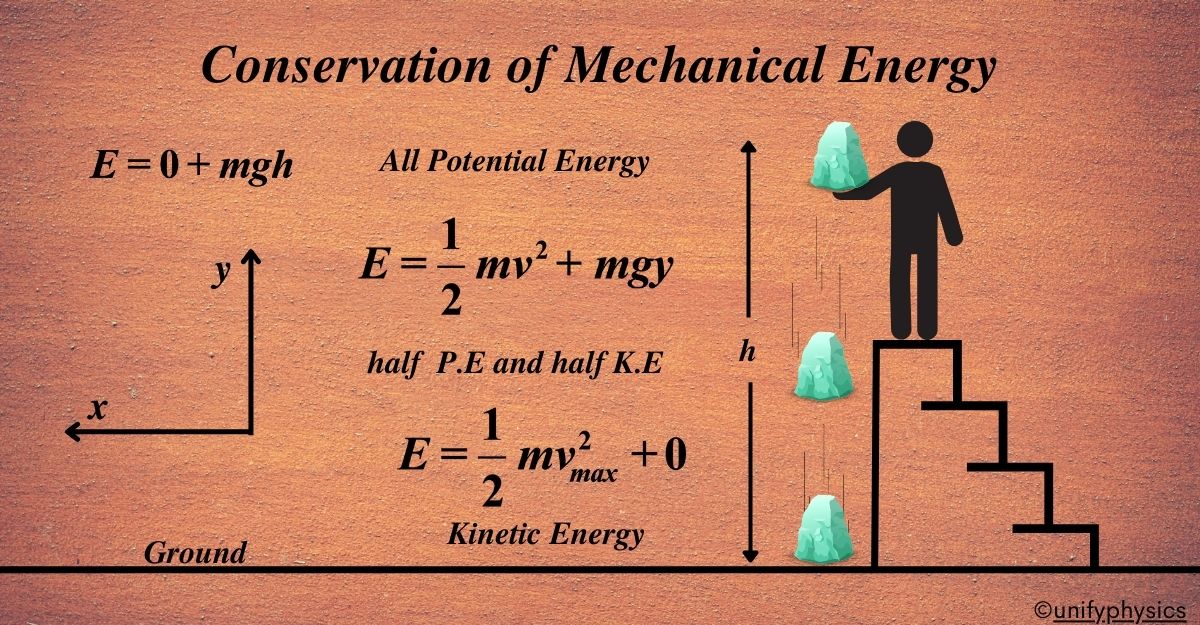
This energy transformation provides a powerful way to solve problems. Before we jump into an example, let's establish a clear problem-solving strategy.
Problem-Solving Strategy: Conservation of Energy
This resource from University Physics Volume 1 outlines a clear, step-by-step method for applying the conservation of energy principle. Following these steps will help you structure your thinking and solve problems consistently.
Read the 5-step strategy under the heading 'Problem-Solving Strategy: Conservation of Energy'. This will be our guide for the problems we solve today.
Now, let's use that strategy to analyze a classic, fun example: a roller coaster.
Conservation of Energy Physics Problems
This video from The Organic Chemistry Tutor solves a typical roller coaster problem. Notice how it uses the conservation of energy equation to find the coaster's speed at different points without needing to know anything about time or acceleration.
Watch the segment from 18:58 to 25:42. Observe how the equation PE_i + KE_i = PE_f + KE_f is set up and simplified for each part of the problem (finding speed at points B, C, and D).
You might have noticed something interesting in that video: the mass () of the roller coaster was cancelled out in the equations. This means, in the absence of friction, the final speed of the coaster at any point depends only on its initial height and speed, not its mass!
3. Application 2: The Simple Pendulum
A pendulum is another classic example where mechanical energy is conserved (if we ignore air resistance). As it swings, it continuously trades potential energy for kinetic energy and back again.

This continuous, graceful conversion of energy is what the host of the Flipping Physics video called the "dance of the pendulum."
Let's see how to apply the conservation principle to a pendulum problem. This involves a little bit of trigonometry to find the change in height, which is a common technique in physics.
Worked Example: Simple Pendulum
Let's return to the University Physics text. It features a perfectly worked-out example of a simple pendulum that shows how to calculate the speed at the bottom of the swing.
Read the example titled 'Simple Pendulum'. Focus on how the change in height, h, is calculated using the length of the string (L) and the angle ( heta). This is a key step. Follow the logic as they set up the energy conservation equation to solve for the final speed.
4. Practice Problem
Now it's your turn to apply the principle. Use the 5-step strategy we reviewed.
Problem: A child climbs a tree house and drops a 0.5 kg toy from rest. The toy falls 2.5 m to the grass below. Assuming air resistance is negligible, what is the toy's speed just before it hits the ground?
Your Steps:
- Identify the system: The toy and the Earth.
- Identify the forces: Only gravity does work (we assume negligible air resistance).
- Is mechanical energy conserved? Yes, because only a conservative force is doing work.
- Set up reference points: Let's set the final height (the grass) as the zero point for potential energy (). This means the initial height is m.
- Apply the conservation of energy equation:
Try to solve it from here.
Click here to see the solution
Let's plug in the values into our conservation equation:
- The toy is dropped from rest, so its initial velocity is zero (). This makes the initial kinetic energy .
- We set the final height to be zero, so . This makes the final potential energy .
The equation simplifies greatly:
Notice that mass () appears on both sides, so we can cancel it out.
Now, we solve for the final velocity, :
Plugging in the numbers ( and ):
So, the toy's speed just before hitting the ground is 7.0 m/s.
Conclusion
Today we've added a very powerful tool to our physics toolkit. By understanding how energy transforms between kinetic and potential forms, we can solve for speeds and heights without needing to calculate forces and accelerations over time.
Key Takeaways:
- Mechanical Energy is the sum of kinetic and potential energy: .
- The Principle of Conservation of Mechanical Energy states that if no work is done by non-conservative forces (like friction) or external forces.
- This principle allows us to relate an object's speed and height at two different points in its motion. For problems involving free-fall, pendulums, or frictionless slopes, this is often the easiest method of solving.
Preview of the Next Lesson:
We've discussed the amount of energy an object has and how it's transformed. But how quickly is that energy used or transferred? A powerful engine and a weak engine might both lift the same weight to the same height (doing the same work), but one does it much faster. In our next lesson, we will explore the concept of Power, which is the rate of doing work or transferring energy. This is a critical concept for understanding real-world applications, from car engines to the motors in a robotic arm.