Hello! Welcome to a new module in our physics journey. Having explored the world of forces and motion, we're now ready to look at these same ideas through a powerful new lens: energy.
Introduction
In the last module, we focused on Newton's Laws, using forces to calculate acceleration and predict motion. You learned to analyze complex situations, like a box sliding down a ramp with friction. That approach, based on forces, is fundamental to physics.
Now, we're starting the "Work, Energy, and Power" module. We'll discover an alternative way to analyze motion that doesn't always require thinking about vectors and acceleration directly. Instead, we'll use scalar quantities—work and energy—which can often make problem-solving much simpler.
Today's learning outcome is to define work done by a constant force and calculate it for forces applied at an angle to displacement. This concept is the gateway to understanding energy. For your interest in robotics, understanding work is key to quantifying how a motor or actuator transfers energy to a robot's arm to lift an object or to its wheels to move it across a room.
1. What is "Work" in Physics?
In everyday language, we use the word "work" for many things: homework, a job, or even just a difficult physical effort. In physics, however, the term "work" has a very precise definition. Let's start by clarifying what it is and what it isn't.
This video from the 'Professor Dave Explains' channel does an excellent job of distinguishing the scientific definition of work from the everyday one. It also introduces the basic formula.
Watch from the beginning to 1:36. Pay close attention to the three 'ingredients' needed for work to be done: a force, a displacement, and the force causing that displacement.
As the video explained, for work to be done on an object, two conditions must be met:
- A force must be exerted on the object.
- The object must be displaced (i.e., it must move) as a result of that force.
If you push against a wall with all your might, you might feel tired, but if the wall doesn't move, you've done zero work on the wall.
When the force is in the same direction as the displacement, the calculation is simple:
The standard unit for work is the Joule (J). One Joule of work is done when a force of one Newton displaces an object by one meter. So, .
2. When Force is Applied at an Angle
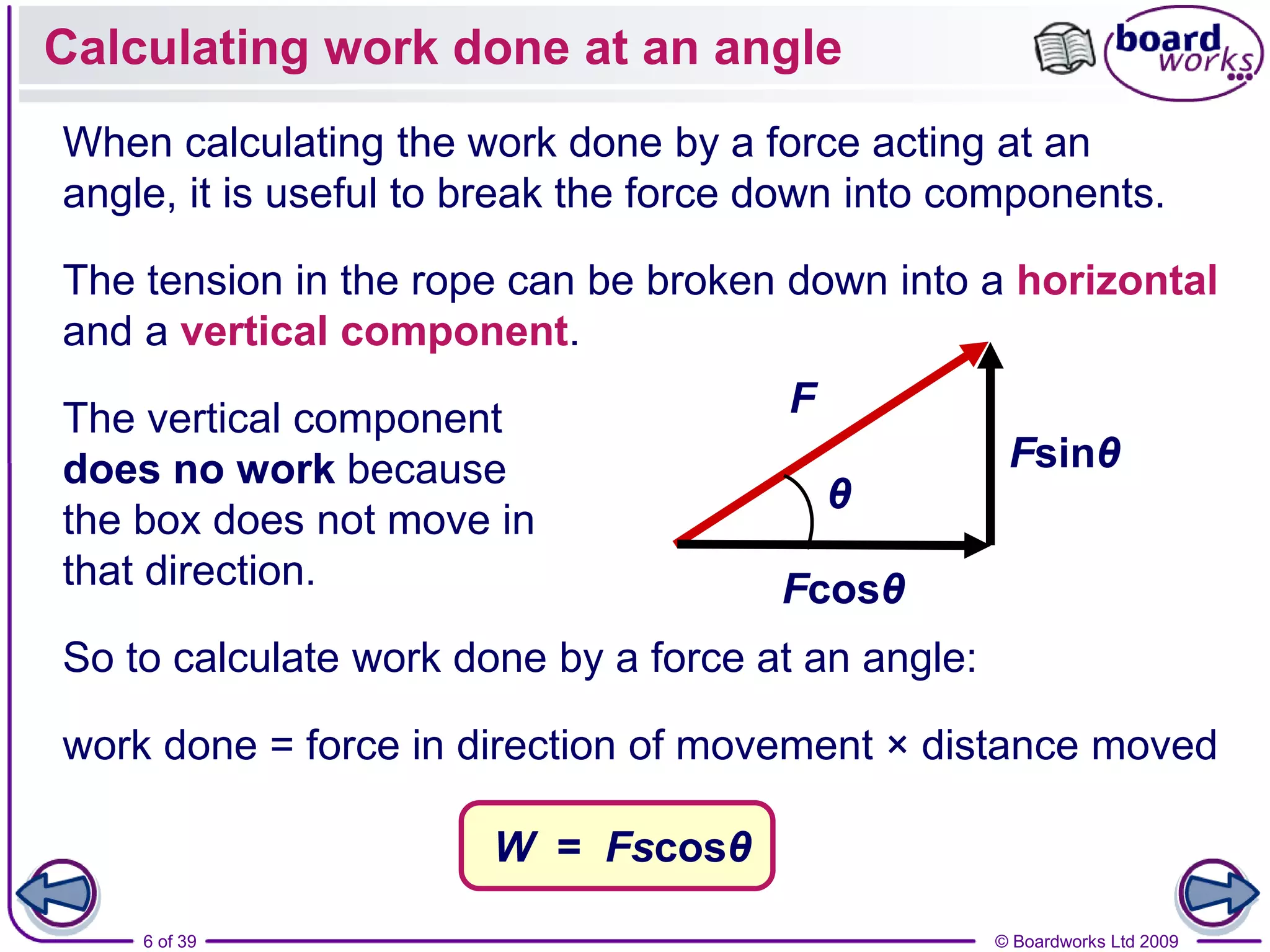
But what happens if you pull a wagon with a rope angled upwards? Not all of your force is helping to pull the wagon forward. Part of your force is pulling it upwards. This is where the angle becomes critical.
To handle this, we modify the work equation to include the angle, , between the force vector and the displacement vector.
The term mathematically isolates the component of the force that lies along the direction of displacement. As you know from breaking vectors into components, this is the only part of the force that "causes" the motion in that direction.
Let's dive a little deeper into the importance of this angle with a short reading.
Definition and Mathematics of Work
This article from 'The Physics Classroom' provides a clear, text-based explanation of the work equation and the crucial role of the angle, theta. It uses helpful scenarios to illustrate the concept.
Read the section titled 'Work Equation', starting just below the four quiz questions. Pay special attention to the three scenarios (A, B, and C) and the explanation of the waiter carrying the tray. This will solidify your understanding of why theta is so important.
The key takeaways from that reading are:
- Positive Work (): The force (or a component of it) is in the direction of motion. The force helps the object move.
- Zero Work (): The force is perpendicular to the motion. The force does not help or hinder the motion. The waiter pushing up on the tray while walking horizontally is the classic example. Since , the work done is zero.
- Negative Work (): The force (or a component of it) is opposite to the direction of motion. The force hinders the object's motion. Friction, for instance, does negative work on a sliding object. Since , the work is negative.
3. A Worked Example
Now let's see how to apply the formula in a straightforward problem.
Work Done By a Force - Incline Planes & Dot Product Formula - Physics
This clip from 'The Organic Chemistry Tutor' provides a very clear, step-by-step calculation for a block being pulled at an angle. It's a perfect demonstration of how to use the work formula.
Watch the first example, from the beginning to 1:42. Notice how the values for force, displacement, and the angle are identified and plugged directly into the equation.
The process is always the same:
- Identify the magnitude of the constant force, .
- Identify the magnitude of the displacement, .
- Identify the angle, , between the direction of the force and the direction of the displacement.
- Calculate .
4. Let's Practice
Time to try one yourself. Read the problem below and use the formula to find the solution.
Problem: A boy pulls his sister in a wagon for a distance of 30.0 m. He pulls on a rope with a constant force of 50.0 N. The rope makes an angle of 30.0° with the horizontal ground. How much work does the boy do on the wagon?
Take a few minutes to solve it on your own before checking the solution below.
Click here to see the solution
1. Identify the given values:
- Force,
- Displacement,
- Angle,
2. Choose the correct formula:
Since the force is applied at an angle to the displacement, we use:
3. Substitute the values and calculate:
We know that .
Answer: The boy does approximately 1299 Joules of work on the wagon.
Conclusion
In this lesson, you've taken the first step into the topic of energy by mastering the concept of work.
Key Takeaways:
- In physics, work is done when a force causes an object to be displaced.
- The work done by a constant force is calculated with the formula .
- The angle is always the angle between the force vector and the displacement vector.
- Work is a scalar quantity (it has magnitude but no direction) and is measured in Joules (J).
- Work can be positive (force aids motion), zero (force is perpendicular to motion), or negative (force opposes motion).
Preview of the Next Lesson:
We've learned how to calculate work, but what does that work accomplish? In our next lesson, we will answer that question by introducing the Work-Energy Theorem. You'll see that the net work done on an object is directly equal to the change in its energy of motion, a concept we will define as kinetic energy. This powerful theorem connects the world of forces directly to the world of energy.