Hello! Let's dive into the next part of our study of forces.
Introduction
In our last lesson, we calculated the acceleration of an object already sliding down a ramp, using the concept of kinetic friction (), the force that opposes motion. We saw that .
But what about a box that's just sitting on a ramp? What determines if it stays put or starts to slide? This is where a different kind of friction comes into play: static friction.
Today's lesson is all about this crucial difference. Our learning goal is to distinguish between static and kinetic friction and incorporate the friction model into 2D force problems. We'll learn how to predict whether an object will move and, if it does, what its acceleration will be. This is the key to understanding why some things grip and others slip. For a robot trying to climb a ramp, the difference between its wheels gripping the surface (static friction) and spinning out (kinetic friction) is everything!
1. Static vs. Kinetic Friction: What's the Difference?
Let's start by building a clear picture of these two types of friction.
Introduction to Static and Kinetic Friction by Bobby
This short video from Flipping Physics provides a great introduction to the microscopic origins of friction and the basic difference between static (not moving) and kinetic (moving) friction.
Watch from the beginning to 2:15, and then from 2:49 to the end (4:02). Focus on the definition of static vs. kinetic friction and the three rules about the direction of friction.
As the video explained, static friction prevents motion between surfaces at rest, while kinetic friction acts on surfaces that are sliding against each other. The direction of friction is always parallel to the surface and opposes the motion or attempted motion.
This animated image gives a simple visual for the two states:

The Mathematical Model
The biggest difference between the two is in their mathematical description.
-
Kinetic Friction () is straightforward. As we saw last lesson, its magnitude is constant for a given situation:
where is the coefficient of kinetic friction and is the normal force.
-
Static Friction () is more subtle. It's a responsive force. If you push lightly on a heavy desk, it pushes back lightly. If you push harder, it pushes back harder, up to a certain limit. For this reason, its magnitude is an inequality:
where is the coefficient of static friction.
The maximum possible static friction is the force that must be overcome to start the object moving. We call this the "breaking point" or threshold:
Typically, it's harder to get something moving than to keep it moving, which means that usually .
To see this principle in action, let's watch one more short clip.
Static Friction and Kinetic Friction Physics Problems With Free Body Diagrams
The concept of static friction "matching" the applied force can be tricky. This video from The Organic Chemistry Tutor uses a table to perfectly illustrate how the static friction force increases to meet an applied force until it hits its maximum value, at which point kinetic friction takes over.
Watch the segment from 3:24 to 7:45. Pay close attention to the 'static frictional force' column in the table and how its value changes in response to the 'applied force'.
To summarize the video's key point:
- If the applied force is less than or equal to , the object does not move. The static friction force will be exactly equal and opposite to the applied force.
- If the applied force is greater than , the object starts to move. The friction force is no longer static; it instantly drops to the lower, constant kinetic friction value, .
2. Applying the Full Friction Model
Now, let's put this all together to solve problems. The core of any friction problem is a two-step process:
- First, determine if the object moves. To do this, you compare the force trying to cause motion (like a push, or gravity on a ramp) with the maximum static friction, .
- Then, calculate the acceleration. If the object stays put, the acceleration is zero. If it moves, you use the kinetic friction force, , in Newton's Second Law ().
Example: A Box on a Horizontal Floor
Let's start with a horizontal surface.
Static Friction and Kinetic Friction Physics Problems With Free Body Diagrams
This video walks through a classic problem: finding the minimum force to move a box and then its acceleration once it's moving. This demonstrates the two-step process perfectly.
Watch the worked example from 7:45 to 12:18. Follow the steps for part (a) (finding the minimum force to slide) and part (b) (finding the acceleration with a larger force).
Let's break down the logic from the video:
- Part A: What is the minimum force to start sliding?
- Find N: On a flat surface with no vertical forces other than gravity and the normal force, , so .
- Find : The minimum force required to initiate movement must be equal to the maximum static friction: .
- Part B: What is the acceleration if the applied force is larger?
- Compare forces: The applied force (90 N) is greater than the (51.45 N), so the box will accelerate.
- Use kinetic friction: Since the box is moving, friction is now kinetic: .
- Apply Newton's Second Law: The net force in the x-direction is . You then solve for .
3. Friction on an Inclined Plane
Now let's return to the inclined plane, armed with our complete friction model. This is where your previous work on free-body diagrams comes together with today's concepts.
The key question is: Will an object at rest on a rough incline stay there, or will it slide?
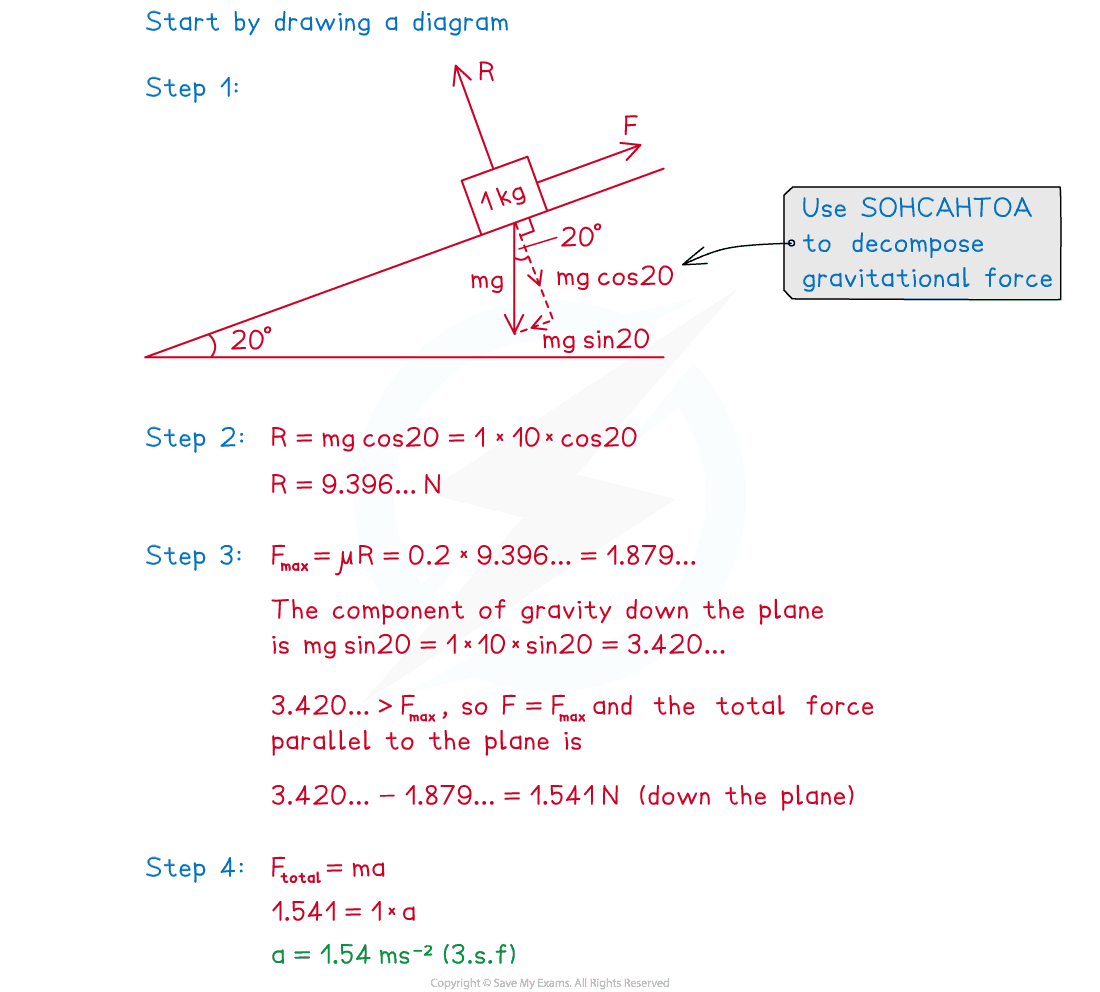
To answer this, we compare the force pulling the object down the ramp with the maximum static friction holding it in place.
- Force pulling it down the ramp: As we know from last lesson, this is the parallel component of gravity: .
- Maximum static friction: This is . And on an incline, . So, .
The decision is a direct comparison:
- If , the object stays put. Static friction's grip is strong enough.
- If , the object slides. Gravity's pull overcomes the friction.
Let's study a resource that walks through this decision-making process.
Intro to Incline Plane with Friction
This webpage from Pearson provides a concise summary and clear example of analyzing an object on a rough inclined plane. Focus on the logic of comparing the gravitational component to the maximum static friction.
Read the text under the section titled 'Intro to Incline Plane with FrictionVideo Summary'. It details the step-by-step calculation for a 10 kg block, from finding force components to comparing them to determine if the block moves, and finally calculating acceleration.
The example you just read is the core application for this topic. Here is a worked solution presented visually that summarizes this exact process. Study it carefully as a final reinforcement.
Conclusion
Today you've gained a complete understanding of the friction model, moving beyond just kinetic friction to include the crucial role of static friction.
Key Takeaways:
- Static friction () is a responsive force that prevents motion and has a maximum value: . It matches the applied force up to this limit.
- Kinetic friction () is a constant force that opposes the motion of sliding objects: .
- To solve any friction problem, you must first compare the force causing motion to the maximum static friction to determine if the object moves at all.
- On an incline, this comparison is between the parallel component of gravity () and the maximum static friction ().
This two-step analysis—Will it move? If so, how fast?—is fundamental in physics and engineering, whether you're designing brakes for a car, ensuring a satellite's components don't slip during launch, or programming a robot to navigate a complex environment.
Preview of the Next Lesson:
So far, we've analyzed the world through the lens of forces and acceleration. In the next module, we'll begin to look at motion from a different perspective: Energy. We will define concepts like Work and Kinetic Energy, and see how they provide a powerful alternative way to solve problems. We'll discover that friction plays a special role in the world of energy as a force that removes mechanical energy from a system, usually by turning it into heat.