Welcome to the first lesson of your course on transitioning to a DevOps role. We'll begin by building a solid foundation, exploring the "why" behind the practices and tools you'll be learning. With your extensive background in software test automation and CI/CD, you're already deeply familiar with some key components of the DevOps world. This lesson will help you place that experience within a broader philosophical framework.
Our goal is to explain the core principles that underpin the DevOps movement: collaboration, automation, continuous improvement, and feedback. Understanding these principles is the crucial first step in shifting from a specialist role, like test automation, to the holistic perspective required in DevOps.
Beyond the Buzzword: What is DevOps?
You've likely heard the term "DevOps" used in many different contexts, sometimes referring to a job title, a team, or a set of tools. At its heart, however, DevOps is a cultural philosophy. It began as a response to the friction and inefficiency created when development and IT operations teams work in isolated silos.
To get a feel for the origin of this movement, let's start with a short reading.
DevOps CALMS Framework: 5 key principles [+3 ways explained]
This article from ManageEngine provides an excellent historical context for DevOps and clarifies its purpose. It helps frame DevOps not as a goal in itself, but as a means to achieve better business outcomes.
Please read the first two main sections of the article. Start with the introduction, which explains the term's origin and Patrick Debois's foundational definition. Pay close attention to the concept of overcoming "the friction between silos." Then, continue to the section DevOps is NOT the goal, which frames the practice in terms of business objectives.
As you just read, the goal isn't "to do DevOps"; the goal is to deliver Better Value, Sooner, Safer, and Happier (BVSSH). DevOps is the collection of cultural philosophies, practices, and tools that enable this. The "wall of confusion" between development and operations is something you may have experienced from the testing and quality assurance perspective—long cycles, finger-pointing when bugs are found late, and a general disconnect between building the software and running it. DevOps aims to tear down that wall.
The Four Core Principles
While there are several models to describe DevOps, the philosophy can be distilled into four interconnected principles that directly address the learning outcome for this lesson. Many of these will resonate with your work in test automation, but here we will view them through a wider, end-to-end lens.
A popular framework that captures these ideas is CALMS: Culture, Automation, Lean, Measurement, and Sharing. We can map our four core principles directly onto this framework.
1. Collaboration and Sharing (Culture & Sharing)
This is the absolute cornerstone of DevOps. It's about fundamentally changing how people and teams interact. Instead of siloed teams handing off work "over the wall," DevOps fosters a culture of shared responsibility.

To dive deeper into this cultural shift, let's turn to another resource that breaks down this pillar.
4 Pillars Of DevOps Culture And Its Macro And Micro Benefits
This article by Octopus Deploy provides clear, concise definitions for the pillars of DevOps culture.
Please read the two subsections under "Pillars of DevOps culture and mindset." Start with Collaboration and open communication, and then continue to the next one, Shared responsibility and blameless mindset.
The concept of a "blameless mindset" is revolutionary for many organizations. When an incident occurs, the focus isn't on "who made the error?" but rather "what in our system or process allowed this error to happen, and how can we improve it?" This fosters psychological safety, encouraging people to innovate and report issues without fear.
The following short video provides a great summary of the CAMS model (a variation of CALMS), starting with Culture and ending with Sharing, which together form the collaboration pillar.
DevOps Principles - The C.A.M.S. Model
This video from the Coding Tech channel succinctly explains the CAMS model for DevOps principles.
Watch the segment on the Culture principle, which emphasizes breaking down silos and shared responsibility. Then, watch the explanation of the Sharing principle, which highlights transparency and collective intelligence.
2. Automation (Automation)
Your 16 years in software test automation place you at the forefront of this principle. You've seen firsthand how automating repetitive testing tasks frees up human intellect for more complex problem-solving, improves quality, and accelerates feedback. In DevOps, this principle is applied across the entire software delivery lifecycle.
This includes:
- Continuous Integration/Continuous Delivery (CI/CD): Automating the build, test, and deployment pipeline, something you are very familiar with using tools like Jenkins and GitLab CI.
- Infrastructure as Code (IaC): Automating the provisioning and management of infrastructure (servers, networks, databases) using code, which we will cover in-depth with Terraform.
- Configuration Management: Automating the configuration of software and systems, which we will explore with Ansible.
- Automated Monitoring and Alerting: Automatically gathering metrics and logs to observe system health and trigger alerts.
The goal of automation is to make processes repeatable, reliable, and scalable, minimizing the risk of human error and reducing toil. Let's hear a quick take on this from the same video.
DevOps Principles - The C.A.M.S. Model
Continuing with the video on the CAMS model.
Now, watch the section on the Automation principle. Notice how it connects automation directly to the practices of continuous integration and delivery.
3. Fast Feedback (Measurement)
How do we know if our changes are making things better or worse? How do we detect problems before they impact users? The answer lies in creating fast, high-quality feedback loops. As an automation expert, you live this principle daily: a failing test provides immediate feedback that a change has broken something.
DevOps extends this concept to the entire system:
- Automated Testing: Provides feedback on code quality.
- CI/CD Pipelines: Provide feedback on the viability of a build.
- Monitoring & Observability: Tools like Prometheus and Grafana provide real-time feedback on the health and performance of the application in production.
- User Analytics: Tracking user behavior provides feedback on whether a new feature is valuable.
This principle is about making data-driven decisions. The "M" in CALMS stands for Measurement. By measuring key metrics, teams can understand the impact of their work and identify areas for improvement.
DevOps Principles - The C.A.M.S. Model
Let's complete the CAMS model from the video.
Watch the final main segment on the Measurement principle. It highlights how measuring key performance indicators helps teams to continuously improve.
4. Continuous Improvement (Lean & Continuous Learning)
The final principle ties all the others together. DevOps is not a one-time project; it is a commitment to perpetual evolution. This is captured by the "L" (Lean) in CALMS, which focuses on eliminating waste and optimizing flow, and by the idea of a learning culture.
This principle is embodied by the "Three Ways of DevOps," a model popularized by the book The Phoenix Project.
- The First Way: Flow. Optimize the flow of work from left to right, from idea to production. This is about removing bottlenecks and delays.
- The Second Way: Feedback. Create fast and constant feedback loops from right to left, bringing information from production back into the development process.
- The Third Way: Continuous Learning and Experimentation. Create a culture of learning, risk-taking, and repetition to master the craft.
DevOps CALMS Framework: 5 key principles [+3 ways explained]
Let's revisit the article from ManageEngine to understand this framework.
Please find the section titled "The Three Ways of DevOps" and read the descriptions for all three ways. This model is a powerful way to think about continuous improvement.
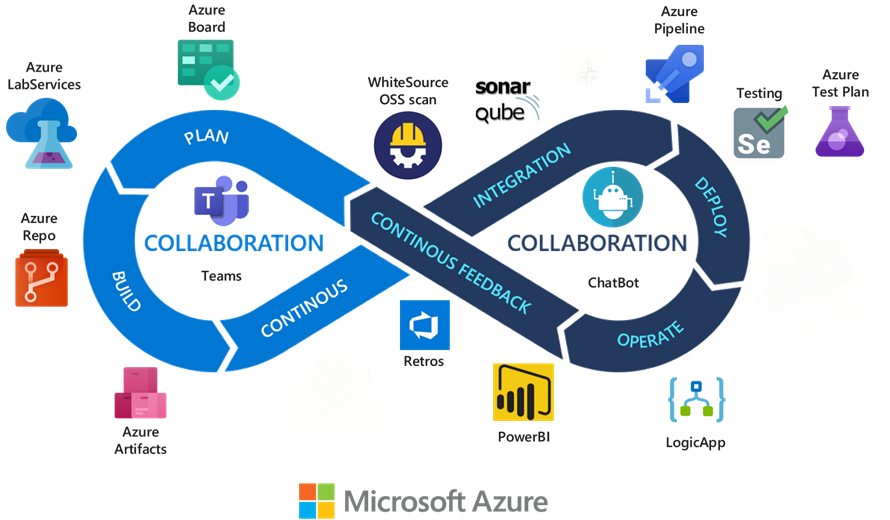
This relentless focus on learning and improving is what drives a DevOps culture forward. It's the engine of the infinity loop, ensuring that with each cycle, the process, the product, and the people get better.
Conclusion
In this lesson, we have established the foundational philosophy of DevOps by exploring its four core principles:
- Collaboration: Breaking down silos and fostering a culture of shared responsibility and blamelessness.
- Automation: Using tools to make processes reliable, repeatable, and efficient, reducing manual toil.
- Fast Feedback: Implementing measurement and monitoring to enable rapid, data-driven decision-making.
- Continuous Improvement: Creating a culture of learning and experimentation to constantly optimize the flow of value.
These principles are not separate ideas but a tightly integrated system. Collaboration is impossible without shared feedback. Meaningful automation requires feedback to know what to automate. And continuous improvement is the outcome of applying all these principles together.
Your background has given you a strong head start, particularly in automation and understanding the need for fast feedback. As we proceed, we will build on this foundation, connecting these principles to the specific practices and tools used to implement them in an Azure environment.
In our next lesson, we will take a closer look at the DevOps infinity loop and describe the stages of the modern software delivery lifecycle in more detail. This will provide a roadmap for the rest of the course, showing you where each new skill you learn fits into the larger picture.