Hello! Welcome back to our series on EIGRP.
In our last lesson, we delved into the mechanics of EIGRP's path selection, analyzing how it uses composite and wide metrics to calculate the Feasible Distance (FD) and elect a Successor. We saw that this sophisticated process allows EIGRP to choose the best path and even pre-calculate a loop-free backup, the Feasible Successor.
While having detailed information about every subnet is powerful, it can lead to very large routing tables in an enterprise network. This consumes memory and CPU resources, and can make troubleshooting complex. Today, we'll learn how to manage this complexity. Your learning outcome for this lesson is to configure and verify EIGRP route summarization at network boundaries. We'll explore how to aggregate groups of routes into a single, more general advertisement, which is a fundamental skill for building scalable and stable networks.
1. Why Summarize? The Benefits of Route Aggregation
Route summarization is the process of advertising a single, less-specific summary route to represent multiple, more-specific routes. Think of it like a postal system advertising "all mail for the 90210 zip code comes to this post office" instead of listing every single street address.
The primary benefits are:
- Scalability: Summarization shrinks routing tables on downstream routers. A router in the network core doesn't need to know about every single user subnet at a remote branch; it just needs a single summary route pointing toward that branch. This reduces memory and CPU load.
- Stability: This is a crucial benefit related to EIGRP's DUAL algorithm. Summarization creates a "query boundary." If a specific subnet within a summarized block fails, the summarizing router knows it has no other path for it. It will not send DUAL queries for that specific subnet to its other neighbors, because those neighbors only know about the summary route, not the specific one that failed. This contains the impact of a link failure to a smaller area of the network, preventing queries from propagating across your entire enterprise.
To learn more about how summarization limits the scope of queries, let's refer to a Cisco technical document.
Understand and Use the Enhanced Interior Gateway Routing Protocol
The document 'Understand and Use the Enhanced Interior Gateway Routing Protocol' from Cisco explains how summarization points act as barriers for EIGRP queries.
Read the section titled 'How Summarization Points Affect the Query Range'. You don't need to follow every step of the query/reply example, but focus on the main idea: the query for the specific 10.1.1.0/24 network stops at Router Four because it only knows about the summarized 10.0.0.0/8 route.
2. Auto-Summarization: A Legacy Feature
Historically, EIGRP supported auto-summarization. When enabled, a router would automatically summarize routes to their classful boundary (e.g., /8 for Class A, /16 for Class B) as they crossed from one major network to another.
While it sounds convenient, auto-summarization is highly problematic in modern, classless networks and is now disabled by default. It lacks control, can lead to suboptimal routing, and fails completely in designs with discontiguous networks. Because of this, it's considered a legacy feature that you should always ensure is disabled.
Let's watch a short video that clearly demonstrates this behavior and reinforces why we avoid it.
The video 'EIGRP Automatic Summarization' by StormWind Studios provides a concise explanation of how auto-summarization works and why it's generally not recommended in production networks.
Watch the video from 02:24 to 08:34. Pay attention to how the routing table changes when auto-summary is enabled on the central router. Note the strong recommendation at the end to use manual summarization for precise control.
The command to disable this feature (which should be your default practice) is issued within the EIGRP router configuration mode:
router eigrp 100
 no auto-summary
3. Manual Summarization: The Modern Approach
Manual summarization gives you, the network administrator, complete control over how and where routes are aggregated. This is the standard and recommended method.
Key characteristics of manual summarization:
- Configured per-interface: You apply a summary route to an outgoing interface. The summary is only advertised out of that specific interface.
- Total control: You define the exact summary address and subnet mask, allowing for efficient aggregation that matches your IP addressing plan.
- Loop prevention: When a router advertises a summary, it automatically creates a route for that summary pointing to a
Null0interface in its own routing table. This is a critical loop-prevention mechanism. If the router receives a packet destined for a network within the summarized range that doesn't actually exist, the packet will match theNull0route and be discarded, rather than being looped back.
The command to configure a manual summary in classic EIGRP mode is:
ip summary-address eigrp <as-number> <network-address> <subnet-mask>

For EIGRP Named Mode, the configuration is slightly different, applied under the address family interface configuration:
router eigrp MY_EIGRP
 !
 address-family ipv4 unicast autonomous-system 100
  !
  af-interface GigabitEthernet0/1
   summary-address 10.10.0.0 255.255.252.0
  exit-af-interface
 exit-address-family
4. Configuration and Verification Lab
Now, let's walk through a practical lab scenario to see these concepts in action. We'll start with a basic EIGRP configuration, observe the effects of the default auto-summary behavior (on older IOS versions), disable it, and then configure and verify a manual summary route.
CCNP Route (300 - 101) version 2.0: Summarization EIGRP LAB
The video 'Summarization EIGRP LAB' by Sikandar Shaik is a hands-on demonstration that covers all the key aspects of our lesson today.
Watch the video from 01:51 to 19:12. Follow these key stages: (01:51 - 07:48) Observe how the individual 13.x.x.x networks are automatically summarized to 13.0.0.0/8. Pay close attention to the explanation of the Null0 summary route created on R3 for loop prevention. (11:50 - 13:57) Watch how the no auto-summary command restores the advertisement of individual, specific routes. (13:57 - 19:12) This is the core of the lesson. See how a manual summary (13.0.0.0/22) is calculated and configured on the correct outgoing interface (R3's S1/0). Verify the result on R2's routing table (show ip route eigrp).
Test your understanding!
You are the administrator for Router R1. R1 has the following networks connected to it:
172.16.4.0/24172.16.5.0/24172.16.6.0/24172.16.7.0/24
You need to advertise a single summary route for these networks out of R1's GigabitEthernet0/1 interface to a neighboring router, using EIGRP AS 10. What is the most efficient summary route, and what is the full command to configure it?
Show answer
The most efficient summary route that includes all four networks is 172.16.4.0/22.
The command to configure this on interface GigabitEthernet0/1 would be:
interface GigabitEthernet0/1
 ip summary-address eigrp 10 172.16.4.0 255.255.252.0
This is because the /22 mask (255.255.252.0) covers the IP range from 172.16.4.0 to 172.16.7.255.
5. Summarization in Hierarchical Network Design
Summarization is not just a configuration trick; it's a fundamental principle of good network design. In the classic three-tier hierarchical model (Core, Distribution, Access), summarization is performed at specific boundaries to maintain stability and performance.
- Distribution to Core: The distribution layer is the ideal place to summarize routes from the access layer. The core routers should not need to know about every VLAN and user subnet. They only need a summary route for each distribution block.
- Between sites: At the edge of a campus or branch, you would summarize all internal networks before advertising them to the wider corporate WAN.
This creates "choke points" or boundaries that define failure domains, exactly as we discussed earlier with query bounding.
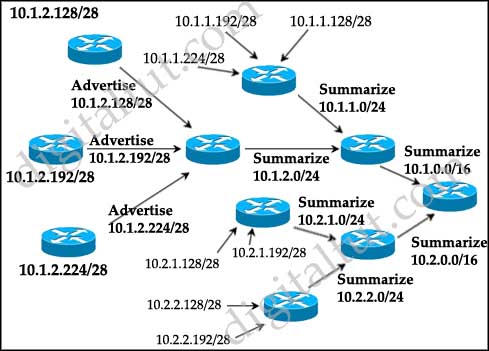
The article from Network Devices Inc. provides a great example of applying this principle in a hierarchical topology.
Advanced EIGRP Configuration for Reliable and Fast Networks
Let's revisit the 'Advanced EIGRP Configuration' article to see how summarization is applied in a multi-layer design.
Read the section 'Architecting Hierarchical Networks with EIGRP'. Focus on the diagram and the concept of using summarization to create a hierarchy and define 'zones' and 'choke points'. This directly relates to the architectural principles you apply as a solutions engineer.
Conclusion
Today we've seen how EIGRP route summarization is a critical tool for building scalable and resilient networks. By aggregating routes, we not only make our routing tables smaller and more manageable but also create boundaries that contain the impact of network failures.
Key Takeaways:
- Route summarization improves scalability by reducing routing table size and stability by limiting the EIGRP query domain.
- Auto-summarization is a legacy, classful feature that should be disabled with
no auto-summary. - Manual summarization provides precise, interface-level control and is the industry best practice. It is configured with the
ip summary-address eigrpcommand. - When a summary is created, a corresponding route to
Null0is installed locally on the summarizing router to prevent routing loops. - Summarization is a cornerstone of hierarchical network design, typically implemented at the distribution layer to protect the core.
Preview of the Next Lesson:
We have now covered how EIGRP establishes neighbors, calculates metrics, selects paths, and summarizes routes. The next logical step is to learn what to do when things go wrong. In our next lesson, we will focus on how to troubleshoot EIGRP neighbor adjacency failures and route propagation issues. We'll dive into show and debug commands to diagnose and resolve common EIGRP problems.