Hello! Welcome back to your CCNP ENCOR course.
In our last lesson, we established a solid foundation by analyzing the traditional three-tier hierarchical network design. We broke down the distinct roles of the access, distribution, and core layers and understood the design trade-offs between Layer 2 and Layer 3 access models.
Today, we will build directly on that knowledge to address a core concept in modern networking: fabric architectures. The goal of this lesson is to compare fabric architectures, specifically Cisco's Software-Defined Access (SD-Access), with the traditional three-tier designs we've just studied.
This comparison is not just academic; it represents a fundamental shift in network design philosophy and is a critical topic for the ENCOR exam. We will explore the limitations of traditional designs that prompted this evolution and then deconstruct the components of SD-Access to see how it provides a more automated, flexible, and secure networking solution.
The Problem with Tradition
As we touched on in the previous lesson, while the hierarchical model provides structure, its common implementations come with significant challenges, especially at scale. Spanning Tree Protocol, rigid VLANs tied to physical locations, and manual, box-by-box configuration create complexity and limit agility.
To understand these challenges in more detail, let's watch a video that explores the "why" behind the move to software-defined networking.
This video from KishSquared discusses the key problems in traditional campus networks that technologies like SD-Access aim to solve. It covers the issues with Spanning Tree, broadcast domains, and the difficulties of implementing consistent security and QoS policies.
Please watch the video from 03:08 to 25:43. As you watch, focus on three main pain points: The Layer 2 vs. Layer 3 design conundrum and the role of Spanning Tree Protocol. The challenges of managing broadcast domains and user mobility. The difficulty of maintaining consistent security and QoS policies using traditional tools like ACLs.
As the video highlights, traditional networks face several key limitations:
- Spanning Tree Protocol (STP) Dependency: In traditional Layer 2 access designs, STP is required to prevent loops. This leads to blocked, underutilized links and slower convergence times compared to routed alternatives.
- Lack of Mobility/Flexibility: Subnets are typically tied to a specific set of distribution switches. This creates "VLAN sprawl" and makes it difficult to provide seamless connectivity for users who move between different physical areas of the campus.
- Static, Topology-Dependent Policy: Security policies, implemented with Access Control Lists (ACLs), are bound to IP addresses and VLANs. If a user's IP address changes, their policy enforcement can break. This makes policy management complex and error-prone.
- Manual Configuration: Network changes require logging into individual devices to apply configurations via the command-line interface (CLI). This is slow, inconsistent, and does not scale well.
These challenges led the industry to develop a new architectural approach: the software-defined fabric.
The Fabric Architecture: Introducing SD-Access
A fabric architecture fundamentally reimagines the network by creating a logical, virtualized network on top of the physical hardware. Cisco's implementation for the campus is called Software-Defined Access (SD-Access).
The core idea is to separate the network into two main parts:
- Underlay Network: This is the physical infrastructure—the switches and routers and the links connecting them. Its only job is to provide IP reachability between all the network devices. It is almost always built as a simple, highly resilient Layer 3 routed network using a standard IGP like IS-IS or OSPF.
- Overlay Network: This is a virtual network built on top of the underlay using tunneling technology. All user traffic, along with its associated policies, travels through this overlay. This is where all the advanced services and segmentation happen.
This separation allows you to manage the network based on your logical intent without being constrained by the physical topology.
An illustration of the overlay and underlay relationship in a network fabric.
This diagram from the Cisco SD-Access Design Guide illustrates the relationship between the physical underlay and the virtual overlay. The overlay creates logical connections between fabric nodes, independent of the physical path.
The Operational Planes of SD-Access
To make this underlay/overlay model work, SD-Access divides network functions into four distinct "planes," each powered by a specific technology.
Cisco Software-Defined Access Solution Design Guide
This section of the official Cisco SD-Access Design Guide provides a concise, authoritative definition of the four operational planes that make up the fabric.
Please read the section titled 'SD-Access operational planes' (including the subsections on the control, data, policy, and management planes). Focus on understanding the role of LISP, VXLAN, and Cisco TrustSec.
Let's summarize these crucial components:
- Management Plane (Cisco DNA Center): This is the centralized controller and user interface for the entire fabric. Instead of configuring individual switches, you define your network's design, policies, and services in Cisco DNA Center. The controller then automates the configuration of all devices in the underlay and overlay to match your intent. Your experience with REST APIs and automation will make the value proposition of a controller-based approach very clear.
- Control Plane (LISP): The Locator/ID Separation Protocol is the "GPS" of the fabric. It decouples a device's identity (its Endpoint ID or EID, like an IP or MAC address) from its location (its Routing Locator or RLOC, which is the IP address of the switch it's connected to). This allows an endpoint to move anywhere in the fabric and keep its IP address, while the control plane simply updates the EID-to-RLOC mapping.
- Data Plane (VXLAN): The Virtual Extensible LAN is the encapsulation protocol that creates the overlay tunnels. It takes the original Ethernet frame from an endpoint and wraps it in a new set of IP and UDP headers (a process called MAC-in-IP encapsulation). This VXLAN packet is then routed across the Layer 3 underlay. This is how SD-Access extends Layer 2 connectivity across a routed network, eliminating the need for STP.
- Policy Plane (Cisco TrustSec): Instead of using ACLs based on IP addresses, SD-Access uses identity-based policy. When a user or device connects, they are assigned a Scalable Group Tag (SGT) by the Identity Services Engine (ISE). This tag is carried within the VXLAN header and is used by fabric devices to enforce security policies. For example, you can create a policy that says "devices in the 'IoT_Cameras' group cannot communicate with devices in the 'Financial_Servers' group," regardless of their IP addresses or physical location.
Test your understanding!
In a traditional network, if you move your laptop from a desk in Building A to a conference room in Building B, you will likely be on a different VLAN and receive a new IP address. How does the SD-Access fabric solve this problem to enable seamless mobility?
Show answer
SD-Access uses the combination of its control and data planes to solve this:
- Data Plane (VXLAN): Because user subnets exist in the overlay, they are no longer tied to a physical location. A single subnet (like 10.10.20.0/24) can be "stretched" across the entire fabric.
- Control Plane (LISP): When you move from Building A to Building B, your laptop keeps its identity (EID), which is its IP address (e.g., 10.10.20.55). The fabric edge switch you connect to in Building B simply registers your new location (its RLOC) with the LISP control plane.
When another device wants to communicate with you, it queries the LISP control plane, gets your new location, and the VXLAN tunnel is built to the correct edge switch. Your IP address never has to change.
New Architecture, New Roles
In a traditional three-tier design, we think in terms of core, distribution, and access switches. In an SD-Access fabric, devices are defined by their logical role.
The following video provides an excellent and detailed walkthrough of the physical components and their roles in an SD-Access fabric.
ENCOR - SD-Access Architecture
This video details the primary roles within an SD-Access fabric, explaining the function of each component and how it fits into the overall architecture.
Watch the segment from 08:42 to 31:04. Pay close attention to the descriptions of these four key roles: Fabric Edge Node (where endpoints connect) Fabric Border Node (the gateway to external networks) Fabric Control Plane Node (the LISP mapping system) Fabric Wireless LAN Controller (and its unique integration)
To summarize the key roles:
- Fabric Edge Node: This is where wired endpoints (PCs, phones) and wireless Access Points connect to the fabric. It is analogous to an access layer switch. Its main job is to identify and register endpoints, assign policy (SGTs), and perform VXLAN encapsulation/de-encapsulation.
- Fabric Border Node: This node is the gateway connecting the SD-Access fabric to any external network, such as the data center, WAN, or internet. It is responsible for translating policies (e.g., SGTs) and routing information between the fabric and the non-fabric world. It often serves a similar function to a core or distribution switch that connects to the WAN edge.
- Fabric Control Plane Node: This is a device (or set of devices for redundancy) running the LISP control plane service. It maintains the EID-to-RLOC mapping database for the entire fabric site.
- Intermediate Node: Any switch in the underlay that doesn't have a specific fabric role. Its only job is to route IP packets between the other fabric nodes. A traditional distribution switch could become an intermediate node during a migration.
It's important to note that these are roles, and a single physical device can often perform multiple roles (e.g., a single powerful switch could be both a border node and a control plane node).
Side-by-Side Comparison: Three-Tier vs. SD-Access Fabric
Now let's bring it all together. The most effective way to understand the differences is a direct comparison.
The image below shows a high-level view of a traditional non-fabric enterprise network next to an SD-Access fabric.
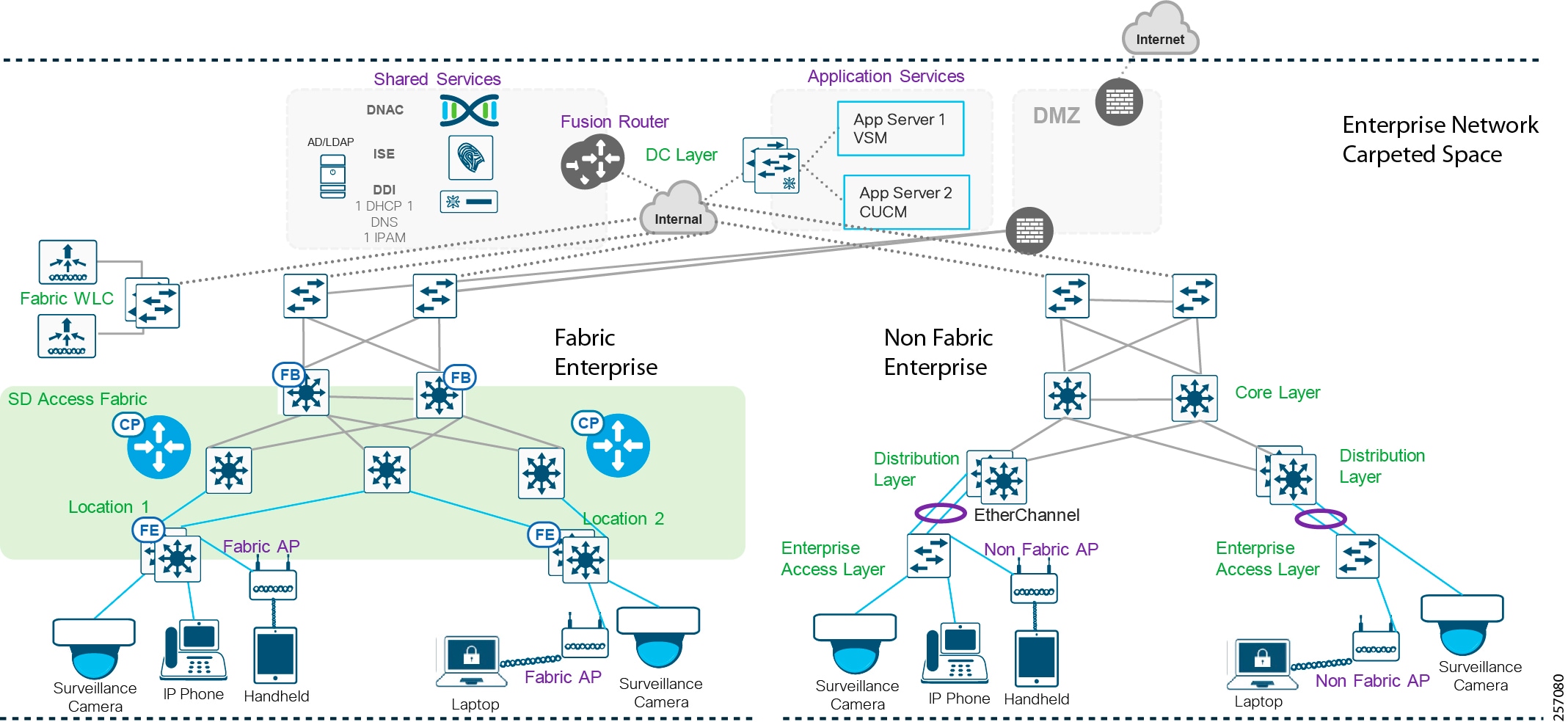
Let's break this down further in a table.
| Feature | Traditional Three-Tier Architecture | Cisco SD-Access Fabric Architecture |
|---|---|---|
| Core Concept | Hardware-defined hierarchical layers (Access, Distro, Core). | Software-defined Underlay and Overlay networks. |
| Topology | Rigid physical hierarchy. | Flexible logical topology over a simple Layer 3 physical underlay. |
| L2 Extension | Relies on Spanning Tree Protocol (STP), causing blocked links. | Uses VXLAN tunneling over the L3 underlay. All links are active (ECMP). |
| Default Gateway | Redundant SVIs on distribution switches using FHRP (HSRP/VRRP). | Anycast gateway present on every Fabric Edge Node. |
| Segmentation | Coarse-grained segmentation using VLANs and VRFs (Macrosegmentation). | Both Macrosegmentation (VRFs) and Microsegmentation (SGTs). |
| Security Policy | ACLs tied to IP addresses and subnets. Brittle and complex. | Dynamic, identity-based policy using SGTs. Independent of topology. |
| Management | Manual, per-device CLI configuration. | Centralized, intent-based automation via Cisco DNA Center. |
| Mobility | Limited. Roaming across L3 boundaries requires IP change. | Seamless. LISP allows endpoints to move anywhere and retain their IP. |
Finally, to see how these concepts apply in a practical migration scenario, the last part of the video we just watched provides a perfect illustration.
ENCOR - SD-Access Architecture
This concluding segment visualizes how a traditional three-tier network is conceptually transformed into an SD-Access fabric, mapping old roles to new ones.
Watch from 59:15 to 01:05:32. This ties everything together by showing how access, distribution, and core switches assume new roles in a fabric design.
Conclusion
Today we've bridged the gap between traditional networking and the software-defined future. You now have a solid framework for comparing these two dominant architectural models.
Key Takeaways:
- Traditional three-tier networks are built on a rigid physical hierarchy and managed device-by-device, with policy tied to topology (IPs/VLANs).
- Fabric architectures like SD-Access separate the network into a simple physical underlay for transport and a flexible virtual overlay for services.
- SD-Access uses a suite of protocols to achieve this: LISP for the control plane, VXLAN for the data plane, and Cisco TrustSec (SGTs) for the policy plane.
- The entire fabric is managed by a centralized controller, Cisco DNA Center, which translates business intent into automated network configuration.
- This approach provides superior flexibility, scalability, security (micro-segmentation), and operational simplicity compared to traditional designs.
Preview of the Next Lesson:
Now that we have compared the two primary architectural models, our next lesson will focus on applying these concepts. We will explore how to use the principles of the Cisco Enterprise Architecture framework to analyze requirements and make informed decisions in real-world network design scenarios.