Welcome back. In our last lesson, we explored the restorative qualities of "forest music," noting how birdsong and ambient sounds can shift us into a state of alert calm. We observed that these sounds have a powerful effect, but we left a key question unanswered: Why?
Today, we will answer that question by delving into the psychological framework that explains this phenomenon: Attention Restoration Theory (ART). This theory provides a robust model for understanding how natural environments—and their soundscapes—help us recover from mental fatigue. By the end of this lesson, you will be able to explain the core principles of ART and connect them directly to the natural sounds we've been studying, giving you a theoretical foundation for your curation practice.
Two Modes of Attention
To begin, it's helpful to think of our attention as operating in two primary modes. The first is directed attention, the kind you use to focus on a demanding task like analyzing data, reading a dense text, or navigating city traffic. It's voluntary, effortful, and, like a muscle, it gets tired with use.
The second mode is involuntary attention, or "effortless attention." This is when something in our environment gently captures our awareness without any conscious effort. Think of watching clouds drift by or listening to the sound of rain. Attention Restoration Theory is built on the interplay between these two modes.
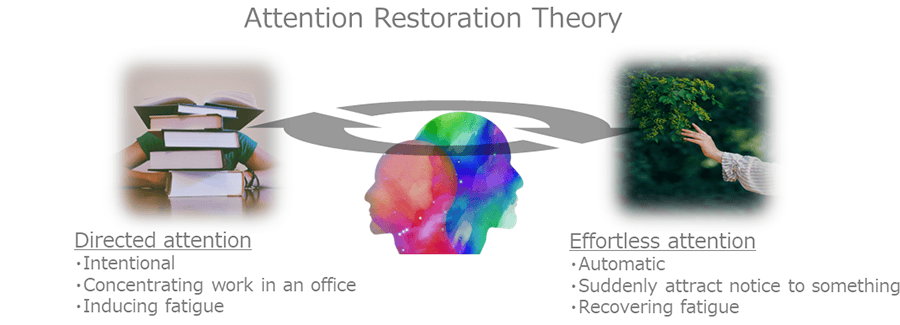
The central idea of ART, developed by environmental psychologists Rachel and Stephen Kaplan, is that exposure to nature allows our depleted directed attention to rest and recover by engaging our involuntary attention.
Let's get a formal definition of the theory.
What is Kaplan's Attention Restoration Theory (ART)?
This article from Positive Psychology provides a clear and accessible introduction to ART.
Please read the first section, "What is Attention Restoration Theory?". This will ground you in the history and basic hypothesis of the Kaplans' work.
As you've just read, ART is about renewing our mental energy. The critical question for a curator is, what makes an environment "restorative"? The theory proposes four key components that must be present.
The Four Components of a Restorative Environment
For an environment to effectively restore our attention, it needs to possess a specific set of characteristics. Understanding these is crucial for selecting or designing effective soundscapes.
What is Kaplan's Attention Restoration Theory (ART)?
This section breaks down the four essential ingredients of a restorative experience. It is the theoretical core of ART.
Please read the section titled "Key Components," paying close attention to the descriptions of all four elements. In particular, focus on the distinction the authors make between hard and soft fascination.
Let's summarize these four essential components:
- Being Away: This is a sense of psychological distance from your usual tasks and worries. It’s about leaving your mental to-do list behind.
- Extent: The environment must be rich and coherent enough to feel like a whole other world you can be immersed in. It has to be large enough in scope to engage your mind.
- Compatibility: There must be a fit between the environment and your personal inclinations. You feel a sense of belonging and enjoyment, not obligation or discomfort.
- Soft Fascination: This is the most crucial component for our purposes. The environment holds your attention effortlessly with stimuli that are interesting but not overpowering. This allows your directed attention to rest.
The opposite, "hard fascination," describes experiences that grab and hold your attention intensely, like watching an action movie or a competitive sport. While engaging, they don't leave room for mental recovery or reflection.
Natural soundscapes are powerful because they are premier sources of soft fascination. The non-repetitive song of a bird, the fractal rhythm of wind in the trees, or the gentle patter of rain are all acoustically fascinating without being demanding.
This concept of acoustic soft fascination is explained well in the context of how sound affects us, particularly when we are trying to rest.
This article from Flower of Sound connects the psychological concept of soft fascination directly to the acoustic properties of natural sound.
Read the section titled "Why your environment matters more at night," focusing on the paragraph that defines soft fascination in an acoustic context: "Natural sound does something different from silence in this context."
This gives us the psychological mechanism: natural sounds provide non-demanding input that occupies the brain’s environmental monitoring systems just enough to prevent mind-wandering and worry, thereby giving our directed attention "acoustic permission to stop being alert."
The Neurological Shift
So what is happening in our brains and bodies during this process? The shift from directed to effortless attention corresponds to a measurable change in our nervous system and brain activity. Your background as a social researcher familiar with human relationships might offer an interesting parallel: just as a safe, compatible relationship allows a person to let their guard down, a safe, compatible environment allows the nervous system to shift its state.
Let's explore this neurological basis.
This resource explains the physiological shift that underpins the experience of restoration.
First, read the section "What your nervous system is doing" to understand how natural sounds encourage a shift from the sympathetic (fight-or-flight) to the parasympathetic (rest-and-digest) nervous system. Next, read the following section, which explains how this corresponds to a change in brain activity from "inward-directed attention" (associated with worry and rumination) to "outward-directed attention."
As the research shows, urban or artificial sounds tend to keep our sympathetic nervous system activated and promote inward-focused, ruminative thought patterns—the kind of mental state you might experience when worrying about something at night.
In contrast, natural sounds do the opposite. They signal safety to our evolutionary-tuned brains, allowing the body to shift into the parasympathetic "rest-and-digest" mode. Cognitively, this encourages a state of "outward-directed attention," a gentle, diffuse awareness of your surroundings rather than a narrow focus on internal anxieties. This is the neurological signature of attention restoration.
Conclusion
In this lesson, we have moved from observing the effects of natural soundscapes to understanding the theory that explains them. Attention Restoration Theory provides a powerful framework for you as a curator, helping you make informed choices about why certain sounds are effective for mental recovery.
Here are the key takeaways for your curator's toolkit:
- The Core Problem: We have a limited reserve of directed attention that becomes fatigued through concentration and daily demands.
- The Solution (ART): Attention Restoration Theory states that we can restore this mental energy by engaging our involuntary attention in natural environments.
- The Key Mechanism: The most critical ingredient for restoration is soft fascination—stimuli that are inherently interesting but do not demand cognitive effort. Natural sounds are a prime source of this.
- The Four Components: A truly restorative experience requires Being Away, Extent, Compatibility, and Soft Fascination.
- The Biological Basis: This psychological process is mirrored by a physiological shift from the sympathetic to the parasympathetic nervous system, and a cognitive shift from inward-focused rumination to outward-focused awareness.
Now that we understand the what (the qualities of natural soundscapes) and the why (the principles of ART), we are ready to address the how. In our next lesson, we will focus on the practical art of curation, exploring principles for layering nature sounds with music to design effective playlists for focus, relaxation, and sleep.