Welcome to our next lesson. In our previous session, we submerged ourselves in the profound, resonant world of humpback whale songs, analyzing their complex musical structure. Today, we ascend from the ocean depths into the forest canopy to explore a soundscape that is perhaps more familiar but no less powerful: the symphony of birdsong and forest ambience.
Our objective is to understand how these natural sounds affect our mood and attention, providing you with the knowledge and recommended recordings to effectively use them in your curation practice. We will discover that "forest music" is a rich orchestra of sounds that works on our minds in subtle but potent ways, offering a powerful tool for restoration and calm.
More Than Ambience: The Concept of Forest Music
When we talk about the sounds of a forest, we're referring to more than just a pleasant background noise. The concept of "forest music" encompasses a whole orchestra of cues that influence our nervous system, mood, and attention. This idea is central to practices like the Japanese art of Shinrin-yoku, or "forest bathing," which has been shown to produce measurable physiological effects, such as reductions in the stress hormone cortisol.
To begin, let's explore this broader definition of forest music and why it matters.
7 Healing Signals the Forest Sends (and How to Use Them)
This article from Aliens Love Earth introduces the idea of "forest music" as a holistic soundscape with tangible health benefits.
Please read the introductory section, "Why 'forest music' matters." Pay attention to how it defines this music as both a literal soundscape (birds, wind, water) and a metaphorical one, and note the mention of measurable physiological effects.
As the article points out, this "music" is an orchestra with many players. While we will focus on two of the most prominent—birdsong and the general forest ambience—it's useful to think of them as part of a larger, interconnected sonic environment.
Birdsong: Nature's Alert Calm
Birdsong is perhaps the most universally recognized sound of a healthy, thriving natural environment. Its presence alone can be reassuring, but the acoustic properties of the sound itself are what make it so effective for influencing our mental state.
Bird vocalizations are often complex, non-repetitive, and fall within a frequency range to which our ears are particularly sensitive. This combination has a unique effect: it gently captures our attention without demanding analysis, helping to pull the mind away from ruminative thought patterns and into the present moment.
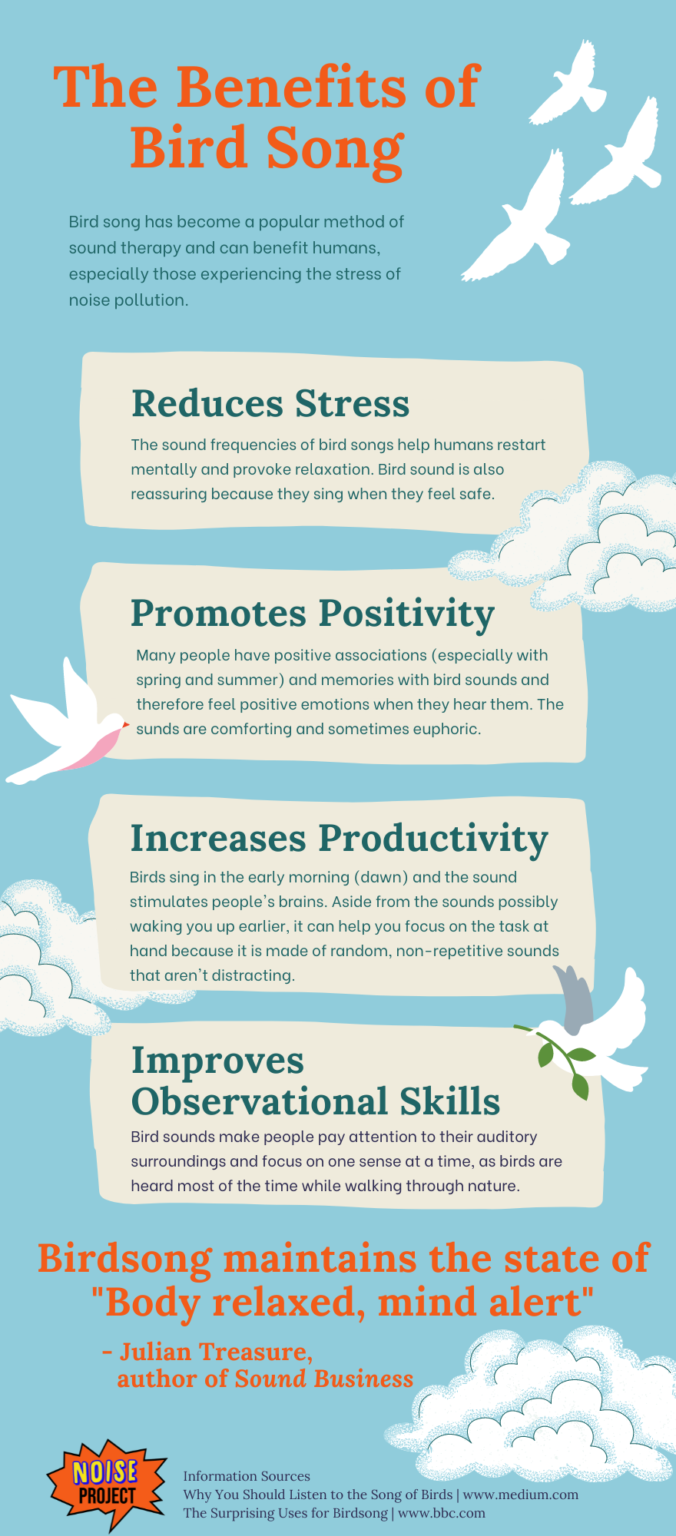
For a more detailed look at the science and practical application of listening to birdsong, the next section of the article we've been using is very helpful.
7 Healing Signals the Forest Sends (and How to Use Them)
This section focuses specifically on the acoustic qualities of birdsong and its documented effects on mood and attention.
Read the part titled "Birdsong — nature's calming melody." Note the specific frequency range (2–8 kHz) and the key takeaway: its calming rhythm and unpredictability help the brain shift out of a state of hypervigilance.
The key for a curator is to understand this dual quality: birdsong is both stimulating enough to engage a tired mind and unstructured enough to promote relaxation. It creates a state often described as "alert calm," making it excellent for gentle focus or recovering from mental fatigue.
The Broader Ambience: Wind and Insects
Beyond birdsong, the general ambience of a forest is composed of other critical sounds that contribute to its restorative effect. Two of the most significant are the rustle of wind through leaves and the steady hum of insects.
1. Wind Through Leaves: The sound of wind is an example of a fractal soundscape. Unlike the rigid, predictable drone of a machine, it is irregular yet patterned. This type of sound is deeply grounding for the human nervous system. Your background in jazz improvisation gives you a keen sense of how structure and freedom can coexist; the sound of wind in trees is a natural analogy, providing a loose, organic rhythm that can anchor a meditative state.
2. Natural Low Hums: The steady chorus of insects or frogs provides a continuous, low-frequency sonic bed. This functions much like the brown noise we discussed in our first module. It creates a stable auditory foundation that can mask more jarring, sudden noises, reducing our startle reflex and calming the nervous system. This "acoustic bed" is particularly effective for creating a sense of safety and stability.
To explore these concepts further, let's return to our main resource.
7 Healing Signals the Forest Sends (and How to Use Them)
These sections explain the roles of wind and insect sounds in creating a calming forest soundscape.
First, read "Wind through leaves." Focus on the idea of fractal, irregular patterns. Next, read "Natural low hums." Note how this steady sound creates a predictable "acoustic bed."
Curating the Forest: Recommended Recordings
For your playlists, the goal is to find high-quality field recordings that capture these elements effectively. A key question for any curator is whether recordings can truly substitute for the real thing. For many of the key benefits, the answer is yes.
7 Healing Signals the Forest Sends (and How to Use Them)
These sections offer practical advice on the effectiveness and use of recorded nature sounds.
First, read the FAQ question about the benefits of recordings. This directly addresses a core concern for curation. Then, review the "Practical tips for urban dwellers" for ideas on how to integrate these sounds.
Now, let's explore some specific albums that serve as excellent examples of forest soundscapes. These range from pure, unprocessed recordings to artistic integrations of nature sounds with music, giving you a broad palette to work with.
The best field recording albums in the world - a collection
This article from Cities and Memory highlights several outstanding albums based on field recordings.
We'll look at a few examples that are particularly relevant for forest ambience. For a pure, immersive soundscape: Read the description of Isabella Dłużyk's Soundscapes of Summer. This is an ideal example of a high-quality, unprocessed recording capturing both birdsong and insect hums. For integrating with music: Read about Hidden Orchestra's Dawn Chorus. This is a fantastic case study in how field recordings of birdsong can be the foundational element for complex musical compositions, something that should resonate with your music theory background. For a different kind of forest: Finally, look at La Selva by Francisco Lopez. This album captures the more intense, dense soundscape of a rainforest, including thunder and rain, expanding the definition of "forest ambience."
These examples show that "forest music" for your playlists can range from a simple, clean recording of a local woodland to a complex, layered piece where natural sounds and composed music are in dialogue.
Conclusion
In this lesson, we explored the rich, restorative soundscape of the forest. We learned that the effectiveness of these sounds lies not just in one element, but in the interplay of the entire "forest orchestra."
Here are the key takeaways for your curator's toolkit:
- Birdsong's "Alert Calm": Birdsong engages attention gently with its non-repetitive, high-frequency melodies, helping the brain shift out of hypervigilance and into a state of relaxed awareness.
- Ambient Foundation: The broader forest ambience, including the fractal rhythms of wind and the steady hum of insects, creates a stable and grounding sonic environment that calms the nervous system.
- Recordings Are Effective: High-quality field recordings have been shown to be effective for stress reduction and attention restoration, making them a powerful tool for playlist curation.
- Curation Palette: Your options range from pure, unprocessed nature soundscapes (like Soundscapes of Summer) to complex musical compositions built around field recordings (like Dawn Chorus).
In our next lesson, we will delve into the psychological theory that explains why these natural soundscapes are so effective. We'll explore Attention Restoration Theory, which provides a fascinating framework for understanding how nature helps us recover from mental fatigue.