Introduction
Throughout this module, we've explored the world of resonant metallic instruments, each with its unique capacity to influence our mental state. We began with the ancient, harmonically rich tones of singing bowls, moved to the modern, melodic handpan that has become a staple of meditation music, and delved into the complex, hypnotic world of Indonesian Gamelan. We've distinguished between styles suited for active listening and those ideal for passive relaxation.
Now, we will synthesize all of this knowledge into the practical tool you've been working towards: a "curator's cheat sheet." This lesson is designed to consolidate the key characteristics, use cases, and selection criteria for these instruments, providing you with a quick-reference guide for building effective playlists. This framework will be your go-to resource for making informed curatorial choices with resonant sounds.
The Art of Combining Resonant Sounds
Before we build the cheat sheet, let's consider a crucial aspect of curation: how these instruments work together. A successful playlist is more than a sequence of tracks; it's a composed journey. Your background in jazz improvisation, with its focus on interplay and arrangement, provides an excellent foundation for thinking about this.
A helpful framework for combining these sounds is to think in terms of sonic layers, much like arranging for a small group.
The Beginner's Guide to Combining Sound Healing ...
This article from Didge Project provides a practical guide to layering instruments in a sound healing context. It categorizes sounds into foundational, melodic/rhythmic, and accent layers, which is a perfect model for our curatorial work.
Please read the section titled "Experiment With Layers and Space." Focus on understanding the role of each layer: the foundational "bed," the melodic or rhythmic patterns, and the accent "spices." Also, note the importance of silence as an integrative element.
As you read, consider how this layering concept applies to the instruments we've studied:
- Foundational Layer: A deep, continuous drone from a large Tibetan bowl, the cyclical structure of Javanese Gamelan, or a shruti box can create the stable "bed" of sound.
- Melodic/Rhythmic Layer: The handpan is a perfect candidate here, weaving a gentle melodic narrative over the foundation.
- Accent Layer: The pure, high-pitched ring of a crystal bowl or the bright tap of a small chime can add sparkle and highlight transitions.
Keeping this structure in mind, let's build our cheat sheet.
Curator's Cheat Sheet: Resonant & Metallic Instruments
We will construct the cheat sheet piece by piece, starting with the instruments most commonly associated with individual relaxation and meditation.
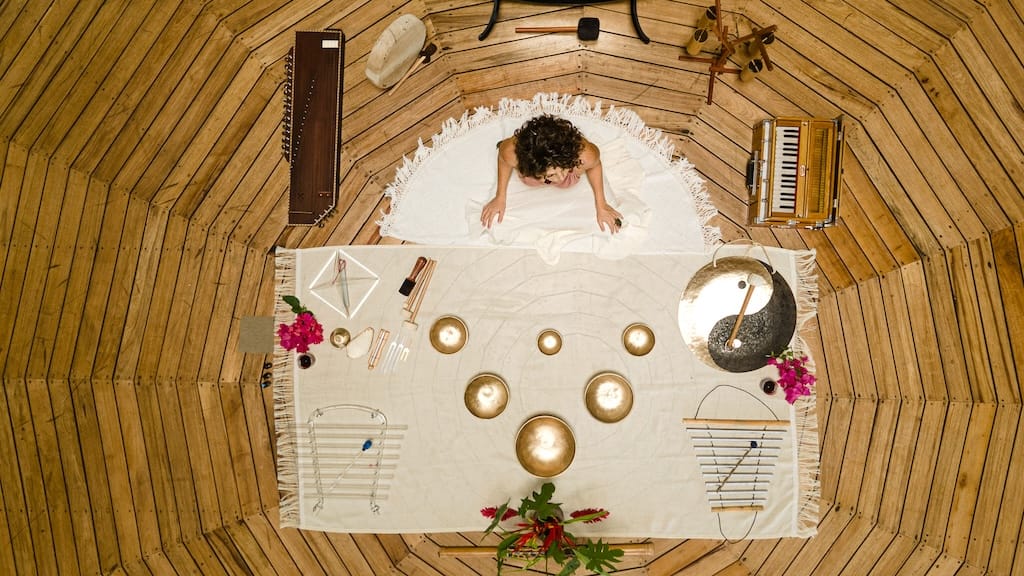
1. Singing Bowls (Tibetan & Crystal)
Singing bowls are perhaps the archetypal "meditation" instrument. Their power lies in their rich overtone profile and long sustain, which can fill a space and seem to quiet the mind. However, as we've learned, not all bowls are the same.
10 Powerful Sound Healing Instruments: An In-Depth Demonstration
This video from Didge Project demonstrates both Himalayan (Tibetan-style) and crystal singing bowls. Watching it will help solidify the sonic differences between them.
First, watch the demonstration of the Himalayan bowls. Notice the complex, warm, and somewhat earthy character of these hand-hammered instruments. Pay attention to the different tones produced by striking versus the continuous "singing" drone. Next, watch the segment on crystal bowls. Observe their pure, bright, and almost perfectly clear pitch, as well as their exceptionally long sustain.
The key distinction for a curator is between the complex, grounding quality of traditional metal bowls and the pure, uplifting nature of crystal bowls.
Cheat Sheet Entry: Singing Bowls
| Aspect | Tibetan / Himalayan Bowls | Crystal Bowls |
|---|---|---|
| Primary Use Case | Deep relaxation, grounding, sleep, meditation, bodywork (physical vibration). | Uplifting meditation, space clearing, creating an ethereal atmosphere, focus. |
| Sonic DNA | Complex, warm, rich overtones. Hand-hammered nature creates multiple, less distinct partials. Lower to mid-range focus. | Pure, bright, high-frequency focus. Very clear fundamental pitch with distinct, bell-like overtones. Extremely long sustain. |
| Curation Keywords | "Tibetan bowl meditation", "Himalayan sound bath", "sound healing". | "Crystal bowl meditation", "432 Hz healing", "chakra bowls", "quartz bowls". |
| Curation Red Flags | Poor recordings with distracting handling noise. Overly busy playing with too many strikes. | For sleep, very high-pitched or loud bowls can be stimulating rather than relaxing. |
| Playlist Role | Foundational / Grounding. Excellent for opening or closing a session. The continuous drone from a "sung" bowl can serve as a bed for other sounds. | Accent / Ethereal. Best used to add brightness, mark transitions, or create a sense of spaciousness. Layering multiple bowls creates powerful harmonic consonance. |
2. Handpan
The handpan bridges the gap between percussive rhythm and ethereal melody. Its accessibility and consonant tunings have made it a star of modern meditation music. As we discussed in the last lesson, the curatorial challenge is to separate the virtuosic from the meditative.
Cheat Sheet Entry: Handpan
| Aspect | Meditative Handpan |
|---|---|
| Primary Use Case | Light focus, active relaxation, emotional release, creative flow. Can be too melodic for deep sleep. |
| Sonic DNA | Clear, bell-like tones with harmonious overtones, typically tuned to a single consonant scale (e.g., minor, pentatonic). Combines melody and gentle rhythm. |
| Curation Keywords | "Meditative handpan", "calm handpan", "hang drum sleep music". Search for artists like Malte Marten or Yatao (their slower pieces). |
| Curation Red Flags | Fast tempos, complex polyrhythms, heavy use of percussive body slaps. Music by virtuosic players like Manu Delago or Kabeção is often for active listening. |
| Playlist Role | Melodic / Rhythmic. Perfect for the main body of a relaxation playlist, providing gentle structure and emotional arc after an atmospheric opening. |
The thesis you read, "Meditative Music as a Method for Stress Reduction", analyzes compositions that combine handpan with other instruments. For instance, the analysis of the song "Falling Within" describes the handpan starting abstractly before introducing a clear rhythm, while a shruti box provides a foundational drone. This is a classic example of the layering principle in action.
3. Gamelan (Javanese & Balinese)
Gamelan offers a profoundly different experience. It's not about a single instrument, but an entire orchestra creating an immersive sonic ecosystem. Your job as a curator is to select the right ecosystem for your listener's goal.
As we recapped, the central distinction is between the vigorous, dynamic Balinese Gong Kebyar and the stately, contemplative court music of Central Java. The shimmering effect called ombak, which we explored in the video "Bali's DANGEROUS Music," is a hallmark of Balinese Gamelan, created by deliberately detuning pairs of instruments to produce a beautiful acoustic beating. While fascinating, this intensity can be less suited for deep relaxation.
Cheat Sheet Entry: Gamelan
| Aspect | Javanese / Solonese Gamelan | Balinese Gamelan (Gong Kebyar) |
|---|---|---|
| Primary Use Case | Deep meditation, trance-like states, long-form focus sessions. | "Soft fascination," active listening, world music exploration. Generally too stimulating for sleep. |
| Sonic DNA | Slow, spacious, cyclical (gongan). A "stratified" texture with deep gongs marking time, mid-range instruments playing the core melody, and faster, higher instruments elaborating. | Fast, dynamic, explosive. Features rapid, interlocking patterns (kotekan) and dramatic shifts in tempo and volume. Brilliant, shimmering texture. |
| Curation Keywords | "Javanese Gamelan", "Solonese court music", "Gamelan for meditation". Look for producers like John Noise Manis or labels like Nonesuch Explorer Series. | "Balinese Gamelan", "Gong Kebyar". |
| Curation Red Flags | For relaxation, avoid searching just "Gamelan," as this often yields the more energetic Balinese style. | If the goal is calm or sleep, this style is a "red flag" itself. Its energy is its purpose. |
| Playlist Role | Foundational World. A single, long piece can be the entire session. Its self-contained, layered structure functions as a complete soundscape. | Active Listening. Best placed in playlists designed for cultural exploration or to induce a state of energized focus. |
The Consolidated Curator's Cheat Sheet
Here is the complete reference table, combining all the information for quick access.
| Instrument/Style | Primary Use Case | Sonic DNA | Curation Keywords | Curation Red Flags | Playlist Role |
|---|---|---|---|---|---|
| Tibetan Singing Bowl | Deep Relaxation, Grounding, Sleep | Warm, complex overtones, earthy, physical vibration | "Tibetan bowl meditation", "Himalayan sound bath" | Poor recordings, distracting handling noise | Foundational / Grounding |
| Crystal Singing Bowl | Uplifting Meditation, Focus, Space Clearing | Pure, bright, high-frequency, bell-like, long sustain | "Crystal bowl meditation", "432 Hz healing", "chakra bowls" | Overly loud or high-pitched bowls for sleep | Accent / Ethereal |
| Handpan (Meditative) | Light Focus, Active Relaxation, Creative Flow | Melodic, rhythmic, consonant scales, bell-like tone | "Meditative handpan", "calm hang drum music" | Fast tempos, complex rhythms, percussive playing | Melodic / Rhythmic |
| Javanese Gamelan | Deep Meditation, Trance, Extended Focus | Slow, spacious, cyclical, stratified texture, deep gongs | "Javanese Gamelan", "Solonese court music" | N/A (inherently suited for its use case) | Foundational World |
| Balinese Gamelan | Active Listening, "Soft Fascination" | Fast, dynamic, explosive, interlocking patterns, shimmer | "Balinese Gamelan", "Gong Kebyar" | Using it for sleep or deep relaxation playlists | Active Listening |
Conclusion
You have now created a comprehensive curator's cheat sheet for resonant and metallic instruments. This tool synthesizes the unique properties of singing bowls, handpans, and Gamelan into a practical framework, enabling you to make deliberate, effective choices for your focus, relaxation, and sleep playlists. You can now move beyond simply finding "meditation music" to curating it with an understanding of style, texture, and intent.
Key Takeaways:
- Singing Bowls: Use Tibetan bowls for grounding and crystal bowls for ethereal brightness.
- Handpan: Seek out slower, spacious playing for relaxation and avoid virtuosic, rhythmically complex styles.
- Gamelan: Prioritize the slow, contemplative structures of Javanese Gamelan for deep meditation over the energetic, dazzling style of Balinese Gamelan.
- Layering: Combine these instruments thoughtfully, using drones as a foundation, handpans for melody, and high-pitched bowls as accents to create a cohesive sonic journey.
In our next module, we will journey to the Indian subcontinent to explore the world of Indian Classical Ragas. You will find fascinating parallels between the drone of a singing bowl and the tanpura, and see how the concept of evoking a specific mood, which we've touched on here, is codified into a sophisticated system of scales, melodies, and time-of-day associations.