Introduction
In our last module, we assembled a "curator's cheat sheet" for resonant metallic instruments, exploring how the textures of singing bowls, handpans, and Gamelan can shape a listener's mental state. We concluded by looking ahead to the music of the Indian subcontinent, where the concept of crafting music to evoke a specific mood is not just an artistic goal but a highly sophisticated and ancient science.
This lesson begins our exploration of that system. We will delve into the world of Indian Classical Ragas, which are far more than simple melodies or scales. You will discover how a raga is a complex melodic entity, designed with specific rules and structures to evoke a precise emotional state, or rasa. We'll focus on answering the core question for any curator: how do these musical structures, and their traditional association with specific times of the day, combine to so powerfully influence the listener's mind?
What is a Raga?
To begin, it's crucial to understand that a raga is not equivalent to a Western scale or key. While a scale is a collection of notes, a raga is a blueprint for a melody, complete with its own personality, rules, and prescribed mood.
How to Identify the Mood & Time of a Raga in Indian ...
This article from Krishna Music School provides a clear, concise introduction to the concept of a raga and its core components.
First, read the section "What is a Raga?" to get a foundational definition. Then, review the list under "Key Musical Concepts Explained" to familiarize yourself with the essential vocabulary we will be using today, such as Rasa, Samay, and Vaadi-Samvaadi.
The legendary sitarist Ravi Shankar offers a wonderful demonstration of why a raga is so much more than its notes. He explains how the emphasis placed on certain notes—the vadi (primary note) and samvadi (secondary note)—is what truly defines a raga's character.
Raga: a personal introduction by Ravi Shankar
In this classic introduction, Ravi Shankar distinguishes the skeletal scale from the living, breathing raga.
Please watch from this section. Pay close attention to his explanation of vadi and samvadi around the 3:49 mark. He demonstrates how two different ragas can use the exact same notes, but the emphasis on different "prime notes" gives each a completely unique identity and mood.
As Ravi Shankar shows, the vadi acts as a gravitational center, a "home base" that the melody continually refers back to. This concept will be familiar to you from your jazz background, where certain chord tones are emphasized over specific changes to define the harmony. In a raga, this hierarchical structure is a primary tool for establishing its emotional core. Other critical elements that define a raga's identity, which we'll explore later, include its pakad (a signature melodic phrase) and its specific ascending (aaroh) and descending (avroh) lines.
The Emotional Language: Rasa and Swaras
Every raga is designed to evoke a specific emotional state or mood, known as rasa. The ancient Indian treatise on performance arts, the Natyashastra, codified these into nine primary emotional states.
How to Identify the Mood & Time of a Raga in Indian ...
This same article provides a helpful table outlining the nine classical rasas.
Focus on the section "Understanding Rasa." Study the table to get a sense of the emotional palette of Indian classical music, from Shringar (Love) to Shant (Peace).
How does a raga encode these emotions? The answer lies in its specific structure of notes, or swaras. Indian classical music uses a 12-tone system that corresponds to the Western chromatic scale, but the notes are categorized in a way that directly relates to their emotional function.
For someone with your background in music theory, the most precise way to see this is through a direct comparison. The following table from a research paper on emotional responses to raga music maps the Indian swaras to their Western equivalents.
Emotional responses to Hindustani raga music: the role of ...
This table from a study published in Frontiers in Psychology provides a technical breakdown of the 12 tones used in North Indian Classical Music.
Please examine Table 1 and the accompanying text, from "The basic set of tones" down to the end of the table. The key distinction to note is between the shuddh ("natural" or major) intervals and the komal ("flat" or minor) intervals.
The fundamental principle linking scale structure to emotion is this:
- Shuddh (natural) notes tend to create bright, joyful, or peaceful moods.
- Komal (flat) notes tend to create introspective, melancholic, or tense moods.
This traditional wisdom is now being validated by modern research. The same study you just referenced found strong correlations between the types of intervals used in a raga and the emotions reported by listeners.
Emotional responses to Hindustani raga music: the role of ...
This paper empirically investigates the connection between a raga's tonal structure and the emotion it evokes.
First, read the short subsection titled "Tonality." It directly states the core finding: ragas rated "calm" were dominated by major intervals (shuddh swaras), while those rated "sad" featured minor intervals (komal swaras). Then, jump to the discussion section and read the paragraph starting "Tonality analysis of ragas revealed...". This summarizes how the tonal patterns determine the underlying mood (rasa).
Given your background as a statistician, you'll appreciate that this isn't just anecdotal. The data shows a significant negative correlation between the presence of the minor second (komal re) and "happy" or "calm" ratings, and a strong positive correlation with "tensed" ratings. The minor second, a highly dissonant interval, acts as a powerful "pointer" to the tonic, creating tension that yearns for resolution. This is a clear, data-backed example of how specific note choices are used to engineer a desired mental state.
The Raga Time Cycle: Samay Chakra
The final layer of a raga's identity is its association with a specific time of day or season. This system, known as the Samay Chakra (Time Cycle), is based on the idea that our own energy and mood change with the daily cycle of the sun. Performing a raga at its designated time is believed to maximize its emotional and psychological impact.
This concept is beautifully visualized in a "raga clock."
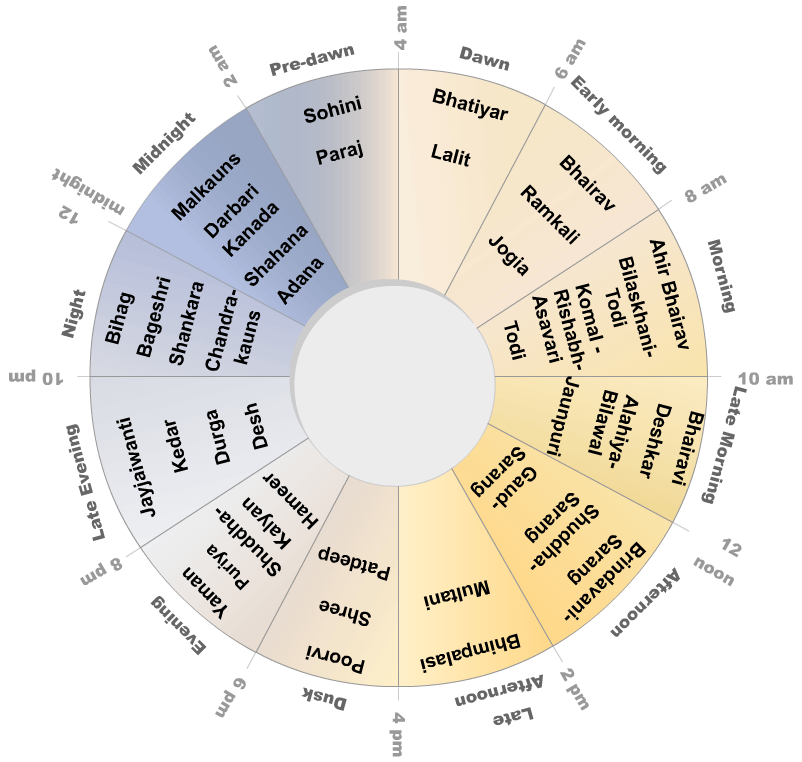
As you can see, the 24-hour day is divided into sections, each with its own family of associated ragas. For a curator, understanding this cycle is essential for selecting music that aligns with a desired state, whether it's awakening energy in the morning or promoting deep introspection at night.
How to Identify the Mood & Time of a Raga in Indian ...
This article provides detailed tables that serve as a practical guide to the Samay Chakra.
Read the section "Samay Explained," paying close attention to the tables for Morning, Midday, Evening, and Night Ragas. For each time block, notice the described mood and characteristics. After reviewing the tables, read the short FAQ answer under the heading "Why must ragas be performed at specific times?" This connects the use of shuddh and komal notes to the body's circadian rhythms.
The logic behind the Samay Chakra connects directly back to the swaras.
- Morning Ragas (e.g., Bhairav, Todi) often use komal (flat) notes like Re and Dha. The mood is solemn, introspective, and devotional, suitable for gentle awakening and meditation.
- Evening Ragas (e.g., Yaman, Bhoopali) are dominated by shuddh (natural) notes. The mood is typically romantic, peaceful, and stable, ideal for winding down.
- Night Ragas (e.g., Malkauns, Darbari Kanada) often return to using multiple komal notes, creating a mood of deep pathos, longing, or profound tranquility suited for late-night listening and sleep.
This system provides a powerful framework for curation, aligning the musical structure with the listener's biological and psychological state throughout the day.
Conclusion
In this lesson, we have deconstructed the core components of an Indian Classical Raga. You've learned that a raga is a sophisticated melodic framework, not just a scale, defined by its note hierarchy (vadi/samvadi), signature phrases, and specific note choices. We've seen how these choices, particularly between shuddh (major) and komal (minor) intervals, systematically encode the emotional mood, or rasa. Finally, we explored the Samay Chakra, the traditional time-cycle theory that aligns these emotionally-charged musical structures with the natural rhythms of the day to enhance their impact.
Key Takeaways:
- A raga's identity is defined by its emphasized notes (vadi/samvadi) and melodic rules, not just its scale.
- The emotional mood (rasa) is strongly influenced by the use of swaras: shuddh (major) notes correlate with positive or calm states, while komal (minor) notes correlate with introspective or tense states.
- The Samay Chakra is a system that associates ragas with specific times of day, providing a framework for choosing music that aligns with a listener's natural energy cycle.
In our next lesson, we will examine the anatomy of a raga performance. We will focus on the alap—the unmetered, rhythmically free introduction—and the crucial role of the tanpura drone in establishing a meditative, immersive foundation for the music to unfold.