Welcome to your first lesson in the Solana smart contract security course. Your journey to becoming a Solana security researcher starts with the most fundamental concept in the entire ecosystem: the account model. Everything that happens on Solana—from sending tokens to executing complex DeFi logic—revolves around accounts.
In this lesson, you will learn to explain the Solana account model, including its core components, the rules of ownership, and the rent mechanism that keeps it sustainable. Given your experience with Rust and the Ethereum Virtual Machine (EVM), we will frequently draw comparisons to highlight the unique—and often surprising—differences in Solana's architecture. Understanding these differences is the first step toward spotting Solana-specific vulnerabilities.
Let's begin by exploring what an account truly is in Solana.
The Code-Data Separation Model
In Ethereum, an account is a single entity that bundles together its balance, nonce, code, and storage. A smart contract's logic and its state live together within the same contract account.

Solana takes a radically different approach. It separates code from data. Think of it like a traditional computer operating system: you have executable files (programs) and data files (documents, images, etc.). The programs operate on the data files but don't store the data themselves.
On Solana:
- Program Accounts store immutable, executable code (compiled from Rust, in our case). They are stateless.
- Data Accounts store all the mutable data that programs interact with, from a user's token balance to the state of a complex DeFi protocol.
This means that a single, deployed program can interact with a virtually unlimited number of data accounts. This design is key to Solana's performance and scalability, but it also creates a new set of challenges and potential security flaws that do not exist in Ethereum.
To get a better sense of this fundamental concept, please read the introductory sections of the following article from Helius.
The Solana Programming Model: An Introduction to ...
This article provides an excellent introduction to Solana's programming model, starting with the core concept of accounts. We'll read two sections.
First, read the section What are accounts? to understand how everything on Solana is an account and the basic distinction between executable and data accounts. Then, skip to the section How do accounts on Solana differ from accounts on Ethereum? This will directly leverage your existing EVM knowledge to highlight the key architectural differences.
The Anatomy of a Solana Account
Now that you have a high-level view, let's dissect the structure of a Solana account. Since you're comfortable with Rust, the best way to visualize this is as a struct. Every account on Solana, whether it holds a program or data, shares a common metadata structure.
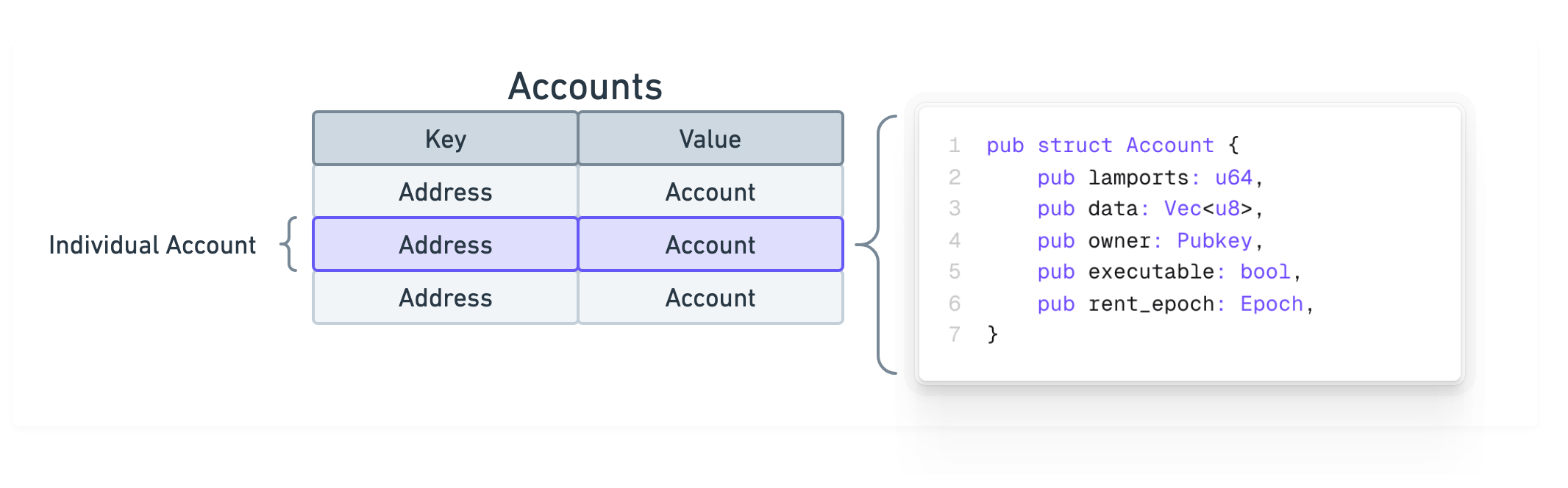
The fields in this struct are the building blocks of all on-chain state and logic. Let's explore what each one means.
This article from the official Solana documentation is designed for developers transitioning from Ethereum. It provides a concise breakdown of the account fields and a direct comparison table.
Please read the section titled Account in Solana, paying close attention to the table that describes the five main fields: lamports, owner, executable, data, and rent_epoch. After that, review the comparison table that maps Ethereum account fields to their Solana equivalents.
As you've just read, the core fields are:
lamports: The number of native tokens (SOL) owned by the account, in the smallest denomination (1 SOL = 1,000,000,000 lamports). This is analogous to Ethereum'sbalance.data: A raw byte array (Vec<u8>) that stores the actual state. For a program account, this holds the executable BPF bytecode. For a data account, this is where your program will read from and write to. The interpretation of these bytes is entirely up to the program that owns the account.owner: The address of the program that is allowed to modify this account'sdataand subtractlamports. This is a runtime-enforced rule and is the single most important field for security. An incorrect owner can lead to a complete loss of control over an account's state. By default, new accounts are owned by the System Program.executable: A boolean flag. Iftrue, the account is a program and its data is treated as BPF bytecode. Iffalse, it's a data account.rent_epoch: A field related to Solana's storage cost mechanism, known as rent.
The Rent Lifecycle
Unlike Ethereum, where you pay a one-time gas fee to store data forever, Solana requires accounts to pay a recurring "rent" to cover the cost of storage. This prevents the blockchain's state from bloating indefinitely with unused accounts.
However, the modern implementation of this is simple: any new account must deposit enough SOL to be rent-exempt, which covers the cost of storage for approximately two years. This deposit is locked in the account's lamports balance. If the account is later closed, this SOL deposit is refunded to the user.
Let's watch a short video that explains this concept clearly.
A simple introduction to Solana accounts, rent, and PDAs
This video provides a simple, visual explanation of rent and the account lifecycle.
Watch the section from rent explanation, where the creator explains what rent is, why it exists, and what it means to be rent-exempt. Then, watch the section on the account lifecycle, which covers how accounts are funded, modified, and eventually closed to reclaim the rent deposit.
The key takeaways on rent are:
- Storage is not free on Solana; it requires a SOL deposit.
- All new accounts must be funded with enough SOL to be rent-exempt.
- This rent deposit can be reclaimed by closing the account and reducing its lamports balance to zero.
Owner, Authority, and Signer: The Pillars of Solana Security
Understanding the distinction between owner, authority, and signer is non-negotiable for a security researcher. Confusion between these terms is a primary source of critical vulnerabilities.
- Owner: As we've covered, this is a field in the account's metadata. It's a program ID. The Solana runtime guarantees that only this program can modify the account's data. This is a powerful, low-level security guarantee.
- Signer: This refers to an account whose private key was used to sign a transaction. When a program receives an account, it can check a boolean flag,
is_signer, to see if that account's holder authorized the transaction. However, the program must perform this check. If it doesn't, anyone can pass in the account, and the program will proceed as if it were authorized. This is a classic bug class: missing signer check. - Authority: This is a design pattern, not a runtime concept. It's typically a public key stored inside an account's
datafield. A program's logic will define that for a specific action (e.g., withdrawing funds), the transaction must be signed by theauthorityaddress stored in its state. For example, a token mint account has amint_authorityfield in its data. Only themint_authoritycan sign a transaction to mint new tokens.
The following video is one of the most important resources you'll encounter for understanding these core security primitives. The creator, Solandy, does an excellent job of demonstrating these concepts with code.
Who's really the owner of your account? [Solana Tutorial on Terminology] - Aug 22nd '23
This video provides an in-depth, practical look at the differences between owner, authority, and signer.
Please watch the following segments: What is an owner: This section explains the fundamental rule of ownership—only the owner program can write to an account's data or subtract lamports. Signing with a private key: Here, the video explains the first type of signer—an account on the ed25519 curve with a corresponding private key. This is the basis of user authorization. Definition of authority: This part defines authority as a program-level concept, an address that is granted specific privileges by the program's own logic. Token program example: This final segment applies all three concepts to the SPL Token program, clarifying who owns a token account, who the authority is, and who can sign for it.
To solidify this, let's recap with an example of a user's token account:
- Owner: The SPL Token Program. Only this program can change the token balance in the account's data.
- Signer: The user's wallet. To transfer tokens, the user must sign the transaction, proving they hold the private key.
- Authority: The user's public key. This is stored in the token account's
data. The SPL Token Program checks that thesignerof the transaction matches theauthoritystored in the account data before allowing a transfer.
Conclusion
In this foundational lesson, we've unpacked the Solana account model, which is fundamentally different from Ethereum's. You learned about the crucial separation of code and data, the structure of an account, and the rent mechanism that governs its lifecycle.
Most importantly, you now understand the distinct and critical roles of owner, signer, and authority.
- The owner is the program with write-access, enforced by the runtime.
- The signer is a proof of identity, which a program must manually check.
- The authority is a concept in a program's logic that designates who is allowed to perform certain actions.
Mastering these distinctions is the first major step on your path as a security researcher. Nearly every major Solana exploit involves a misunderstanding or misapplication of one of these three concepts.
In our next lesson, we will move from theory to practice. You will set up your local development environment and use the Solana Command-Line Interface (CLI) to query the blockchain and inspect the fields of live accounts, seeing these concepts in action.