Bonjour !
Introduction
In our last lesson, you learned how to express your opinions and preferences, a key skill for engaging in more personal and professional conversations. We covered verbs like aimer, adorer, and détester and the nuances of using them in different contexts.
Today, we're opening a new, essential chapter: narrating the past. This is fundamental for almost any professional conversation, from discussing a past project to giving a status update or simply chatting about your weekend.
Our learning outcome for this lesson is to identify when to use the passé composé to narrate completed past actions. We won't focus on how to form the tense just yet—that's for our next lesson. The goal today is to build a strong intuition for knowing when it's the right tool for the job.
1. The Passé Composé: What Happened?
The passé composé (literally, "compound past") is the most common past tense in spoken French. Its main job is to talk about actions that are finished and completed.
A great way to think about this is to use an analogy: the passé composé is like the action in a movie, while another past tense, the imparfait (which we'll study later), is like the background scenery in a painting. The passé composé moves the story forward.
Let's watch a short clip that introduces this powerful analogy.
Imparfait vs. Passé Composé Explained: Never Mix Up French Past Tenses Again!
This video from Talk in French introduces a simple and effective 'movie vs. painting' analogy to help distinguish between the two main past tenses.
Watch from 01:16 to 02:09. Focus on the core idea: the 'passé composé' shows clear, sequential actions that move a story forward.
So, the key question to ask yourself is: "What happened?" If you're answering that question, you'll most likely use the passé composé.
2. The Core Scenarios for Using Passé Composé
To really master when to use this tense, let's break it down into three core scenarios.
For a quick overview of these uses, please read the first few sections of this helpful guide.
Le passé composé: the Past Tense in French - Lingolia Français
The Lingolia Français guide provides a very clear and direct explanation of the main purpose of the 'passé composé'.
Read the sections 'What is the passé composé?' and 'When to use the passé composé in French'. Pay close attention to the idea that this tense is for 'one-time, completed actions' that emphasize a 'result or consequence'.
Now, let's explore these scenarios with more examples. The following video clip breaks them down perfectly.
Imparfait vs. Passé Composé Explained: Never Mix Up French Past Tenses Again!
Let's revisit the Talk in French video to see concrete examples of the main uses for the 'passé composé'.
Watch from 02:09 to 03:16. The video explains and gives examples for three key situations where you must use the 'passé composé'.
Let's summarize and add some tech-focused examples for each scenario:
Scenario 1: A specific, completed action in the past
This is the most fundamental use. The action had a beginning and an end, and it's over now.
Hier, **j'ai fini** le projet.(Yesterday, I finished the project.)La semaine dernière, **j'ai déployé** une nouvelle fonctionnalité.(Last week, I deployed a new feature.)
Scenario 2: A sequence of completed actions (telling a story)
This is the "movie" concept in action. You are narrating a series of events that happened one after another.
**Il est entré**, **il a pris** un café et **il a commencé** à travailler.(He came in, he took a coffee, and he started to work.)D'abord, **j'ai analysé** le bug. Ensuite, **j'ai corrigé** le code. Finalement, **j'ai fusionné** la branche.(First, I analyzed the bug. Then, I fixed the code. Finally, I merged the branch.)
Scenario 3: An action that interrupts an ongoing activity
The passé composé is used for the sudden event that interrupts a background situation (which is often described with the imparfait).
Je dormais quand le téléphone **a sonné**.(I was sleeping when the phone rang.)Nous étions en réunion quand le client **a appelé**.(We were in a meeting when the client called.)
3. Passé Composé in Action: A Deeper Look
Now that you have the core rules, let's see how they work in a narrative. Understanding the contrast between a story told only with passé composé versus one that also describes background context is key.
This resource from Lawless French provides excellent examples and distinctions.
Passé composé vs Imparfait - Lawless French Past Tenses
This article by Lawless French is one of the best resources for understanding the practical differences between the past tenses. We will focus on the parts that define the 'passé composé' and show it in a story.
Please read the following sections: 'Incomplete vs Complete': Focus on the 'Passé composé' part. 'Uncounted vs Counted': Again, focus on the 'Passé composé' for actions that happened a specific number of times. 'Background + Event': Note how the 'passé composé' is the interrupting event. 'Histoire au passé composé': Read this short story. Notice how every verb describes a distinct, completed action moving the plot forward.
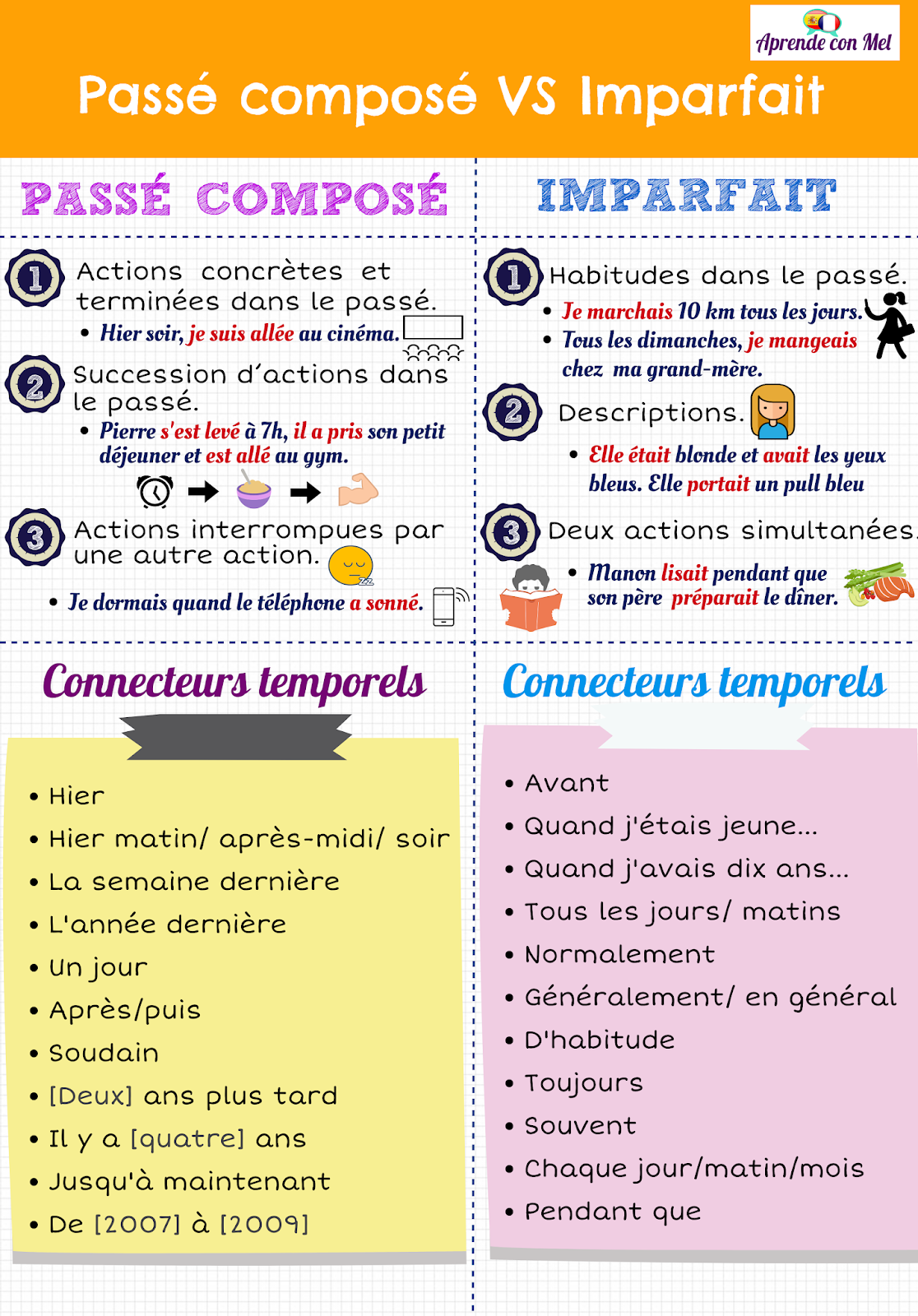
Here is a visual summary of the key differences. For this lesson, focus on the left side, "Passé composé".
4. Practice: Applying the Rules to Your Work
Let's imagine you are in a daily stand-up meeting. Your manager asks: Qu'est-ce que tu as fait hier ? (What did you do yesterday?).
You would use the passé composé to list your completed tasks (Scenario 2: a sequence of events):
Hier, **j'ai participé** à la réunion de sprint planning.(Yesterday, I participated in the sprint planning meeting.)Ensuite, **j'ai commencé** à travailler sur le ticket n°123.(Then, I started to work on ticket #123.)**J'ai écrit** les tests d'intégration et **j'ai ouvert** une pull request.(I wrote the integration tests and I opened a pull request.)
Each of these is a completed action that moves the "story" of your workday forward.
Now, you try. How would you say the following in French? (Don't worry about getting the verb forms perfect; just think about why you would use passé composé.)
- I found a bug.
- I talked to the project manager.
- I finished my task.
... You would use the passé composé for all three because they are all single, completed actions.
J'ai trouvé un bug.J'ai parlé au chef de projet.J'ai fini ma tâche.
Conclusion
Excellent work today! You’ve taken the first and most important step in learning to talk about the past in French. By focusing on when to use the passé composé, you're building a strong foundation for telling stories, reporting on your work, and sharing your experiences.
Key Takeaways:
- The
passé composéis used for completed past actions. It answers the question, "What happened?" - Use it for single, finished events:
J'ai envoyé l'email.(I sent the email.) - Use it for a sequence of actions:
J'ai lu le code, j'ai trouvé l'erreur et j'ai corrigé le bug. - Use it for an interruption:
Je travaillais quand le serveur **a crashé**.(I was working when the server crashed.)
In our next lesson, we will dive into the mechanics of forming the passé composé with the auxiliary verb avoir. You'll learn how to conjugate the majority of French verbs in this tense, allowing you to start building your own sentences about the past.
À bientôt !