Bonjour !
Introduction
In our last lesson, we established when to use the passé composé: for describing completed past actions that move a story forward. You learned to identify it as the right tense for talking about what happened yesterday at work or over the weekend.
Today, we move from the "why" to the "how." Our goal is to form the passé composé with avoir for the majority of verbs. This is the mechanical foundation you need to start constructing your own sentences about the past. Mastering this will allow you to narrate a sequence of events, like describing the steps you took to fix a bug or reporting on your completed tasks in a stand-up meeting.
1. The Formula: avoir + Past Participle
The name passé composé means "compound past," which tells us it's composed of two parts. For most verbs, the structure is:
Subject + the verb avoir (conjugated in the present tense) + the Past Participle of the main verb
This is similar to how you might say "I have finished" in English. The verb 'have' is the auxiliary (or helping verb), and 'finished' is the past participle.
Let's watch a quick introduction to this concept.
This short clip from Madame Beckwith explains the two-part structure of the passé composé and draws a parallel to English, which can be a helpful starting point.
Watch the first minute of the video (00:00 - 01:09). Focus on understanding the concept of a 'helping verb' and a 'past participle'.
Now, let's break down how to build this structure, step by step.
2. Step 1: The Auxiliary avoir (A Quick Review)
The first part of the formula is the verb avoir conjugated in the present tense. You've already learned this, but a quick review is always useful as it's the engine of the passé composé.
Passé composé avec Avoir | French grammar | Learn French
Let's listen to a quick pronunciation and review of the verb 'avoir' in the present tense from the channel The perfect French with Dylane.
Watch from 01:04 to 01:19 for a quick refresher on conjugating 'avoir'.
Here is the conjugation for your reference:
j'ai(I have)tu as(you have, informal)il/elle/on a(he/she/one has)nous avons(we have)vous avez(you have, formal/plural)ils/elles ont(they have)
3. Step 2: Forming the Past Participle
The second part of the formula is the past participle (participe passé). This is the form of the verb that expresses a completed action. How you form it depends on whether the verb is regular or irregular.
Regular Verbs
For regular verbs, there's a simple pattern based on the infinitive ending (-er, -ir, -re).
This video clearly explains the rules for forming the past participle for all three regular verb groups.
Watch from 02:12 to 03:46. Pay close attention to the simple rule for each verb ending: -er, -ir, and -re.
Here are the rules in writing:
-
For -er verbs (like
parler- to speak,développer- to develop):- Drop the
-erand add -é. parler→parlédévelopper→développé
- Drop the
-
For -ir verbs (like
finir- to finish,choisir- to choose):- Drop the
-irand add -i. finir→finichoisir→choisi
- Drop the
-
For -re verbs (like
vendre- to sell,attendre- to wait):- Drop the
-reand add -u. vendre→venduattendre→attendu
- Drop the
This chart provides a great visual summary of how to combine avoir and the past participle for regular verbs.
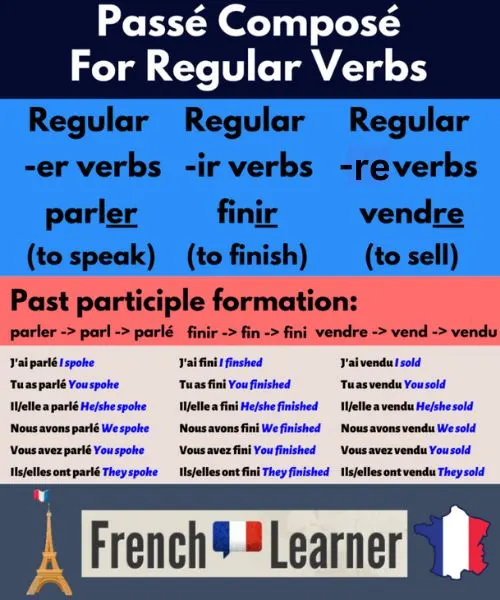
Let's try a full sentence with a verb you'd use at work:
J'**ai développé** une nouvelle fonctionnalité.(I developed a new feature.)Nous **avons fini** le sprint.(We finished the sprint.)
Irregular Verbs
Many of the most common verbs have irregular past participles that don't follow the rules above. These must be memorized. As a software engineer, verbs like faire (to do/make), écrire (to write), lire (to read), voir (to see), and mettre (to put) are essential.
This next video presents many common irregular verbs with example sentences. Listen carefully to the pronunciation.
Passé composé avec Avoir | French grammar | Learn French
Let's learn the past participles for the most frequent irregular verbs. The video provides clear examples for each.
Watch from 02:24 to 09:34. Don't worry about memorizing every single one right now. Instead, focus on recognizing the pattern: a subject, a form of 'avoir', and an irregular past participle. Pay special attention to verbs like 'faire', 'prendre', 'voir', 'dire', 'lire', and 'mettre'.
Here's a list of key irregular past participles for your reference. These are high-priority!
| Infinitive | Past Participle | Example Sentence (Tech Context) |
|---|---|---|
avoir |
eu | Tu as **eu** un bug ? (Did you have a bug?) |
être |
été | La réunion a **été** courte. (The meeting was short.) |
faire |
fait | J'ai **fait** une revue de code. (I did a code review.) |
prendre |
pris | Elle a **pris** des notes. (She took notes.) |
mettre |
mis | On a **mis** le site en production. (We put the site in production.) |
écrire |
écrit | Tu as **écrit** les tests unitaires ? (Did you write the unit tests?) |
lire |
lu | J'ai **lu** la documentation de l'API. (I read the API documentation.) |
dire |
dit | Le client a **dit** oui. (The client said yes.) |
voir |
vu | Nous avons **vu** l'erreur dans les logs. (We saw the error in the logs.) |
pouvoir |
pu | Je n'ai pas **pu** reproduire le bug. (I couldn't reproduce the bug.) |
vouloir |
voulu | J'ai **voulu** optimiser la requête. (I wanted to optimize the query.) |
For a more exhaustive list of irregular verbs, you can consult the table under the "formation" section of the article "passé composé with avoir" from laits.utexas.edu.
4. Practice: Building Your Own Passé Composé Sentences
Now it's your turn. Let's practice forming sentences you might use in a daily stand-up meeting. Complete the sentences below by conjugating the verb in parentheses in the passé composé.
- Hier, je (tester) la nouvelle API.
- Nous (choisir) un nouveau framework.
- Tu (attendre) la réponse du client ?
- Ils (faire) la mise à jour ce matin.
- Elle (écrire) un rapport sur le bug.
Answers:
Hier, j'**ai testé** la nouvelle API.Nous **avons choisi** un nouveau framework.Tu **as attendu** la réponse du client ?Ils **ont fait** la mise à jour ce matin.Elle **a écrit** un rapport sur le bug.
Conclusion
Fantastic work today! You have now learned the fundamental mechanics of forming the most common past tense in French.
Key Takeaways:
- The
passé composéwithavoiris formed with:sujet+avoir(present tense) +participe passé. - For regular verbs, the past participle endings are predictable:
-er→-é,-ir→-i,-re→-u. - Many essential verbs have irregular past participles (
fait,pris,mis,vu,écrit, etc.) that need to be memorized.
In our next lesson, we'll complete your knowledge of the passé composé by learning how to form it with être. A specific, smaller group of verbs (mostly related to movement) uses être instead of avoir as the auxiliary verb. Once you've mastered that, you'll have all the tools to narrate past events confidently.
À bientôt !