Bonjour ! Welcome to your next lesson.
Introduction
In our last lesson, you mastered the verbs être (to be) and avoir (to have). These are the pillars of French, but they are irregular, meaning their conjugations are unique. You can now form crucial sentences like Je suis développeur (I am a developer) and Nous avons besoin de plus de temps (We need more time).
Today, we move from exceptions to rules. We will focus on conjugating regular -er, -ir, and -re verbs in the present tense. The great news is that these verbs follow predictable patterns. Once you learn these patterns, you'll be able to correctly use hundreds of new verbs, dramatically expanding your ability to describe actions in both daily life and your work as a software engineer.
1. The Foundation: Regular -er Verbs
The vast majority of French verbs (around 90%) end in -er. They are the most common and the most regular group. The pattern is simple:
- Take the infinitive form of the verb (e.g.,
parler- to speak). - Remove the
-erending to get the stem (e.g.,parl-). - Add the correct ending based on the subject pronoun.
Let's watch a video that explains this process clearly.
HOW TO CONJUGATE REGULAR FRENCH VERBS IN THE PRESENT TENSE // Conjugate the Present Tense in French
The video 'HOW TO CONJUGATE REGULAR FRENCH VERBS IN THE PRESENT TENSE' from the Bla Bla Kaity channel provides an excellent walkthrough. We'll start with the section on '-er' verbs.
Watch from 02:18 to 04:53. Pay close attention to the pronunciation rule she mentions: for '-er' verbs, the endings for 'je', 'tu', 'il/elle', and 'ils/elles' are silent, so the conjugated verbs all sound the same.
Here are the endings for -er verbs:
| Pronoun | Ending | Example: parler (to speak) |
Tech Example: développer (to develop) |
|---|---|---|---|
| je | -e | je parle | je développe |
| tu | -es | tu parles | tu développes |
| il/elle/on | -e | il parle | il développe |
| nous | -ons | nous parlons | nous développons |
| vous | -ez | vous parlez | vous développez |
| ils/elles | -ent | ils parlent | ils développent |
As you heard, je parle, tu parles, il parle, and ils parlent all sound identical! This is a key feature of French pronunciation. The context and the subject pronoun tell you who is performing the action.
A Small but Important Spelling Rule
For some -er verbs, there's a minor spelling change in the nous form to maintain the correct sound.
Group 1 Regular French Verbs ending in "ER" (Present Tense)
The video 'Group 1 Regular French Verbs' by Learn French With Alexa explains two common exceptions for '-ger' and '-cer' verbs very clearly.
Watch from 06:07 to 08:23. This will show you why 'manger' (to eat) becomes 'nous mangeons' and 'commencer' (to begin) becomes 'nous commençons'.
- Verbs ending in
-ger(likemanger- to eat): Add anebefore the-onsending to keep the 'g' sound soft.Nous mang**e**ons
- Verbs ending in
-cer(likecommencer- to start): Change thecto aç(c-cedilla) before the-onsending to keep the 's' sound.Nous commen**ç**ons le sprint.(We are starting the sprint.)
2. The Second Group: Regular -ir Verbs
The next group of regular verbs are those ending in -ir, like finir (to finish). The conjugation pattern here is also consistent, though slightly different from -er verbs. A key feature is the addition of -iss- in all plural forms (nous, vous, ils/elles).
HOW TO CONJUGATE REGULAR FRENCH VERBS IN THE PRESENT TENSE // Conjugate the Present Tense in French
Let's return to Bla Bla Kaity's video to learn the pattern for regular '-ir' verbs.
Watch from 04:53 to 07:18. Notice how the '-iss-' sound clearly distinguishes the plural forms from the singular ones.
Here are the endings for -ir verbs:
| Pronoun | Ending | Example: finir (to finish) |
Tech Example: choisir (to choose) |
|---|---|---|---|
| je | -is | je finis | je choisis |
| tu | -is | tu finis | tu choisis |
| il/elle/on | -it | il finit | il choisit |
| nous | -issons | nous finissons | nous choisissons |
| vous | -issez | vous finissez | vous choisissez |
| ils/elles | -issent | ils finissent | ils choisissent |
For example, in a daily stand-up meeting, you might say:
Je **finis** le test du nouveau module aujourd'hui.(I'm finishing the test of the new module today.)Nous **choisissons** la meilleure librairie pour le projet.(We are choosing the best library for the project.)
Note: While most -ir verbs follow this pattern, some common ones like partir (to leave) and venir (to come) are irregular. We will cover them in a future lesson.
3. The Third Group: Regular -re Verbs
The final group of regular verbs are those ending in -re, such as vendre (to sell) or attendre (to wait).
HOW TO CONJUGATE REGULAR FRENCH VERBS IN THE PRESENT TENSE // Conjugate the Present Tense in French
One last time, let's watch Bla Bla Kaity's video for the pattern for '-re' verbs.
Watch from 07:18 to 08:30. Note that for the 'il/elle/on' form, you simply drop the '-re' and add nothing.
Here are the endings for -re verbs:
| Pronoun | Ending | Example: attendre (to wait for) |
Tech Example: répondre (to answer/reply) |
|---|---|---|---|
| je | -s | j'attends | je réponds |
| tu | -s | tu attends | tu réponds |
| il/elle/on | - | il attend | il répond |
| nous | -ons | nous attendons | nous répondons |
| vous | -ez | vous attendez | vous répondez |
| ils/elles | -ent | ils attendent | ils répondent |
For example:
J'**attends** une réponse du client.(I am waiting for a response from the client.)Elle **répond** aux commentaires sur le pull request.(She is replying to the comments on the pull request.)
4. Summary and Practice
You now have the keys to unlock a vast portion of the French language! This summary chart is a great tool to keep handy.
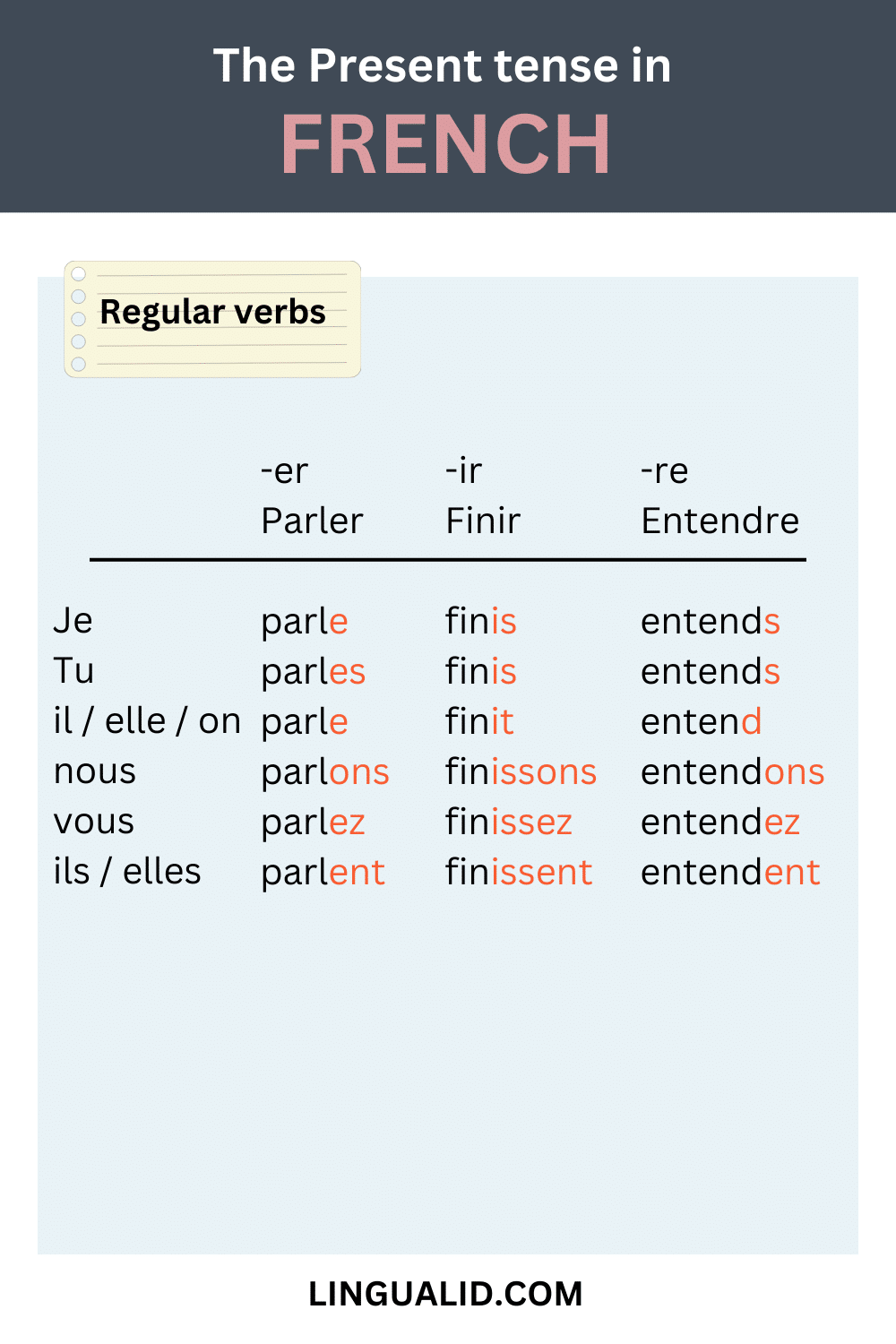
Now, let's put it into practice. Conjugate the verbs in parentheses to complete the sentences.
- Je ____________ (développer) une API REST.
- Nous ____________ (commencer) la phase de test.
- Tu ____________ (choisir) le bon framework ?
- Les ingénieurs ____________ (finir) le déploiement.
- Vous ____________ (attendre) la validation du chef de projet.
- Elle ____________ (répondre) à un ticket urgent.
- Ils ____________ (parler) de l'architecture du système.
- On ____________ (manger) ensemble à midi ? (Shall we eat together at noon?)
Check your answers
- Je développe une API REST.
- Nous commençons la phase de test. (Remember the
ç!) - Tu choisis le bon framework ?
- Les ingénieurs finissent le déploiement.
- Vous attendez la validation du chef de projet.
- Elle répond à un ticket urgent.
- Ils parlent de l'architecture du système.
- On mange ensemble à midi ? (The
eis only needed for thenousform:nous mangeons)
For additional review, this article from BBC Bitesize provides clear, text-based explanations and tables.
Regular present tense verbs in French
If you'd like a text-based summary of everything we've covered, the article 'Regular present tense verbs in French' from BBC Bitesize is a great resource.
Read the sections on '-er verbs', '-ir verbs', and '-re verbs'. The tables provide a clear, quick reference.
Conclusion
Excellent travail ! You have successfully learned the systematic way to conjugate the three groups of regular French verbs in the present tense.
Key Takeaways:
- Verbs are grouped by their infinitive endings: -er, -ir, -re.
- Each group has a specific set of endings you add to the verb's stem.
- -er verbs are the most common. Watch out for spelling changes with
-gerand-cerverbs in thenousform. - -ir verbs often add
-iss-in the plural forms. - -re verbs have no ending for the
il/elle/onform.
In our next lesson, we will learn how to form negative sentences using ne...pas. This will allow you to negate all the actions you can now describe, adding another critical layer to your communication skills. For example, you'll be able to go from Je finis le ticket to Je ne finis pas le ticket.
À bientôt ! (See you soon!)