Bonjour ! Welcome to the first lesson of Module 2.
Introduction
In our last lesson, we mastered French numbers, which allows you to discuss times, prices, and quantities. You can now say, for example, La réunion est à quatorze heures (The meeting is at 2 PM). But to build more complete sentences, we need powerful verbs.
This lesson marks the beginning of our module on core grammar, and we're starting with the two most fundamental verbs in the French language. Our learning outcome is to conjugate and use the verbs 'être' (to be) and 'avoir' (to have) in the present tense. Mastering these will unlock your ability to describe who you are, what you do, what you possess, and how you feel—essential skills for both daily conversation and professional communication.
1. Le Verbe être – To Be
The verb être is used to describe a state of being. You'll use it for:
- Identity & Profession: Je suis développeur. (I am a developer.)
- Nationality: Je suis américain. (I am American.)
- Location: Nous sommes au bureau. (We are at the office.)
- Adjectives/Descriptions: Le code est propre. (The code is clean.)
Être is an irregular verb, so its conjugations must be memorized. Let's start by learning them with correct pronunciation.
IRREGULAR FRENCH VERBS IN PRESENT TENSE // How to Conjugate Être Avoir in Present Tense
The video 'IRREGULAR FRENCH VERBS IN PRESENT TENSE' by Bla Bla Kaity offers a very clear and energetic explanation. We'll focus on the section about 'être'. Pay close attention to her pronunciation tips, especially the liaisons (sound links) with 'nous' and 'vous'.
Watch the segment from 00:55 to 02:38. Repeat the conjugations aloud with the presenter.
Here is a table summarizing the conjugations of être for easy reference.
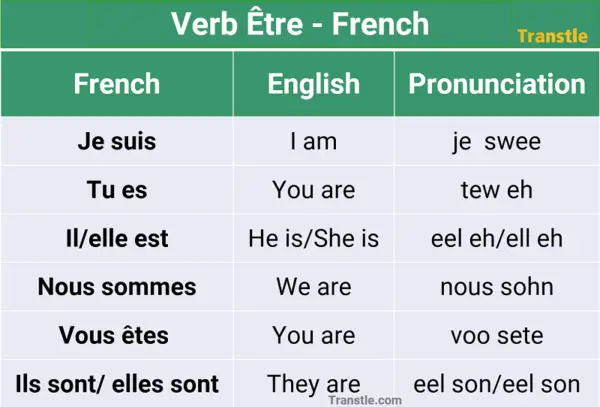
Notice how vous êtes is pronounced "vou-zet". This connection between the 's' and the following vowel is called a liaison and is crucial for sounding natural.
Examples in a professional context:
Je **suis** ingénieur logiciel.(I am a software engineer.)Tu **es** prêt pour la réunion ?(Are you ready for the meeting?)Elle **est** la chef de projet.(She is the project manager.)Nous **sommes** en retard.(We are late.)Vous **êtes** l'expert en QA.(You are the QA expert. - formal)Ils **sont** responsables du déploiement.(They are responsible for the deployment.)
2. Le Verbe avoir – To Have
Next is avoir, which primarily means "to have" and is used to express possession.
- Possession: J'ai un ordinateur portable. (I have a laptop.)
- Experience: Elle a de l'expérience en gestion de projet. (She has experience in project management.)
Like être, avoir is also highly irregular.
IRREGULAR FRENCH VERBS IN PRESENT TENSE // How to Conjugate Être Avoir in Present Tense
Let's return to the same video from Bla Bla Kaity to learn the conjugations for 'avoir'. Again, listen carefully for the liaisons in 'nous avons', 'vous avez', and 'ils/elles ont'.
Watch from 03:26 to 05:01. Notice how 'je + ai' becomes 'j'ai'—this is called an elision and happens when a word ending in a vowel is followed by a word starting with a vowel.
Here are the conjugations in a table format:
| French Form | Pronunciation (approx.) | English Meaning |
|---|---|---|
| j'ai | jhay | I have |
| tu as | tu ah | you have (informal) |
| il/elle a | eel/ell ah | he/she has |
| nous avons | noo za-vohn | we have |
| vous avez | voo za-vay | you have (formal) |
| ils/elles ont | eel/ell zohn | they have |
Crucial Pronunciation Point: Be careful to distinguish between ils sont (they are) and ils ont (they have). The 's' sound in sont is sharp, while the 'z' sound from the liaison in ont is softer.
3. The Most Common Mistake: Using avoir for States of Being
This is one of the most important concepts to master early on. In English, we use "to be" for many states and feelings (I am hungry, I am 25 years old). In French, many of these expressions use avoir. Directly translating from English will lead to common errors.
This video explains the concept perfectly.
AVOIR - Present tense, Every day Expressions and Idioms // French conjugation course // Lesson 8
The video 'AVOIR - Present tense, Every day Expressions' by The perfect French with Dylane clearly breaks down the most important expressions that use 'avoir' where you might expect 'être'.
Watch from 01:21 to 04:35. Pay special attention to the expressions for age, hunger/thirst, feeling hot/cold, and especially 'avoir besoin de' (to need).
Here's a summary of key avoir expressions to memorize:
- Age:
J'**ai** 30 ans.(I am 30 years old.) - Literally: I have 30 years. - Hunger/Thirst:
J'**ai** faim.(I'm hungry.) /J'**ai** soif.(I'm thirsty.) - Temperature:
J'**ai** chaud.(I'm hot.) /J'**ai** froid.(I'm cold.) - Feeling:
J'**ai** peur.(I'm scared.) /Tu **as** raison.(You are right.) - Need:
J'**ai besoin** d'aide.(I need help.) - Want/Feel like:
J'**ai envie** d'un café.(I feel like having a coffee.)
The expression avoir besoin de is incredibly useful in your professional life:
Nous **avons besoin de** plus de temps pour ce ticket.(We need more time for this ticket.)Le client **a besoin d'**une nouvelle fonctionnalité.(The client needs a new feature.)
To solidify your understanding of when to use être versus avoir, let's review a clear written guide.
Être or Avoir in French: When to Use Each Verb
The article 'Être or Avoir in French' from Feelgoodfrench.com provides excellent examples and highlights the common pitfalls for English speakers.
Read the sections 'What does avoir mean in French?', 'What does être mean in French?', and especially 'The most common mistake (and how to fix it)'. This will reinforce what you just learned in the video.
4. Practice Time
Let's apply what you've learned. Fill in the blanks with the correct present tense form of être or avoir.
- Je ______ développeur web full stack.
- Nous ______ une réunion à 15h00.
- Tu ______ quel âge ? (How old are you?)
- Elle ______ besoin de l'accès à la base de données. (She needs access to the database.)
- Vous ______ fatigué ? (Are you tired? - formal)
- Ils ______ raison, le serveur est trop lent. (They are right, the server is too slow.)
- J'______ faim. On va déjeuner ? (I'm hungry. Shall we go for lunch?)
- Le bug ______ critique. (The bug is critical.)
Check your answers
- Je suis développeur web full stack.
- Nous avons une réunion à 15h00.
- Tu as quel âge ?
- Elle a besoin de l'accès à la base de données.
- Vous êtes fatigué ?
- Ils ont raison, le serveur est trop lent.
- J'ai faim. On va déjeuner ?
- Le bug est critique.
For more practice, try the exercises in the "Être or Avoir? Exercises With Real-Life Situations" section of the Feelgoodfrench.com article you just read.
Conclusion
Félicitations ! You have just learned how to use the two most essential verbs in French. This is a huge step forward.
Key Takeaways:
Être(to be) is for identity, profession, location, and descriptions. Its forms aresuis, es, est, sommes, êtes, sont.Avoir(to have) is for possession. Its forms areai, as, a, avons, avez, ont.- Crucially, French uses
avoirfor many states of being where English uses "to be," such as age (avoir ... ans), hunger (avoir faim), and need (avoir besoin de).
In our next lesson, we will continue building your grammatical toolkit by learning how to conjugate regular -er, -ir, and -re verbs in the present tense. This will exponentially increase the number of actions you can describe.
À la prochaine ! (Until next time!)