Bonjour ! Welcome to your new lesson.
Introduction
In our last lesson, you learned how to use the futur proche (aller + infinitive) to talk about your plans and future actions. This is a structure you'll find useful in many situations, including the one we're covering today. For instance, one way to order is to say Je vais prendre... ("I am going to have..."), which directly uses what you've just learned.
Today's lesson focuses on a very practical and essential skill for your time in a French-speaking environment: how to order food and drinks at a café or restaurant. We'll cover everything from getting a table to paying the bill. Mastering this will make your daily interactions, from a quick coffee break between meetings to a formal business dinner, much smoother and more enjoyable.
1. Essential Vocabulary for Dining Out
Before we dive into conversations, let's equip you with the fundamental vocabulary. A restaurant or café has its own set of key terms.
This infographic provides a great visual overview of the most important words you'll need. Take a moment to familiarize yourself with them.

Two key terms to remember are:
- La carte: The full menu from which you order individual items (à la carte).
- Le menu: A fixed-price menu, often with a set number of courses (e.g., appetizer + main course for 25€). You might also see this called une formule.
2. The Core Phrases for Ordering
There are several ways to order, but we'll focus on the two most common and polite forms.
A. "I would like..." - Je voudrais...
This is the most standard and polite way to order. It uses the conditional form of the verb vouloir (to want).
Beginners' French: food and drink
Let's read a short explanation from the OpenLearn course 'Beginners' French: food and drink' on how to use 'je voudrais'.
In the article, find the section titled '2.2 Ordering food at a restaurant'. Read the subsection 'Using je voudrais + un/une + noun to order food' to see how this polite phrase is constructed. Notice the simple formula: 'Je voudrais' + item + 's'il vous plaît'.
Examples:
Je voudrais **un café**, s'il vous plaît.(I would like a coffee, please.)Je voudrais **une salade**, s'il vous plaît.(I would like a salad, please.)
B. "I am going to have..." - Je vais prendre...
This phrase connects directly to our last lesson on the futur proche. It's very common in conversation and means "I'll have..." or "I'm going to take...".
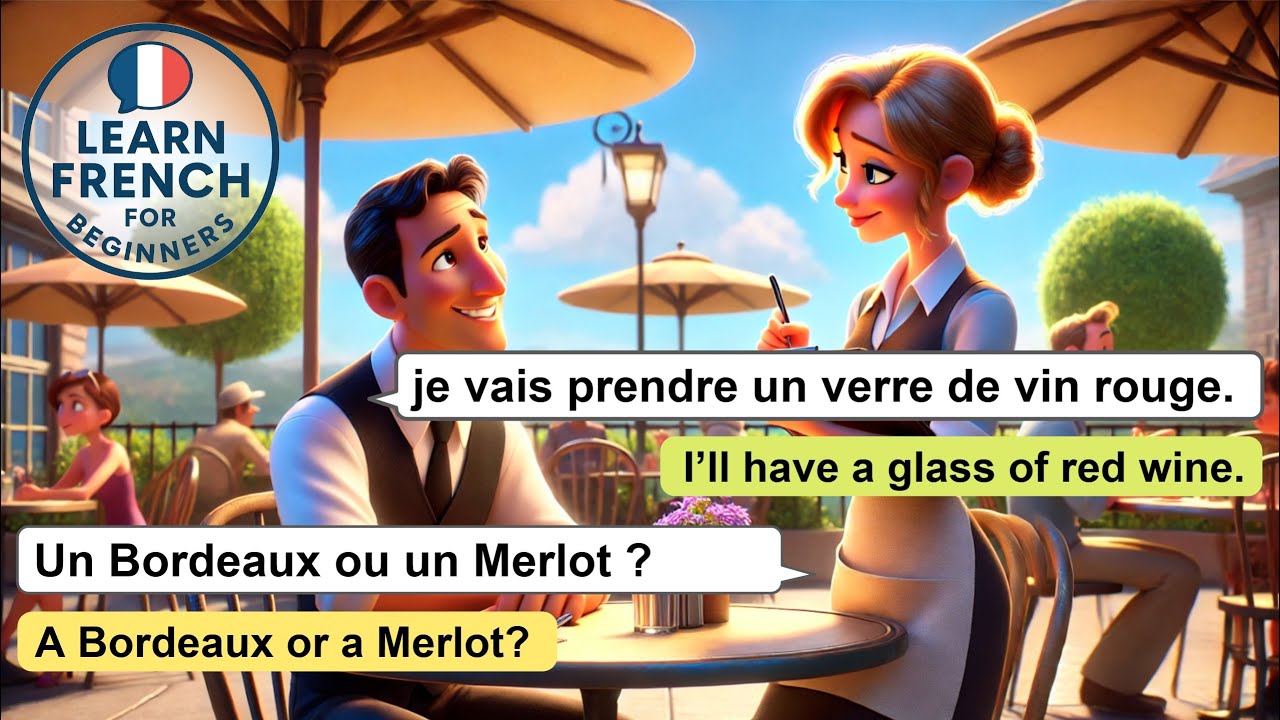
Examples:
Je **vais prendre** le plat du jour.(I'll have the dish of the day.)Nous **allons prendre** une bouteille d'eau.(We are going to have a bottle of water.)
3. A Step-by-Step Restaurant Interaction
Now, let's walk through a complete restaurant scenario, from arriving to leaving. We will use a video that breaks down each stage of the process.
Step 1: Arriving and Ordering Drinks
First, you'll be greeted and seated. Then, the server (le serveur or la serveuse) will often ask if you'd like a drink to start.
Ordering at a Restaurant • Everyday Conversations in French
This video from Rosetta Stone demonstrates a typical restaurant conversation. Let's watch the first part, which covers arriving and ordering a drink.
Watch from 00:14 to 02:52. Listen for these key phrases: 'Vous désirez boire quelque chose ?' (Do you want something to drink?) 'Une carafe d'eau, s'il vous plaît.' (A carafe of water, please.)
Key takeaways from this step:
- You'll be given la carte (the menu).
- If you just want tap water (which is free and perfectly fine to drink in France), ask for une carafe d'eau. If you want bottled water, you'd ask for une bouteille d'eau (either plate - still, or gazeuse - sparkling).
Step 2: Ordering Your Meal
Once you're ready, the server will return to take your food order.
Ordering at a Restaurant • Everyday Conversations in French
Now, let's watch the next part of the video to see how to order the main meal.
Watch from 02:52 to 04:54. Focus on these crucial questions and statements: 'Vous avez choisi ?' (Are you ready to order? / Have you chosen?) 'Qu'est-ce que vous recommandez ?' (What do you recommend?) 'Je vais prendre le plat du jour.' (I'll take the special of the day.)
Key takeaways from this step:
- If you're undecided, asking for a recommendation is a great idea.
- The waiter might ask about how you'd like your steak cooked (la cuisson):
- Bleue: Very rare
- Saignante: Rare
- À point: Medium-rare
- Bien cuit: Well-done
Step 3: Finishing and Paying the Bill
In France, the server will not bring the bill until you ask for it. It's considered rude to rush customers.
Ordering at a Restaurant • Everyday Conversations in French
Finally, let's see how to signal you're finished, order a coffee, and ask for the bill.
Watch from 04:54 to 06:57. Listen for how to get the server's attention and the all-important phrase for the bill. 'Excusez-moi !' (Excuse me!) 'Vous avez fini ?' (Have you finished?) 'L'addition, s'il vous plaît.' (The bill, please.)
Key takeaways from this step:
- To get the server's attention, a simple "Excusez-moi" or raising your hand is appropriate.
- The phrase "L'addition, s'il vous plaît" is essential.
- Cultural note on tipping: Service is included in the price (service compris). Tipping is not expected, but it's common to leave a few coins or round up to the nearest euro (laisser un pourboire) for good service.
4. The Café Experience: Ordering Coffee
The process in a café is similar but often quicker. Ordering coffee can be specific, as "un café" in France defaults to a small, strong espresso.
This next video shows several real interactions in a Parisian café. It will help you get used to the speed of natural conversation and learn the names for different types of coffee.
How to Order Coffee in a French Café | Super Easy French 75
Let's watch some clips from 'Easy French' to see how people order coffee and learn the vocabulary for different types.
Watch from 01:13 to 03:31. Notice the different ways people order ('Je voudrais...', 'Est-ce que je peux avoir...'). Pay close attention to the explanation of these common coffee types: 'Un café' / 'un expresso' 'Un café allongé' (espresso with more water) 'Un café crème' (coffee with steamed milk) 'Un café noisette' (espresso with a dash of milk)
Cultural note on takeaway: As the video mentions, ordering coffee "to go" (à emporter) is not standard in many traditional Parisian cafés. People are expected to drink it there, even if just for a few minutes at the counter (au comptoir).
5. Practice Scenario
Let's put it all together. Imagine you are in a restaurant in Lyon. How would you say the following to the waiter?
- "Good evening, a table for two, please."
- (After being seated) "I would like a glass of red wine, please."
- (When ready to order food) "What do you recommend?"
- (After the recommendation) "Okay, I am going to have the beef bourguignon (
le bœuf bourguignon)." - (After the meal) "The bill, please."
- (When paying) "Can I pay by card?" (
Je peux payer par carte ?)
Take a moment to formulate your French sentences before checking the answers below.
Check your answers
Bonsoir, une table pour deux, s'il vous plaît.Je voudrais un verre de vin rouge, s'il vous plaît.Qu'est-ce que vous recommandez ?D'accord, je vais prendre le bœuf bourguignon.L'addition, s'il vous plaît.Je peux payer par carte ?
For a final review, you can read through this complete restaurant dialogue from Lawless French. It includes many of the phrases we've discussed today.
Au restaurant - Lawless French Listening Comprehension
This resource provides a full restaurant dialogue with a side-by-side English translation. Reading through it is a great way to consolidate everything you've learned.
Read the entire dialogue table. Notice how the conversation flows from making a reservation to ordering drinks, food, dessert, and finally paying.
Conclusion
Très bien ! You now have the essential phrases and cultural knowledge to confidently order in a French café or restaurant.
Key Takeaways:
- Use polite phrases like
Je voudrais...(I would like...) or the common conversational phraseJe vais prendre...(I'll have...). - Remember key vocabulary:
la carte(menu),l'addition(the bill),une carafe d'eau(tap water). - Don't wait for the bill; you must ask for it with
L'addition, s'il vous plaît. - Tipping is not obligatory, as service is included.
In our next lesson, we'll continue building your practical skills by learning how to ask for and give directions in a city. Now that you can order a meal, you'll be able to find your way to the restaurant!
Bon appétit et à la prochaine !