Bonjour ! Welcome to your next lesson.
Introduction
In our last lesson, we focused on reflexive verbs and how to use them to describe your daily routine. You learned to say things like Je me lève (I get up) and Je me prépare (I get ready).
Today, we're going to look forward and learn how to talk about the future. Specifically, this lesson covers how to express future actions and plans using the near future tense, known as le futur proche. This is one of the most common ways French speakers talk about what's going to happen next, whether it's your plans for the evening, your tasks for the next workday, or the next steps in a project.
By the end of this lesson, you'll be able to confidently say what you are "going to do," a crucial skill for both daily conversations and professional planning.
1. What is the Futur Proche?
The futur proche (near future) is a verb tense used to talk about things that are going to happen soon or are planned. It's the direct equivalent of "going to + verb" in English. As a software engineer, you'll find this extremely useful for discussing upcoming tasks, like "I am going to deploy the code" or "We are going to start the next sprint."
The structure is simple and consistent:
Subject + aller (conjugated in the present tense) + infinitive verb
You've already learned the present tense conjugation of aller (to go), which is the key to forming this tense.
Let's start with a video that clearly explains this structure.
French Grammar - Le Futur Proche
This video from the 'Comme une Française' channel will introduce you to the 'futur proche' and how it's constructed. The presenter gives clear examples and reviews the conjugation of 'aller'.
Watch from 03:22 to 05:07. Focus on the simple formula presented: 'sujet + aller au présent + verbe à l'infinitif'. Pay attention to the conjugation of 'aller' which is recited.
To reinforce this structure, take a look at this helpful graphic.
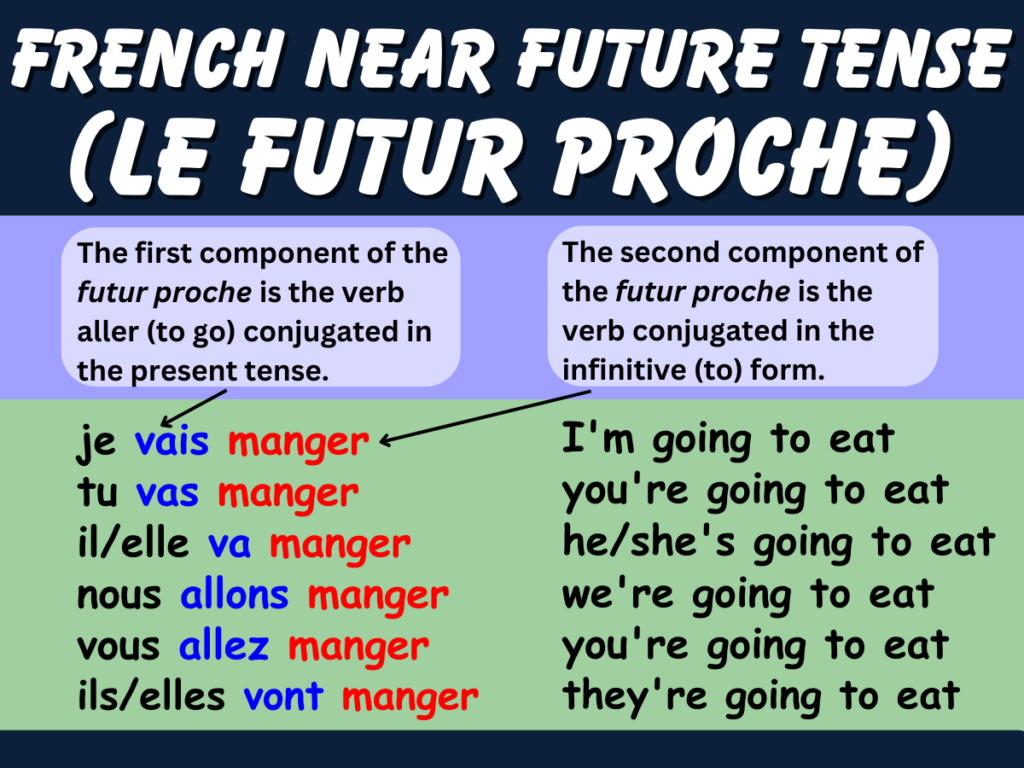
2. Forming the Futur Proche: Examples
Now that you understand the basic structure, let's look at it more closely with written examples. Remember, the infinitive is the unconjugated form of the verb, like parler (to speak), finir (to finish), or vendre (to sell).
Discussing your future study and work plans in French
The article 'Discussing your future study and work plans in French' from BBC Bitesize provides a clear table for the conjugation of 'aller' and several example sentences. This will help you solidify your understanding.
Read the section 'Grammar - How to form the near future tense'. Study the conjugation table for 'aller' and review the example sentences provided.
Let's apply this to your professional context. Notice how the second verb always remains in its infinitive form.
Je **vais développer** une nouvelle fonctionnalité.(I am going to develop a new feature.)Tu **vas tester** le code.(You are going to test the code.)L'équipe **va commencer** le sprint demain.(The team is going to start the sprint tomorrow.)Nous **allons avoir** une réunion à 10h.(We are going to have a meeting at 10 AM.)Vous **allez déployer** le projet.(You are going to deploy the project.)Ils **vont fusionner** la branche.(They are going to merge the branch.)
This structure even works with reflexive verbs, which you learned in the last lesson. The reflexive pronoun simply goes before the infinitive.
Je vais **me connecter** au serveur.(I am going to connect to the server.)Nous allons **nous retrouver** pour le stand-up.(We are going to meet for the stand-up.)
3. Making Plans Negative: ne...pas
What if you want to say what you are not going to do? For negative sentences in the futur proche, the ne...pas structure wraps around the conjugated verb, which is aller.
Subject + ne + aller (conjugated) + pas + infinitive verb
This video provides a very clear explanation of how to form negative sentences.
The FUTUR PROCHE = going to in English // French conjugation course // Lesson 32
Let's watch a clip from 'The perfect French with Dylane' that explains how to use negation with the 'futur proche'.
Watch the segment from 03:42 to 05:17. The key takeaway is the placement of 'ne' and 'pas' around the conjugated form of 'aller'.
Here are some examples relevant to your work:
Je **ne vais pas** écrire la documentation aujourd'hui.(I am not going to write the documentation today.)Elle **ne va pas** corriger ce bug.(She is not going to fix this bug.)Nous **n'allons pas** annuler la réunion.(We are not going to cancel the meeting.) Noticen'is used becauseallonsstarts with a vowel.
4. Practice Exercises
Time to put your knowledge into practice!
A. Listening Practice
Let's start by listening to native speakers discuss their future plans. This will help you get used to hearing the futur proche in context.
Discussing your future study and work plans in French
In the same BBC Bitesize article, there is a short video of friends discussing their plans. Try to spot the 'futur proche' being used.
Scroll down to the 'Video - Describing future plans' section. Watch the video (it's short!) and read the transcript. Try to identify every time a character uses the 'aller + infinitive' structure. For example, you'll hear 'Je vais aller à la mer'.
B. Written Practice
Translate the following sentences into French. This exercise combines what you've learned today with some of the tech vocabulary from your course.
- I am going to write an email.
- We are going to start the project next week.
- Are you (formal,
vous) going to test the application? - My colleague is not going to attend the meeting. (
assister à la réunion) - They (masculine) are going to discuss the architecture. (
discuter de l'architecture) - I am going to get ready for my presentation. (
se préparer pour ma présentation)
Check your answers
Je vais écrire un e-mail.Nous allons commencer le projet la semaine prochaine.Allez-vous tester l'application ?orEst-ce que vous allez tester l'application ?Mon collègue ne va pas assister à la réunion.Ils vont discuter de l'architecture.Je vais me préparer pour ma présentation.
Conclusion
Excellent work! You can now talk about your future intentions and plans using the futur proche. This is a versatile and incredibly common tense that you will hear and use constantly.
Key Takeaways:
- The
futur procheis used for near-future actions and plans, equivalent to "going to" in English. - It is formed with
aller(present tense) + infinitive verb. - For negation,
ne...passurrounds the conjugated verballer. - This structure is essential for discussing upcoming tasks, appointments, and personal plans.
In our next lesson, we will move to another practical, real-world scenario: ordering food and drinks at a café or restaurant. You'll learn the key vocabulary and phrases to handle this common social situation with ease.
À la prochaine ! (Until next time!)