Bonjour! Welcome to your fifth lesson.
Introduction
In our last lesson, you learned how to construct basic declarative sentences using subject pronouns and verb conjugations (e.g., Je suis développeur, Nous avons une réunion). You can now state facts about yourself and your work.
Today, we'll turn those statements into conversations. The learning outcome for this lesson is to ask and answer simple yes/no questions using intonation and 'est-ce que'. This is a crucial step towards your goal of participating in workplace meetings and daily interactions. You'll learn how to transform a simple statement like "You are the project manager" into the question "Are you the project manager?", moving from one-way declarations to two-way dialogue.
From Statement to Conversation
In French, there are several ways to ask a question. We will focus on the two most common and practical methods for yes/no questions, which will cover the vast majority of situations you'll encounter.
- Rising Intonation: The informal, spoken method.
Est-ce que: The neutral, all-purpose method.
Let's start with the simplest one.
1. Asking Questions with Intonation
This is the easiest way to ask a question in spoken French and is extremely common in everyday conversations. You simply take a statement and raise the pitch of your voice at the end.
Statement: Vous parlez anglais. (You speak English.)
Question: Vous parlez anglais ? ↗ (Do you speak English?)
This method is best for informal contexts, like chatting with teammates you know well.
Interrogatives - How to ask a (yes/no) question in French
To see this in writing, let's look at two quick explanations. These articles clearly describe how this simple technique works.
First, read section 1, 'Questions with rising intonation', in the article from Matt French Tutor. It's very short and gives clear examples.
French Question Formation: 4 Key Methods with Examples ...
The article 'French Question Formation' from Preply also offers a great summary and context for when to use this method.
Now, read section 1, 'Intonation', to reinforce the concept and understand the appropriate social context.
In your work environment, you could use this for quick, informal checks:
On commence la réunion ?(Are we starting the meeting?)Tu as reçu mon email ?(Did you receive my email?)Le serveur fonctionne ?(Is the server working?)
2. The Universal Tool: Est-ce que
While intonation is great, it can feel too informal in some professional settings. For a universally understood and grammatically clear way to ask a yes/no question, you can use est-ce que.
Think of est-ce que (pronounced "ess-kuh") as a standard wrapper you place at the beginning of a statement to turn it into a question. The word order of your original sentence does not change at all.
Structure: Est-ce que + [Subject] + [Verb] + ...?
Let's watch a video that explains this simple but powerful structure.
Learn How to Ask Questions in French - A1 [with Alicia]
The video 'Learn How to Ask Questions in French' from lingoni FRENCH provides a very clear demonstration of how est-ce que functions as a fixed expression.
Watch from 00:55 to 03:55. The instructor shows how you can take any affirmative sentence, add est-ce que to the beginning, and you have a perfect question. Notice how the rest of the sentence structure remains identical.
As you just saw, you can turn a statement into a question with minimal effort:
- Statement:
Vous avez un bug.(You have a bug.) - Question:
Est-ce quevous avez un bug ?(Do you have a bug?)
A Step-by-Step Method
For someone with a background in logical processes, like software development, it can be helpful to think of this as an algorithm:
- Formulate the statement you want to question (e.g., "She is the designer").
- Translate that statement into French:
Elle est la designer. - Prepend
Est-ce queto the statement:Est-ce qu'elle est la designer ?
This next video explains this exact process, which can be very helpful for English speakers.
Asking questions in French with EST-CE QUE (French Essentials Lesson 30)
The video 'Asking questions in French with EST-CE QUE' from 'Learn French With Alexa' walks through this logical, step-by-step approach.
Watch from 02:25 to 04:19 and then from 08:12 to 08:41. The first part demonstrates how to build a question from a statement. The second short part explains an important pronunciation rule you see in my example above.
The qu' Elision
As the video mentioned, if the word following est-ce que starts with a vowel sound (a, e, i, o, u), you must contract que to qu' and link the sounds. This is called elision.
Est-ce qu'ila l'accès ?(Does he have access?) — NotEst-ce que il...Est-ce qu'elledéploie le code ?(Is she deploying the code?) — NotEst-ce que elle...Est-ce qu'ona une réunion ?(Do we have a meeting?) — NotEst-ce que on...
Choosing Your Method: Intonation vs. Est-ce que
So, which one should you use? The choice depends entirely on the context and level of formality.
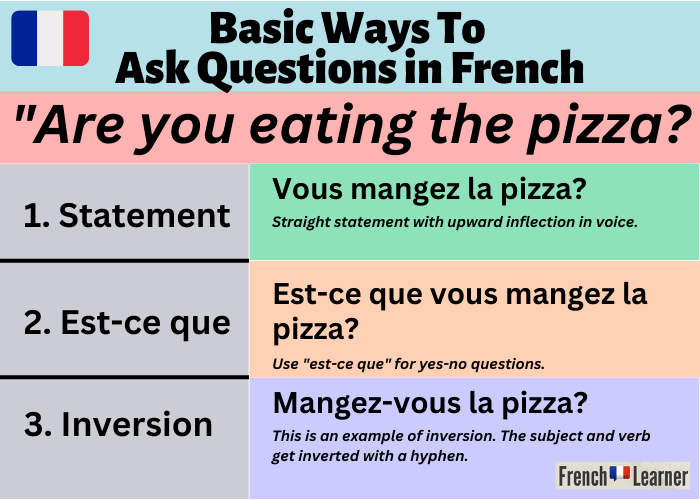
Here's a simple guide:
| Method | Formality | Common Usage | Example (You are ready) |
|---|---|---|---|
| Intonation | Informal | Spoken, with friends, colleagues | Vous êtes prêt ? |
Est-ce que |
Neutral | Spoken & Written, most situations | Est-ce que vous êtes prêt ? |
| Inversion | Formal | Written, very formal speech | Êtes-vous prêt ? |
For your immediate goal of practical communication, mastering intonation and est-ce que is what matters most. Est-ce que is your safest bet—it's never wrong. As you get more comfortable with your team, you'll naturally start using intonation more.
Let's read a quick FAQ that confirms this from the perspective of a native speaker.
French Question Formation: 4 Key Methods with Examples ...
The FAQ section of the Preply article 'French Question Formation' has a perfect, concise answer to how native speakers ask questions in casual conversation.
Find the section 'Frequently asked questions...' and read the second question: 'How do French native speakers typically ask questions in casual conversations?'. This confirms the advice given above.
Test your understanding!
You need to turn the statement "The test passes" (Le test passe) into a question. How would you ask this in the following scenarios?
- A quick, informal question to your developer pair sitting next to you.
- A question to your manager in a slightly more formal review meeting.
Show answer
- Informal:
Le test passe ?(with rising intonation). This is quick, efficient, and perfectly appropriate between colleagues working closely together. - More formal/neutral:
Est-ce que le test passe ?. This is clear, respectful, and can't be misinterpreted. It's the perfect choice when you are not sure about the level of formality.
Conclusion
Excellent travail aujourd'hui ! (Excellent work today!) You have just acquired a fundamental skill for interactive communication.
Key Takeaways:
- You can now form simple yes/no questions in two essential ways.
- Rising intonation turns a statement into an informal question, perfect for casual conversations with peers (
Tu as fini le code ?). Est-ce queis a neutral "question marker" you add to the beginning of a statement for all-purpose use (Est-ce que tu as fini le code ?).- Remember the elision:
est-ce quebecomesest-ce qu'before a vowel sound (Est-ce qu'il est prêt ?).
Now that you can ask about things, our next step is to get better at identifying and naming them. In the next lesson, we will focus on using definite and indefinite articles (le, la, les, un, une, des) correctly. This will allow you to specify whether you're asking about "the bug" (le bug) that everyone knows about, or just "a bug" (un bug) that you've discovered.
À la prochaine !