Bonjour ! Welcome to your fourth lesson.
Introduction
In our last lesson, you learned the essential phrases for introducing yourself, including your name (Je m'appelle...), nationality (Je suis...), and profession (Je suis développeur). These phrases are your entry ticket to any conversation.
Today, we're going to build the grammatical engine that powers those phrases and allows you to create many more. The learning outcome for this lesson is to use subject pronouns (je, tu, il/elle, nous, vous, ils/elles) with correct verb conjugations.
Think of subject pronouns as the "actors" in a sentence and verbs as the "actions." By learning how to pair them correctly, you'll be able to talk not just about yourself (je), but also about your colleagues (il, elle), your team as a whole (nous, ils), and your clients or managers (vous). This is a fundamental step toward your goal of communicating effectively in a professional French environment.
1. The "Actors": French Subject Pronouns
In French, just like in English, the subject pronoun indicates who or what is performing the verb's action. You've already been using one: je (I).
Here is a quick overview of all the French subject pronouns.
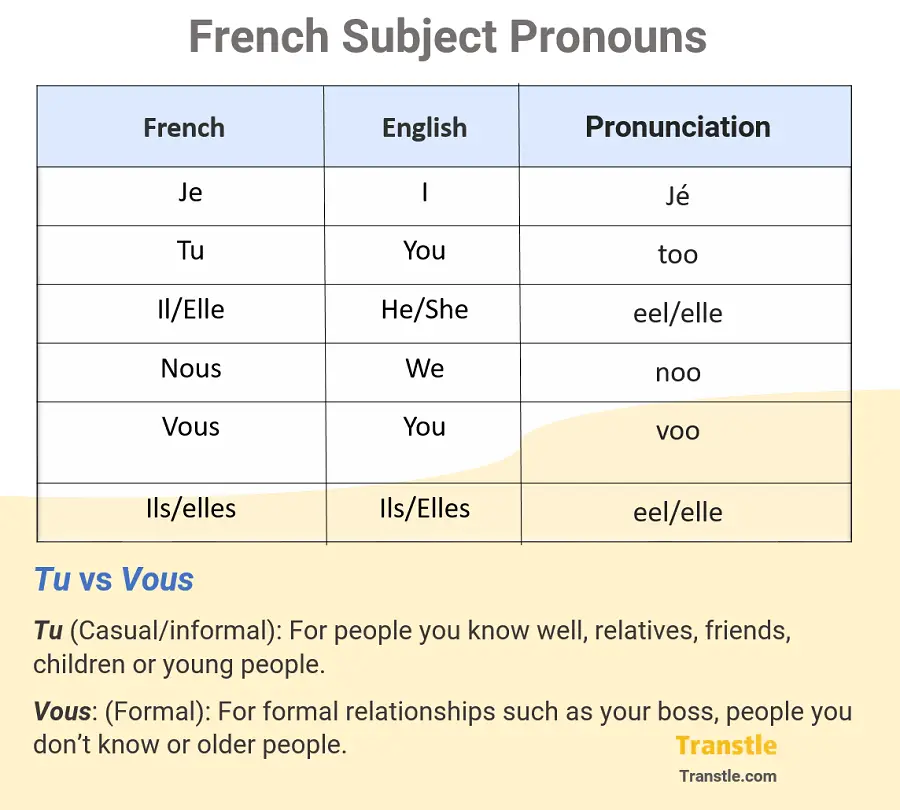
To get a clear understanding of each pronoun, let's watch a video that breaks them down.
French Subject Pronouns (French Essentials Lesson 9)
The video 'French Subject Pronouns' by 'Learn French With Alexa' is an excellent guide. It introduces the pronouns in the order that French children learn them, which is helpful for remembering verb patterns later.
Watch from 02:13 to 10:27. First, the video will cover the singular pronouns (je, tu, il, elle, on). Then, it will explain the plural pronouns (nous, vous, ils, elles). Pay close attention to the rule for ils vs. elles when talking about a mixed-gender group.
Key Distinctions for Professional and Daily Use
While the video gives a great overview, three distinctions are so important for practical communication that we need to examine them more closely.
A. tu (informal 'you') vs. vous (formal 'you')
This is perhaps the most critical cultural aspect of French pronouns. Using the wrong one can be seen as either overly familiar or too distant.
Tu: Use with family, friends, children, and colleagues you know well.Vous: Use with strangers, older people, clients, and in most professional contexts, especially with superiors or when you first meet someone. When in doubt, always usevous. It is a sign of respect.
Vous is also used to address any group of two or more people, regardless of formality.
Let's deepen our understanding of this crucial difference.
How to use subject pronouns and stressed ...
The article 'How to use subject pronouns' from Mango Languages gives practical advice on navigating the tu/vous choice.
Read the section titled 'How to use ‘tu’ and ‘vous’ in French?'. It gives clear examples and a very useful tip on how to ask if you can switch from vous to tu ('On peut se tutoyer?').
B. nous (we) vs. on (we)
Both nous and on can mean "we," but they are used in different contexts.
Nous: This is the grammatically formal "we." You will see it in written documents, formal speeches, and professional emails.On: This is the "we" of everyday spoken French. In a team meeting or a casual chat with colleagues, you will hearonused for "we" almost exclusively.
A key grammar point: nous takes a plural verb form, but on takes a singular verb form (the same as il/elle).
Nous **développons** une API.(We are developing an API - formal)On **développe** une API.(We are developing an API - common/spoken)
C. ils (they) vs. elles (they)
As the video explained, the choice depends on gender.
Ils: Used for a group of all-masculine subjects OR a mixed-gender group. Even if there are 99 women and 1 man, you useils. This is relevant when talking about a typical software development team.Elles: Used for a group of exclusively feminine subjects.
Test your understanding!
Which pronoun would you use in the following situations?
- To ask your manager, whom you've just met, "Are you the project manager?"
- To say "We are fixing a bug" in a casual conversation with your team.
- To refer to a group of colleagues: Maria, Sophie, and Laura.
- To refer to another group of colleagues: Maria, David, and a server named "Le Titan". (Remember, even inanimate objects have gender in French!
Un serveuris masculine.)
Show answer
Vous. This is a formal, professional relationship.Vous êtes le chef de projet ?On. This is a casual, spoken context.On corrige un bug.Elles. This is an all-feminine group.Elles travaillent sur le front-end.Ils. This is a mixed-gender group.Ils sont dans la salle de réunion.(They are in the meeting room.)
2. The "Actions": Verb Conjugation
Conjugation is the process of changing a verb's ending to match its subject. In English, this is simple (e.g., I talk, she talks). In French, it's more complex, as the ending changes for almost every subject pronoun.
Let's start with the two most important verbs in French: être (to be) and avoir (to have). They are irregular, so you need to memorize their forms, but they are essential for thousands of expressions.
"Être" and "Avoir" in French: Master their Conjugation
This article from Busuu provides clear conjugation tables for être and avoir in the present tense.
Read the sections 'Conjugation of "être" in the present tense' and 'Conjugation of "avoir" in the present tense'. Study the tables and the example sentences. These are your foundation.
Here are the conjugations from the article for easy reference:
être (to be) |
avoir (to have) |
|---|---|
Je **suis** |
J'**ai** |
Tu **es** |
Tu **as** |
Il/Elle/On **est** |
Il/Elle/On **a** |
Nous **sommes** |
Nous **avons** |
Vous **êtes** |
Vous **avez** |
Ils/Elles **sont** |
Ils/Elles **ont** |
Examples for your context:
Je **suis** ingénieur.(I am an engineer.)Elle **est** la chef de projet.(She is the project manager.)Nous **avons** une réunion à 10h.(We have a meeting at 10.)Ils **ont** un problème avec le serveur.(They have a problem with the server.)
3. The Regular -er Verb Pattern
The good news is that not all verbs are irregular. The largest group of verbs in French, those ending in -er, follow a predictable pattern. If you learn this one pattern, you can conjugate thousands of verbs!
Let's see how it works.
Group 1 Regular French Verbs ending in "ER" (Present Tense)
The video 'Group 1 Regular French Verbs ending in "ER"' from 'Learn French With Alexa' will show you the simple, step-by-step process for conjugating these verbs.
Watch from 01:56 to 05:08. The video explains the core mechanism: you take the infinitive (like parler), drop the -er to get the 'stem' (parl-), and then add a specific ending for each subject pronoun. Pay attention to which endings are pronounced and which are silent.
Here is the pattern for -er verbs using parler (to speak) as an example:
- Infinitive:
parler - Stem:
parl- - Add endings:
Je parl**e**Tu parl**es**Il/Elle/On parl**e**Nous parl**ons**Vous parl**ez**Ils/Elles parl**ent**
Crucial Pronunciation Tip: The endings for je, tu, il/elle/on, and ils/elles are all silent! So, parle, parles, and parlent all sound exactly the same. This is a key feature of spoken French.
Let's apply this to a verb from your field: développer (to develop).
- Stem:
développ- Je développ**e**Tu développ**es**Il/Elle/On développ**e**Nous développ**ons**Vous développ**ez**Ils/Elles développ**ent**
Test your understanding!
The verb tester (to test) is a regular -er verb. How would you say "We test the application"? (Use the common, spoken form of "we").
Show answer
On teste l'application.
- We use
onfor the common, spoken form of "we". - The stem of
testeristest-. - The ending for
onis-e. On test+-e=On teste.
Conclusion
This was a dense but incredibly important lesson. You've built a core part of your French grammatical toolkit.
Key Takeaways:
- You can now identify and use all the French subject pronouns:
je, tu, il, elle, on, nous, vous, ils, elles. - You understand the critical social and professional distinction between
tu(informal) andvous(formal/plural). - You know when to use
on(spoken "we") versusnous(formal "we"). - You have memorized the present tense of the essential irregular verbs
êtreandavoir. - You can apply the conjugation pattern for the vast majority of French verbs: the regular -er verbs.
In our next lesson, we will put this new knowledge to immediate use. We will learn how to ask and answer simple yes/no questions using intonation and 'est-ce que'. This will enable you to move from making statements to having real, interactive conversations.
Excellent travail ! À la prochaine. (Excellent work! See you next time.)