Bonjour !
In our last lesson, we focused on extracting specific details from a conversation, like action items and deadlines. That skill is essential when you understand most of what's being said. But what happens when you don't? A fast speaker, an unfamiliar word, or background noise can create a comprehension gap that leaves you lost.
Today, we will address that exact situation. Our goal is to apply strategies for handling comprehension gaps, such as asking for repetition or clarification. Mastering these phrases is not a sign of weakness; it's a sign of a confident, proactive communicator who takes responsibility for understanding. These strategies are your safety net, allowing you to engage in any conversation without the fear of getting lost.
1. The First Step: Diagnosing the Problem
When you miss something, the first step is to quickly identify why. Was the problem auditory (you couldn't hear) or cognitive (you couldn't understand)? The strategy you choose depends on this diagnosis. Most students learn Répétez, s'il vous plaît, but this is often not the best phrase to use.
Let's explore this crucial distinction.
10 Tips to Say I'm Confused in French 🤷♀️
The article '10 Tips to Say I'm Confused in French' from FrenchToday explains why 'Répétez s'il vous plaît' isn't always the right choice and offers better alternatives.
Please read the first tip, under the heading '1 – Don’t Say “Répétez s’il vous plaît”'. Focus on the difference between not hearing and not understanding.
As the article points out, if you didn't understand something, having the person repeat the exact same confusing words probably won't help. Répétez is best reserved for when you simply didn't hear.
2. Your Toolkit for Comprehension Gaps
Now let's build your toolkit with phrases for both scenarios. We'll cover everything from short, simple interjections to more complete, polite sentences.
The following video provides a great overview of the most common ways to ask for repetition, ranging from very informal to very polite.
How to say what in French when you need someone to repeat themselves
This video from the 'Oui In France' channel clearly explains several essential phrases to use when you need someone to repeat themselves.
Watch from the beginning until 03:43. Pay close attention to the different levels of formality for 'Comment?', 'Quoi?', 'Pardon?', and 'Hein?'.
Based on the video and our previous reading, let's organize these phrases.
Scenario A: You Didn't Hear
If the issue is noise, a poor connection, or someone speaking too quietly, your goal is simply to have them say it again, maybe louder.
- Polite & Simple:
Pardon ?orComment ?- These are your go-to, all-purpose options. They are polite, quick, and universally understood to mean "I didn't catch that, could you say it again?".
- More Specific & Formal:
Excusez-moi, je n'ai pas bien entendu.(Excuse me, I didn't hear well.)Pourriez-vous parler plus fort, s'il vous plaît ?(Could you speak louder, please?)Vous pouvez répéter, s'il vous plaît ?(Can you repeat, please?) - This is a softer, more polite version than the direct commandRépétez.
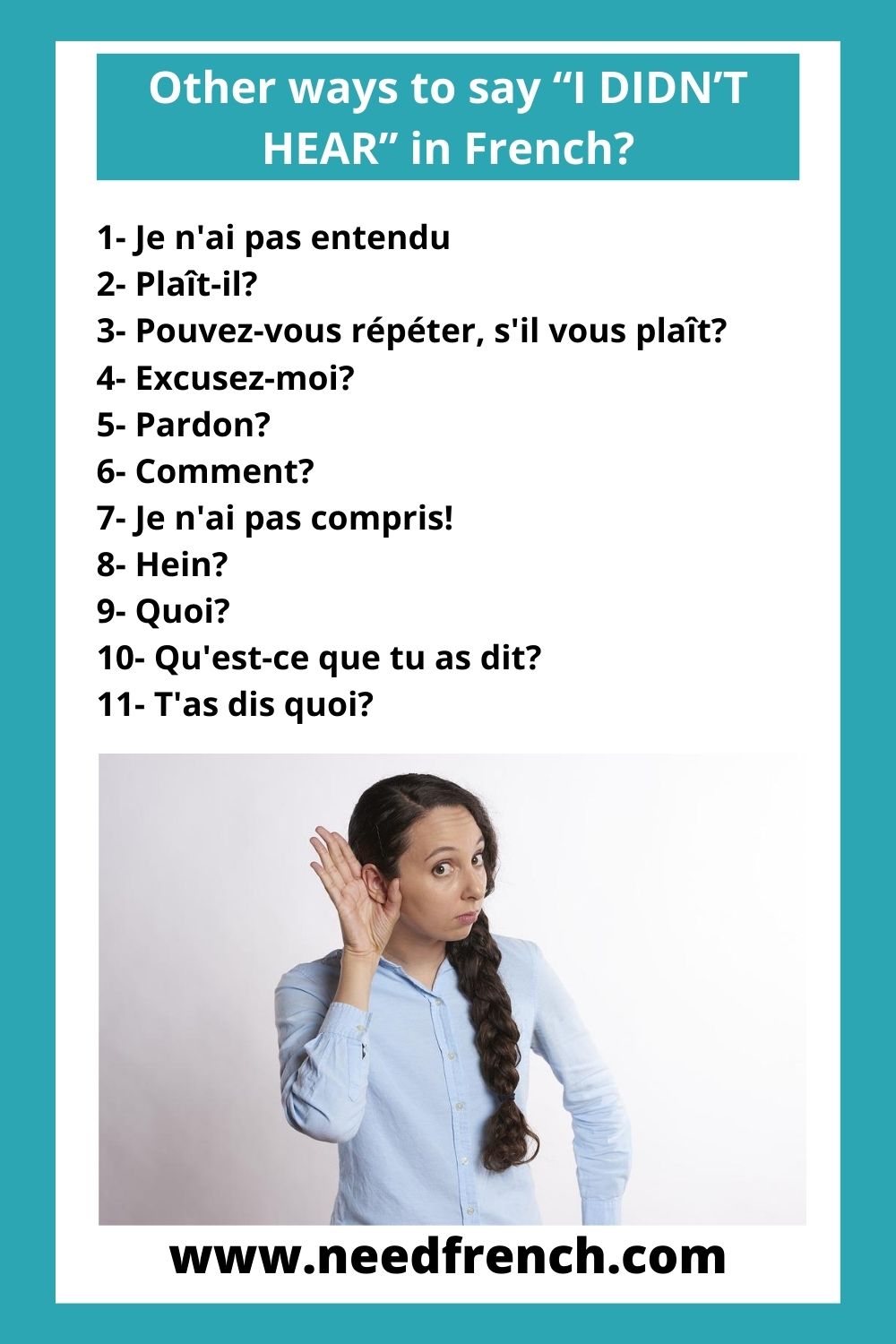
Scenario B: You Didn't Understand
This is more complex. The person's sentence might be too fast, use a word you don't know, or be grammatically complex. Your goal is to get them to reformulate or slow down, not just repeat.
- Avoid:
Je ne comprends pas.- As the FrenchToday article noted, this can signal that you've understood nothing, which may cause your French colleague to give up and switch to English.
- Better Phrases to Encourage Reformulation:
Je n'ai pas **bien** compris.(I didn't understand well.)Je n'ai pas **tout** compris.(I didn't understand everything.)Désolé(e), je suis un peu perdu(e).(Sorry, I'm a little lost.)
These phrases are more precise. They tell the speaker that you're following along but missed a specific part, inviting them to explain it differently.

3. Advanced Strategies for Pinpoint Clarity
Good communicators don't just say they're lost; they help the other person find them. Here are three powerful strategies to pinpoint the source of confusion, which are especially useful in a technical context.
Strategy 1: Ask for a Slower Pace
French is often spoken very quickly. It is perfectly acceptable and very common for learners to ask speakers to slow down.
Excusez-moi, pourriez-vous parler plus lentement, s'il vous plaît ?
(Excuse me, could you speak more slowly, please?)
Strategy 2: Isolate the Unknown Word
If a specific word is the problem, ask about it directly. This is efficient and shows you understood the rest of the sentence.
Qu'est-ce que ça veut dire, 'déboguer' ?
(What does 'déboguer' mean?)
Ça veut dire quoi, 'un point d'arrêt' ?(informal)
(What does 'un point d'arrêt' mean?)
If you're unsure of the spelling of a new term, especially in a remote meeting, you can ask:
Vous pouvez l'épeler, s'il vous plaît ?
(Can you spell it, please?)
Strategy 3: The "Repeat-Back" Technique
This is perhaps the most effective strategy of all. It involves repeating the part of the sentence you did understand with a questioning intonation. This immediately shows your partner where you got lost.
Let's watch the final tip from the "Oui in France" video, which explains this technique perfectly.
How to say what in French when you need someone to repeat themselves
We'll now return to the 'Oui In France' video for a final, incredibly useful tip for beginners.
Watch from 04:39 to 06:20. The speaker gives a brilliant example of how to use the words you understood to get clarification on the parts you missed.
Let's apply this to your work. Imagine your manager says:
"Après le déploiement, il faut vérifier les logs pour s'assurer qu'il n'y a pas d'erreurs d'authentification."
You understood everything except the last word. Instead of saying "Je n'ai pas compris", you can say:
Pardon, des erreurs de quoi ?(Sorry, errors of what?)... or simply repeat back with a rising tone:
Vérifier les logs pour les erreurs d'...?
This is a highly efficient and professional way to handle a comprehension gap.
4. Practice Scenario: Daily Stand-up Meeting
Let's put this into practice. Read the following exchange from a daily stand-up meeting. Your project manager, Léa, is speaking to you. Her speech includes some natural, fast-spoken French.
Léa: "Salut. Bon, pour la nouvelle feature, j'ai vu que t'as pushé le code hier soir. C'est bien, mais j'ai l'impression qu'on a un souci de régression sur le module de paiement. Faut investiguer ça en priorité aujourd'hui. T'as le temps de regarder avant midi ?"
This short paragraph contains several potential comprehension gaps. For each question below, write down the French phrase you would use to get clarification.
- Léa speaks quickly at the beginning. You heard
j'ai vu que...but missed the part right after. How do you ask her to repeat what she just said? - You are not familiar with the term
régression. What do you ask to understand this specific word? - Léa says
Faut investiguer ça.... You understand the general idea but want to confirm the action item and priority. How could you reformulate to confirm your understanding?
Check your suggested phrases
- To ask for repetition:
Pardon, vous avez vu que... quoi ?(using the repeat-back technique)Excusez-moi, je n'ai pas bien saisi le début de la phrase.(Excuse me, I didn't quite catch the beginning of the sentence.)
- To ask about a specific word:
Excusez-moi, qu'est-ce que ça veut dire, un 'souci de régression' ?'Régression', ça veut dire quoi ?
- To reformulate and confirm:
Donc, si je comprends bien, la priorité aujourd'hui est d'investiguer un possible bug de régression sur le module de paiement. C'est bien ça ?D'accord, alors l'action pour moi, c'est de vérifier le module de paiement avant midi, c'est ça ?
Conclusion
Excellent work today. You've just acquired a complete toolkit for confidently navigating conversations, even when you don't understand everything. This is a massive step towards fluency and professional poise.
Key Takeaways:
- It's not just okay to ask for clarification—it's necessary for effective communication.
- First, diagnose the problem: did you not hear or not understand? Choose your phrase accordingly.
- Avoid generic phrases like
Je ne comprends pas. Be specific. Ask the speaker to slow down, define a word, or use the "repeat-back" technique to pinpoint your confusion. - Reformulating (
Si je comprends bien...) is a powerful tool to confirm details and show you're engaged.
Preview of the Next Lesson:
Now that you have this essential safety net, you're ready to take on a more active role. In our next lesson, you will learn to participate in a mock technical planning meeting, defending a chosen approach. The skills you learned today will give you the confidence to handle any uncertainties as you discuss and debate technical solutions.
À très bientôt