Hello again.
In our last few lessons, we've been building a "philosopher's toolkit" by exploring foundational concepts. We've distinguished between metaphysics and epistemology, semantic realism and anti-realism, and surveyed the major theories of truth. These concepts often operate in the background of philosophical arguments about logic. Today, we turn to one of the most influential distinctions in the history of philosophy, one that lies at the very heart of questions about the nature of logical and mathematical knowledge.
This lesson addresses the learning outcome: Explain the analytic-synthetic distinction and its traditional role in grounding a priori knowledge. We will investigate a classic epistemological puzzle: How can we acquire knowledge about the world, especially in disciplines like mathematics and logic, without relying on sensory experience? The concepts we explore today were central to the attempts by philosophers and logicians to answer this very question.
1. Two Fundamental Distinctions
To understand the analytic-synthetic distinction, we must first place it alongside another key epistemological distinction: the difference between a priori and a posteriori knowledge. It is crucial to see that these are two separate distinctions that classify judgments along different axes.
- The a priori / a posteriori distinction concerns the justification of our knowledge: how we come to know something.
- The analytic / synthetic distinction concerns the content of a proposition: what makes it true.
To get a clear grasp of these two distinctions and how they differ, please read the following short explanations from a few philosophers.
The Teaching Workshop: The Analytic Synthetic Distinction
This article from the American Philosophical Association blog provides clear, concise explanations of the two distinctions. Edgar Valdez's contribution is particularly good at separating them, while Gillian Russell's 'two-factor story' offers a helpful way to think about analyticity.
Please read the initial answers by Edgar Valdez and Gillian Russell. Focus on Valdez's separation of 'how we are in a position to make judgments' (epistemology) from 'the information contained in the judgment' (semantics). Also, note Russell's idea that analytic sentences are 'true in virtue of meaning alone.'
As the readings suggest, we can define the terms as follows:
- A Priori Knowledge: Knowledge that can be justified independently of any particular sensory experience. For example, knowing that or that "no object can be both entirely red and entirely green at the same time."
- A Posteriori Knowledge: Knowledge that can only be justified by appeal to sensory experience. For example, knowing that "it is raining outside" or that "the speed of light is approximately 299,792 km/s."
- Analytic Judgment: A judgment whose truth is determined solely by the meanings of the terms involved. The classic example is "All bachelors are unmarried," where the predicate concept (unmarried) is already part of the subject concept (bachelor). These are often called "true by definition."
- Synthetic Judgment: A judgment where the predicate concept adds new information that is not contained in the subject concept. "All bachelors are happy" is synthetic because being happy is not part of the definition of a bachelor. These judgments are ampliative—they amplify our knowledge.
2. Kant's Framework: The Birth of the Problem
The philosopher Immanuel Kant was the first to systematically deploy these distinctions to tackle a profound philosophical problem: how is metaphysical and mathematical knowledge possible?
This short video explains Kant's original formulation and the motivation behind it. It will also introduce his most controversial and influential idea: the existence of synthetic a priori knowledge.
PHILOSOPHY - Kant: On Metaphysical Knowledge [HD]
This video from Wireless Philosophy walks through Kant's reasoning. It clearly explains his 'containment' metaphor for analyticity and shows why he thought mathematics presented a special case.
Please watch from 01:43 to 09:03. Pay close attention to (1) the definitions of a priori and analytic, and (2) Kant's argument for why a proposition like '7+5=12' is synthetic, not analytic.
Kant's analysis gives us a two-by-two matrix of possible types of judgments.
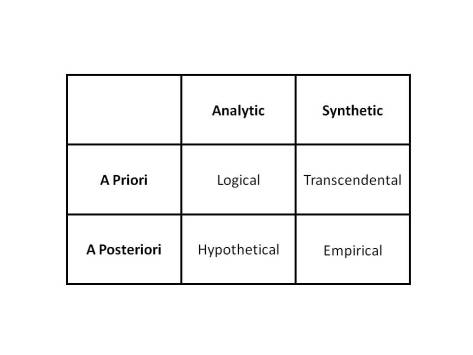
Let's review the categories:
- Analytic a priori: Uncontroversial. Truths of definition are known independently of experience. "All triangles have three sides."
- Synthetic a posteriori: Also uncontroversial. These are the standard empirical truths we learn through our senses. "The triangle on the board is blue."
- Analytic a posteriori: Generally considered to be an empty category.
- Synthetic a priori: This is Kant's bombshell. He argued that fundamental principles of mathematics and metaphysics fall into this category. They are truths that add genuinely new information to our concepts (they are synthetic), yet they can be known with the necessity and universality that comes from being independent of experience (they are a priori). For Kant, mathematical proof was a process of construction that yielded new knowledge, not merely a process of analyzing definitions.
3. The Traditional Role: Analyticity as the Ground of A Priori Knowledge
Kant's idea of the synthetic a priori was deeply puzzling to many later philosophers. How could mere thinking produce substantive knowledge about the world? For a major philosophical movement of the early 20th century, Logical Positivism, the solution was to reject Kant's fourth category. They argued that Kant was wrong about mathematics. All a priori knowledge, they claimed, is analytic.
This move was intended to demystify a priori knowledge. If mathematical truths are analytic, they are not profound insights into a Platonic realm of numbers. Instead, they are complex tautologies, ultimately true by virtue of definitions and the rules of language.
The Analytic/Synthetic Distinction: Quine's Critique
This video explains the crucial role the analytic/synthetic distinction played for philosophers trying to account for necessary and a priori truths in a scientific worldview.
Watch from 02:21 to 04:26. The video directly addresses the puzzle of how non-empirical disciplines like logic and mathematics can yield knowledge, and how identifying their truths as 'analytic' was proposed as a solution.
This "analytic explanation" of a priori knowledge became a cornerstone of analytic philosophy for decades. It promised to explain how we could have certain knowledge in logic and mathematics without appealing to mysterious faculties of intuition. The knowledge isn't about a transcendent reality; it's about our own conceptual scheme.
To make this view plausible, however, a more rigorous account of analyticity than Kant's "containment" metaphor was needed. This is where the logician Gottlob Frege, whose work we will study in depth soon, made a critical contribution. Frege proposed that a statement is analytic if it can be turned into a logical truth simply by substituting synonyms for synonyms.
For example, the statement:
All pediatricians are doctors.
...is not a formal logical truth. But if we substitute the definition "doctors that specialize on children" for "pediatricians," we get:
All doctors that specialize on children are doctors.
This is a logical truth, of the form "All Fs that are G are Fs". Frege's great project, known as logicism, was to show that all of arithmetic could be reduced to logic in this way, thereby demonstrating that mathematical truths are analytic and knowable a priori.
The Analytic/Synthetic Distinction
The Stanford Encyclopedia of Philosophy provides an excellent, MSc-level discussion of Frege's refinement of Kant's idea and the high hopes that philosophers placed on the notion of analyticity.
Please read sections 1.2 ('Frege'), 2 ('High Hopes'), and 2.1 ('Mathematics'). Section 1.2 explains Frege's crucial move towards a more logical definition of analyticity. Sections 2 and 2.1 detail precisely how analyticity was seen as the epistemological foundation for a priori knowledge, particularly in mathematics.
Conclusion
In this lesson, we have untangled one of philosophy's most important conceptual pairings. Understanding this terrain is essential, as the status of the analytic-synthetic distinction has been a major point of contention and has profound implications for how we view the nature of logic itself.
Key Takeaways:
- The analytic/synthetic distinction concerns the source of a statement's truth (meaning vs. facts), while the a priori/a posteriori distinction concerns the justification for our knowledge of it (independent of vs. dependent on experience).
- Kant introduced these distinctions to argue for the existence of synthetic a priori knowledge, which he believed was the basis for mathematics and metaphysics.
- The traditional role of analyticity, especially for the Logical Positivists, was to provide a naturalistic explanation for a priori knowledge. On this view, all a priori knowledge (including mathematics) is analytic. It is true by virtue of language and definitions, not because of insight into a mysterious abstract realm.
- Frege's re-definition of analyticity—as reducibility to a logical truth via substitution of synonyms—was a crucial step in making this logicist project seem viable.
Preview of the Next Lesson:
We have now examined the structure of truth (realism vs. anti-realism), the nature of truth (correspondence, coherence, etc.), and the grounds of truth (analytic vs. synthetic). To complete our toolkit, we need to consider how individual beliefs, once we have them, fit together to form a justified system of knowledge. In the next lesson, we will examine two competing theories of epistemic justification: foundationalism and coherentism. This will conclude our first module and prepare us to begin our historical journey with Kant and Frege.