Hello again.
In our last lesson, we explored the analytic-synthetic distinction, a crucial tool for understanding how statements might be true and how we could come to know them a priori. We saw how philosophers like the logical positivists hoped to explain all a priori knowledge, including mathematics, as analytic—true by definition.
This brings us to a more general question: how do our beliefs, whatever their source, hang together to form a justified system of knowledge? When you believe something, say , and someone asks "Why do you believe ?", you might offer another belief, , as your reason. But then they can ask, "Why do you believe ?" This simple pattern of questioning opens up a deep philosophical problem about the very structure of justification.
Today's lesson addresses the learning outcome: Explain the core tenets of foundationalism and coherentism as theories of epistemic justification. These two theories offer competing pictures of what a well-structured, justified system of beliefs looks like. This topic concludes the core epistemological part of our toolkit, setting the stage for our historical analysis of logic.
1. The Epistemic Regress Problem
The challenge of explaining how justification works is traditionally known as the epistemic regress problem. It arises from the seemingly simple idea that to be justified, a belief must be supported by good reasons, which are themselves other justified beliefs.
To get a feel for this problem, please watch the first part of the following video from Wireless Philosophy. It uses a very intuitive analogy of a child's persistent "why?" questions to introduce the core issue.
The Epistemic Regress Problem - Epistemology | WIRELESS PHILOSOPHY
This video, 'The Epistemic Regress Problem', sets up the central puzzle that foundationalism and coherentism are designed to solve. It clearly lays out the logical possibilities for any chain of justification.
Please watch from the beginning to 04:43. Focus on how the demand for reasons for our beliefs leads to a potential regress, and what the three structural options for this regress are.
As the video explains, when we trace a chain of reasons , there seem to be only three possibilities:
- The chain goes on infinitely. This is known as infinitism.
- The chain eventually circles back on itself (e.g., belief A is supported by B, which is supported by C, which is in turn supported by A).
- The chain stops at some point with beliefs that are not justified by other beliefs.
Skeptics argue that none of these options can provide genuine justification. However, most epistemologists have taken one of these structures and developed it into a positive theory of justification. The circular structure gives rise to coherentism, and the terminating structure gives rise to foundationalism.
These structures can be visualized like this:

We will now examine the two most influential theories, foundationalism and coherentism.
2. Foundationalism: Knowledge as a Building
Foundationalism is arguably the more intuitive of the two theories. It holds that our knowledge is structured like a building: it rests on a secure foundation of beliefs that need no further support from other beliefs. All other, "superstructure" beliefs derive their justification from this foundation.
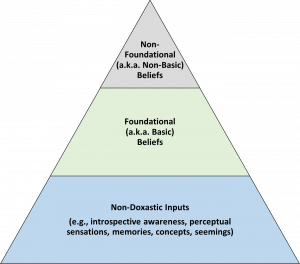
This picture requires a distinction between two types of justified belief:
- Immediately (or non-inferentially) justified beliefs: These are the "basic" beliefs that form the foundation. Their justification does not come from other beliefs.
- Mediately (or inferentially) justified beliefs: These are the "non-basic" beliefs in the superstructure. They are justified by being appropriately inferred from the foundational beliefs.
But what could a foundational belief be? And how could it be justified if not by another belief? To explore this, let's watch a more detailed video on foundationalism.
Foundationalism - Epistemology Video 8
This video by Victor Gijsbers provides a more in-depth analysis of foundationalism, distinguishing between strong and weak versions and exploring the main candidates for foundational beliefs.
Please watch from 02:03 to 09:55. Pay attention to the distinction between 'strong' and 'weak' foundationalism. Also, consider the two proposed classes of foundational beliefs: self-evident truths (like those in logic or mathematics) and beliefs based on experience.
As the video discusses, foundationalists have proposed two main sources for basic beliefs:
- Self-evident truths of reason: These are propositions that are understood as true as soon as they are grasped. Candidates include René Descartes' famous cogito ("I think"), simple logical truths ("A cannot be not-A"), and basic mathematical truths ("1+1=2"). Given your background in mathematics, you can see the appeal of grounding knowledge in such seemingly indubitable starting points.
- Beliefs based on direct experience: These are beliefs about one's own sensory or internal states, such as "I am experiencing the sensation of red" or "I feel pain." The justification is supposed to come directly from the experience itself, not from another belief.
A crucial point raised in the video is the distinction between strong foundationalism (often called classical foundationalism), which holds that basic beliefs are infallible and beyond doubt, and weak foundationalism (or modest foundationalism), which holds that basic beliefs are simply non-inferentially justified but may be fallible and open to revision. Most contemporary foundationalists adopt a modest version of the view.
3. Coherentism: Knowledge as a Web
Coherentists reject the entire building metaphor. They argue that there are no foundational beliefs. Instead, they propose that justification is a holistic property of a system of beliefs. A belief is justified if it is part of a coherent system. The metaphor here is not a building, but a web or a raft, where each strand or plank supports and is supported by the others.
To understand what "coherence" means and how this theory works, please read the following course notes by philosopher Jim Pryor.
Foundationalism and Coherentism
These notes on 'Foundationalism and Coherentism' offer a very clear definition of coherentism and its key features.
Please read the section titled 'Coherentism'. Focus on what makes a set of beliefs 'coherent' (it's more than just logical consistency) and the idea that for a coherentist, all justification is 'mediate' or inferential.
As the text explains, the core tenets of coherentism are:
- Rejection of Basic Beliefs: All justification is inferential. There are no "unmoved movers" in the justificatory system.
- Justification is Holistic: Individual beliefs are not justified in isolation. Justification is a property of the entire belief system.
- Coherence as the Source of Justification: A belief is justified by virtue of its membership in a coherent set of beliefs. Coherence involves:
- Logical Consistency: The beliefs do not contradict each other.
- Explanatory Connections: The beliefs explain and are explained by each other.
- Mutual Support: The beliefs stand in widespread inferential relationships.
The most powerful objection to coherentism is the isolation problem. A perfectly coherent set of beliefs (like a detailed fantasy novel) could be completely detached from reality. If coherence is the only source of justification, it's hard to see how we can ensure our beliefs are about the world rather than just a well-crafted story. Sophisticated coherentists try to solve this by giving a special role to "observational beliefs," arguing that a coherent system must accommodate and explain input from the senses. However, as the end of the Gijsbers video hinted, this move can make coherentism look a lot like weak foundationalism, blurring the lines between the two theories.
4. A Deeper Look (Optional)
The debate between foundationalism and coherentism is one of the deepest in epistemology. The resources so far provide a solid introduction. If you wish to explore the arguments at a more advanced level, I highly recommend the chapter "Foundationalism and Coherentism" by Laurence BonJour. BonJour was a leading coherentist who later converted to foundationalism, so he knew the arguments on both sides intimately.
Foundationalism and Coherentism
This chapter by Laurence BonJour is a professional, MSc-level treatment of the debate. It's not required for this lesson but is an excellent resource if you want to see how these arguments are developed in detail.
This is a challenging text. You could focus on 'Objections to Foundationalism' (section 1, pp. 181-186) to see the powerful dilemma that motivates the move to coherentism, and 'Some Objections to Coherentism' (section 5, pp. 193-196) for a devastating critique of the view.
BonJour's critique of foundationalism focuses on a difficult dilemma: if our awareness of our experience is conceptual (like a belief), it seems to require its own justification, restarting the regress. If it's non-conceptual, how can it justify a conceptual belief? His critique of coherentism powerfully develops the isolation problem, arguing that a coherentist can't distinguish between genuine observational input and a "counterfeit" set of beliefs about having that input.
Conclusion
We have now sketched the two dominant theories of epistemic justification. This completes the main part of our "philosopher's toolkit" by adding a framework for understanding how beliefs are structured into a system of knowledge.
Key Takeaways:
- The epistemic regress problem asks how any chain of justification can terminate in a way that provides knowledge.
- Foundationalism answers that the chain terminates with basic beliefs that are immediately justified (e.g., by reason or experience). Its structure is hierarchical, like a building.
- Coherentism answers that justification is not linear but holistic. A belief is justified by being part of a mutually reinforcing web of coherent beliefs.
- Both theories face significant challenges. Foundationalism struggles to explain how its foundations are themselves justified and how they support the rest of knowledge. Coherentism struggles with the isolation problem, the worry that a coherent belief system might have no connection to reality.
Preview of the Next Lesson:
In our next and final lesson of this introductory module, we will turn to a distinction that is central to the philosophy of logic and mathematics: the distinction between model-theoretic and proof-theoretic conceptions of logical consequence. This will connect directly with your formal logic studies and provide the last piece of conceptual machinery we need before diving into the revolutionary work of Gottlob Frege.