Introduction
Welcome to the seventh module of our course. In the previous module, we delved into the intuitionistic challenge to classical logic, culminating in an assessment of whether the dispute is a substantive philosophical conflict or a merely verbal one. We concluded that it represents a deep disagreement rooted in differing metaphysical and semantic commitments.
We now pivot to a different, but equally profound, set of philosophical problems that arise from a seemingly simple extension of logic: the logic of necessity and possibility, known as modal logic. While your work in mathematical logic has focused on extensional systems where truth values depend only on the references of terms and the truth values of sub-formulas, modal logic forces us into intensional territory, where things are not so straightforward.
This lesson will introduce the foundational concepts and puzzles of modal logic. Your learning outcome is to distinguish between de re and de dicto modal ascriptions and explain the problem of referential opacity. We will see how adding operators like 'necessarily' and 'possibly' to our language challenges fundamental logical principles and creates ambiguities that require careful philosophical analysis.
1. Modality and the Failure of Extensionality
Classical logic is celebrated for its extensionality. A key feature of an extensional system is that its connectives are truth-functional. The truth value of a complex sentence like is determined entirely by the truth values of and .
However, consider the modal operators 'it is necessary that' () and 'it is possible that' (). Are they truth-functional?
Let's look at two true statements:
- "2+2=4"
- "Grass is green"
Now let's apply the necessity operator:
- "Necessarily, 2+2=4" (True)
- "Necessarily, grass is green" (False, as it could have been another colour)
Even though the original statements were both true, applying the necessity operator yielded different truth values. This demonstrates that is not truth-functional. Its application depends on something more than the truth value of the proposition it modifies—it depends on the way in which the proposition is true. This is our first sign that we are moving beyond the familiar landscape of extensional logic.
The following brief clip introduces this fundamental distinction between necessary truths and contingent (non-necessary) truths, which is the conceptual starting point for modal logic.
Please watch from 02:18 to 03:36. The speaker contrasts the truth of '2+2=4' with 'grass is green' to motivate the concepts of necessity and possibility.
This failure of truth-functionality is just the tip of the iceberg. A more disruptive problem arises when we consider another cornerstone of extensional logic: the substitutivity of identicals.
2. The Problem of Referential Opacity
A fundamental principle of identity, often called Leibniz's Law, states that if two terms refer to the same object, one can be substituted for the other in any sentence without changing that sentence's truth value (salva veritate).
For example, since "Bob Dylan" and "Robert Zimmerman" name the same person, and the sentence "Bob Dylan is a musician" is true, then "Robert Zimmerman is a musician" must also be true. The context "... is a musician" is referentially transparent.
However, some contexts are not so accommodating. These are called referentially opaque contexts.
Quine's objections to modal logic 4 - referential opacity
This video provides a clear introduction to referential opacity. It begins with non-modal examples like quotation and belief contexts before showing how modal operators also create opacity.
Please watch from the beginning (00:08) to 09:37. Pay close attention to: The definition of the substitutivity of identicals. How quotation marks and 'believes that...' create contexts where substitutivity fails. The classic example involving 'the number of planets', which demonstrates that modal operators like 'Necessarily' also create referentially opaque contexts.
As the video explains, the problem with modal contexts can be illustrated with a simple, yet devastating, argument structure made famous by the philosopher W.V.O. Quine:
- Necessarily, 9 is greater than 7. (True)
- The number of planets = 9. (A contingent astronomical fact, true at the time Quine was writing).
- Therefore, necessarily, the number of planets is greater than 7. (False)
The inference is valid by the principle of substitutivity, but it leads from true premises to a false conclusion. The context "Necessarily, ..." has made the position occupied by the term '9' referentially opaque. It seems that whether the statement is true depends not just on the object being referred to (the number 9), but on how it is referred to ('9' vs. 'the number of planets').
For a more formal definition of these concepts, the following reading is very helpful.
Quine on necessity, extensionality, and essentialism
This text provides precise definitions of the key technical terms we've just encountered, grounding them in Quine's philosophical project.
Please read Section 2, 'Extensionality and referential opacity.' Focus on the definitions of 'purely referential occurrences', 'referentially opaque contexts', and 'extensional/non-extensional contexts'.
This referential opacity is not merely a technical puzzle; for Quine, it signals a deep philosophical confusion at the heart of modal logic. Before we examine his critique, we must first look at the standard way philosophers diagnose the ambiguity revealed by opacity.
3. The Distinction: De Dicto vs. De Re
The failure of substitutivity suggests that sentences like "Necessarily, the number of planets is greater than 7" are ambiguous. Philosophers distinguish between two possible readings. The distinction hinges on what the necessity is being ascribed to.
-
De Dicto (of the saying): The necessity is predicated of the entire proposition or statement (dictum). The statement as a whole is claimed to be a necessary truth.
- Reading of the premise:
□(9 > 7). This is true. The proposition that 9 is greater than 7 is a necessary truth. - Reading of the conclusion:
□(The number of planets > 7). This is false. The proposition that the number of planets is greater than 7 is a contingent truth, not a necessary one.
- Reading of the premise:
-
De Re (of the thing): The necessity is predicated of the object (res) itself. It ascribes a necessary property to the thing, regardless of how it is described.
- Reading of the premise: The object, 9, has the property of being necessarily greater than 7. This is true.
- Reading of the conclusion: The object, which happens to be the number of planets, has the property of being necessarily greater than 7. This is also true, because that object is the number 9.
The fallacy in Quine's puzzle occurs if we interpret the first premise de dicto (or de re) and then substitute a co-referring term to draw a conclusion that we read as de dicto. The de re reading, however, seems to license the substitution. On the de re reading, both premise 1 and the conclusion are about the number 9, and they both attribute the same necessary property to it.
The following resources explain this crucial distinction using different helpful examples.
Quine's objections to modal logic 4 - referential opacity
First, let's return to the video by Kane B, which introduces the distinction as the solution to the 'number of planets' puzzle.
Watch from 09:37 to 12:45. The video explains the de dicto/de re distinction using the Latin terms and applies it to both the 'number of planets' case and another clear example involving a UK election.
This second video explains the distinction using a classic theological puzzle from St. Thomas Aquinas, providing some historical and philosophical depth.
Now watch from 03:36 to 07:56. The speaker uses the problem of divine foreknowledge and free will to illustrate the difference between a proposition being necessarily true (de dicto) and a thing necessarily having a property (de re).
The image below provides a concise summary, mapping the natural language distinction to the formal notation of quantified modal logic, which should be familiar from your studies.
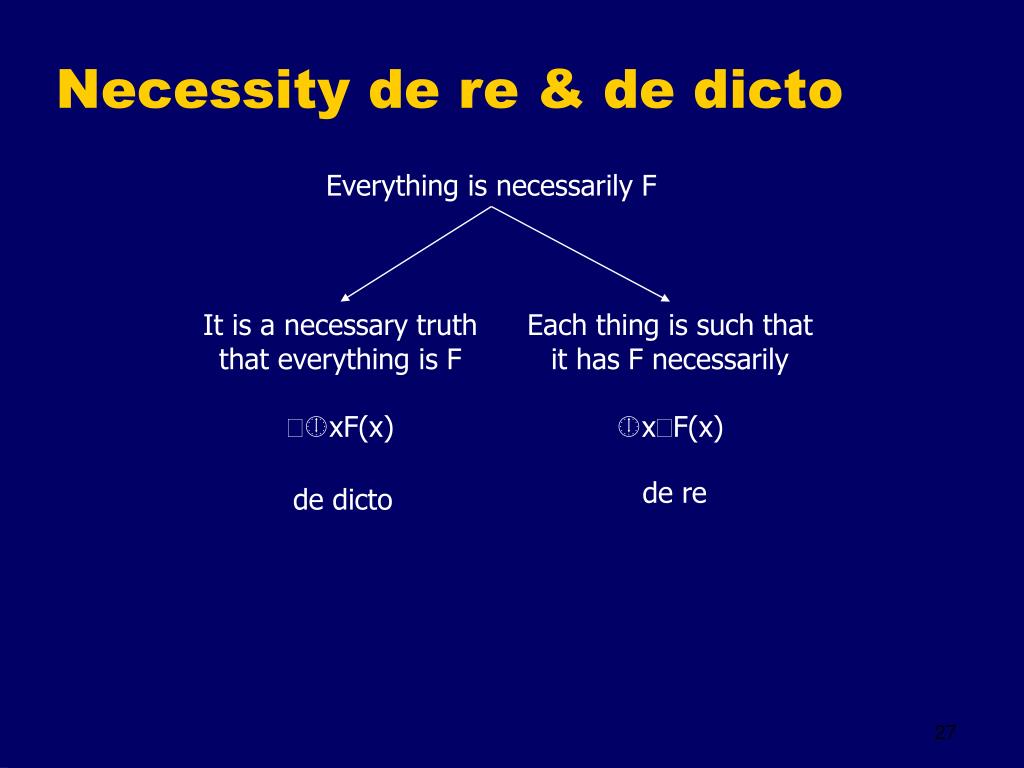
Finally, the Stanford Encyclopedia of Philosophy article on Possible Worlds provides a rich discussion of this topic, connecting it to the concepts of essential properties and transworld identity, which will become central in our upcoming lessons.
Possible Worlds - Stanford Encyclopedia of Philosophy
To solidify your understanding, please read the following section from the Stanford Encyclopedia of Philosophy.
Read the subsection 'The De Re / De Dicto Distinction' within Section 1.3. This text formalizes the distinction, defines modality de re and de dicto, and connects it to the idea of essential vs. accidental properties.
4. Quine's Skepticism: Essentialism and the "Metaphysical Jungle"
For you as a mathematician, distinguishing the scope of operators might seem like a standard way to resolve ambiguity. However, for Quine, the de re reading was not a solution but the source of the problem.
Ascribing a property to an object de re—saying that the number 9 is necessarily greater than 7, regardless of how you describe it—is to claim that this is an essential property of that object. Quine was deeply suspicious of this idea, which he associated with outdated Aristotelian metaphysics.
He famously used the following puzzle to show the apparent absurdity of de re modality:
- Consider a person who is both a mathematician and a cyclist.
- As a mathematician, he is necessarily rational.
- As a cyclist, he is necessarily two-legged (bipedal).
- So, is this single individual necessarily rational but only contingently two-legged, or necessarily two-legged but only contingently rational?
It seems that which properties are "essential" depends on how we describe the person. Quine's point is that it makes no sense to talk about an object's essential properties outside of a particular description. To do so, in his view, is to wander into a "metaphysical jungle."
This clip explains Quine's famous 'mathematical cyclist' argument against the coherence of de re necessity.
Please watch from 11:17 to 14:06. The speaker details Quine's 'mathematical cyclist' example and explains how Quine uses it to argue that de re necessity is an incoherent notion.
Quine's attack suggests that if modal logic requires a commitment to de re modality and essentialism, then it is philosophically bankrupt. This critique set the stage for a defense of modal logic, which we will explore in the next lessons.
Conclusion
In this lesson, we have taken our first steps into the complex philosophical territory of modal logic. We have seen that the introduction of modal operators for necessity and possibility breaks the principle of extensionality that underpins standard logic. This leads to the problem of referential opacity, where the normally reliable principle of substituting co-referential terms fails.
The key to diagnosing this failure is the distinction between two ways of reading a modal claim:
- De Dicto: Ascribing necessity to a whole proposition ("It is a necessary truth that...").
- De Re: Ascribing a necessary property to an object itself ("This thing has the property of being necessarily...").
While this distinction helps clarify the ambiguity, the de re reading itself became the target of a powerful philosophical critique from Quine, who argued it illegitimately revived a confused metaphysics of "essentialism."
Key Takeaways:
- Modal operators like 'necessarily' () are not truth-functional, making modal logic an intensional logic.
- Referential opacity occurs in contexts where the substitution of co-referring terms can change a sentence's truth value. Modal operators create such contexts.
- The de re / de dicto distinction resolves the ambiguity in opaque modal statements by clarifying whether necessity applies to the proposition (dictum) or the object (res).
- De re ascriptions attribute essential properties to objects, a notion Quine found philosophically incoherent and a primary reason to be suspicious of modal logic.
Preview of the Next Lesson:
We have just seen the problem of referential opacity and Quine's skeptical reaction to the de re modality it seems to imply. In the next lesson, we will delve deeper into his objections. Our learning outcome will be to analyse Quine's arguments against the coherence of quantified modal logic, focusing on his critique of essentialism. This will involve a closer look at the logical and philosophical difficulties of "quantifying into" modal contexts.