Hello! In our last lesson, we focused on how to evaluate candidate keys and select the best primary key for a single table. We established that a primary key's core job is to uniquely identify each record.
But as you know from your work in network engineering, systems are rarely isolated; they are interconnected. The same is true for data. Storing everything in one giant table is inefficient and prone to errors. The real power of a relational database comes from splitting data into logical, related tables. This lesson tackles the crucial next step: how do we connect these tables back together?
Today, we will define what a foreign key (FK) is and explain its essential role in linking related tables. This is the mechanism that transforms a collection of separate tables into a cohesive, relational database.
1. The Problem: Separated Data and Lost Connections
In our previous discussions, we established the need to organize data into entities, which become tables. For example, instead of one large table for a business's sales, we might have a CUSTOMERS table and an ORDERS table. But this creates a new challenge: if we separate the data, how do we know which customer placed which order? This leads to data redundancy and potential inconsistencies.
Let's watch a short video that clearly illustrates this problem and introduces the concept that solves it.
This video by Eddie Woo provides an excellent step-by-step explanation, starting with the problem of data redundancy and logically arriving at the solution of using foreign keys.
Please watch the following segments in sequence: Start with the explanation of the problem of redundant data that occurs when using a single, flat table. Next, see how the data is split into two tables (Orders and Customers) to solve this. Notice how a customer ID is used in the Orders table. The video then recaps the role of the primary key in the new Customers table. Finally, pay close attention to the definition of the foreign key and how it "joins these two and creates a relationship between them."
As the video demonstrates, splitting the tables reduces data duplication, but the Customer ID column in the Orders table is the critical piece of the puzzle. It doesn't uniquely identify an order, but it does tell us which customer the order belongs to. This special type of attribute is a foreign key.
2. Defining the Foreign Key
Now that you have the intuition, let's establish a more formal definition.
A Foreign Key (FK) is an attribute, or a collection of attributes, in one table whose value is required to match the value of the primary key in another table.
The table containing the foreign key is often called the child table or referencing table, and the table containing the primary key it refers to is called the parent table or referenced table.
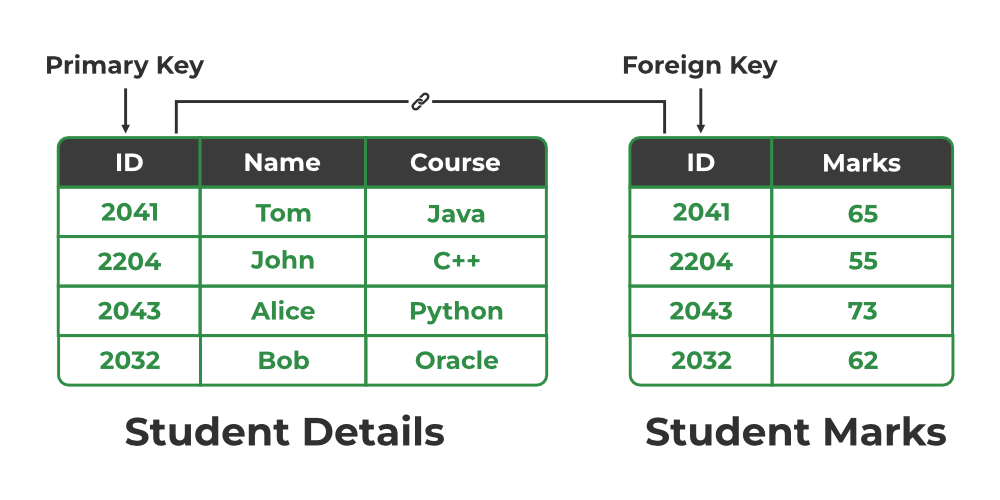
To solidify this definition, let's read a short article from GeeksforGeeks.
This article provides a concise technical definition of a foreign key and illustrates it with a clear example.
Read the introduction under the main title "Foreign Key in DBMS" and the "Example" section. You can ignore the parts about SQL syntax for now, as our focus is on the design concepts. As you read, focus on how the dept_id in the employee_info table acts as a foreign key referencing the department_info table.
3. The Role of Foreign Keys: Enforcing Referential Integrity
The learning outcome for this lesson is not just to define a foreign key, but to explain its role. The primary role of a foreign key is to create a logical link between tables and enforce a critical database rule called referential integrity.
Referential Integrity is a constraint ensuring that a value in a foreign key column must have a corresponding, matching value in the primary key of the referenced (parent) table.
What does this mean in practice?
- You cannot add an order to the
Orderstable with aCustomerIDof 99 if there is no customer withID99 in theCustomerstable. - If a customer (e.g., customer with
ID45) is deleted from theCustomerstable, the database must handle the orders that belonged to them. Usually, this means either deleting those orders as well or preventing the customer's deletion in the first place.
This rule prevents "orphaned" records—like an order without a customer—which maintains the consistency and reliability of your data.
The article from GeeksforGeeks also provides a great summary of why foreign keys are so important.
This section from the same GeeksforGeeks article details the key functions and benefits of using foreign keys.
Read the section titled "Need of Foreign Keys in DBMS". Focus on understanding these key roles: Data Integrity: How FKs ensure data is consistent and accurate. Establishing Relationships: The core function of linking tables. Data Security: How FKs can prevent accidental deletion or modification of related data.
4. Visualizing Keys in a Database Schema
As we move towards creating complete database designs, you will be working with Entity-Relationship Diagrams (ERDs). These diagrams visually represent the tables, their attributes, and the relationships between them, clearly marking primary and foreign keys.
Let's look at an example ERD to see how these concepts come together.

In this diagram, you can trace the relationships:
- An
Employeebelongs to aDepartment. This is enforced by theDepartmentIdforeign key in theEmployeetable, which points to theDepartmentIdprimary key in theDepartmenttable. - An
Employeehas aRole. This is enforced by theRoleIdforeign key in theEmployeetable. - An
EmploymentPeriodis associated with a specificEmployee. This is enforced by theEmployeeIdforeign key.
This diagram gives you a preview of how we will be documenting database designs in upcoming lessons.
Conclusion
In this lesson, we have bridged the gap between isolated tables and a connected, relational database. You've learned about the concept that makes these connections possible: the foreign key.
Here are the main takeaways:
- A Foreign Key is an attribute in a child table that refers to the primary key of a parent table.
- Its primary role is to establish a relationship between the two tables.
- By creating this link, a foreign key enforces referential integrity, which prevents orphaned records and ensures data consistency.
- Ultimately, foreign keys are what enable us to build clean, normalized databases that avoid the problems of data redundancy and inconsistency.
Now that you can define and explain the purpose of both primary and foreign keys, our next lesson will focus on applying this knowledge. We will work through several examples to practice identifying foreign keys in a given set of related tables.