Hello! Welcome to your next lesson.
In our previous lessons, we've built a solid foundation in working with polynomials—from factoring them using various techniques to understanding the deep connection between their factors and roots via the Remainder and Factor Theorems. These skills are all about breaking down and analyzing polynomial expressions.
Today, we'll use that foundation to tackle a new kind of structure: complex rational expressions. These are essentially fractions that have other fractions within their numerator, denominator, or both. They might look intimidating, but they are a natural extension of the arithmetic you already know.
Your goal in this lesson is to learn how to simplify these complex expressions into a single, manageable rational expression. We will explore two powerful and reliable methods to do this. Mastering this skill is crucial, as simplifying complex expressions is a common task in algebra and a necessary step before you can perform more advanced operations in calculus.
1. What is a Complex Rational Expression?
A complex rational expression is a fraction where the numerator or the denominator (or both) contains one or more rational expressions.
For example, this is a complex rational expression:
Our goal is to simplify such an expression into a single fraction with no fractions in its numerator or denominator.
There are two primary methods for achieving this. Let's explore the first one.
2. Method 1: Simplify by Rewriting as Division
The main fraction bar in any fraction, including a complex one, signifies division. This insight is the key to our first method. The strategy is:
- If the main numerator or main denominator are not single fractions, combine their terms to make them so. This will involve finding a least common denominator (LCD) for the "mini" fractions.
- Once you have a single fraction over another single fraction, rewrite the expression as a division problem.
- Solve the division problem by multiplying the first fraction by the reciprocal of the second ("keep, change, flip").
- Simplify the result by canceling any common factors.
This image provides a great visual summary of the basic "keep, change, flip" idea.
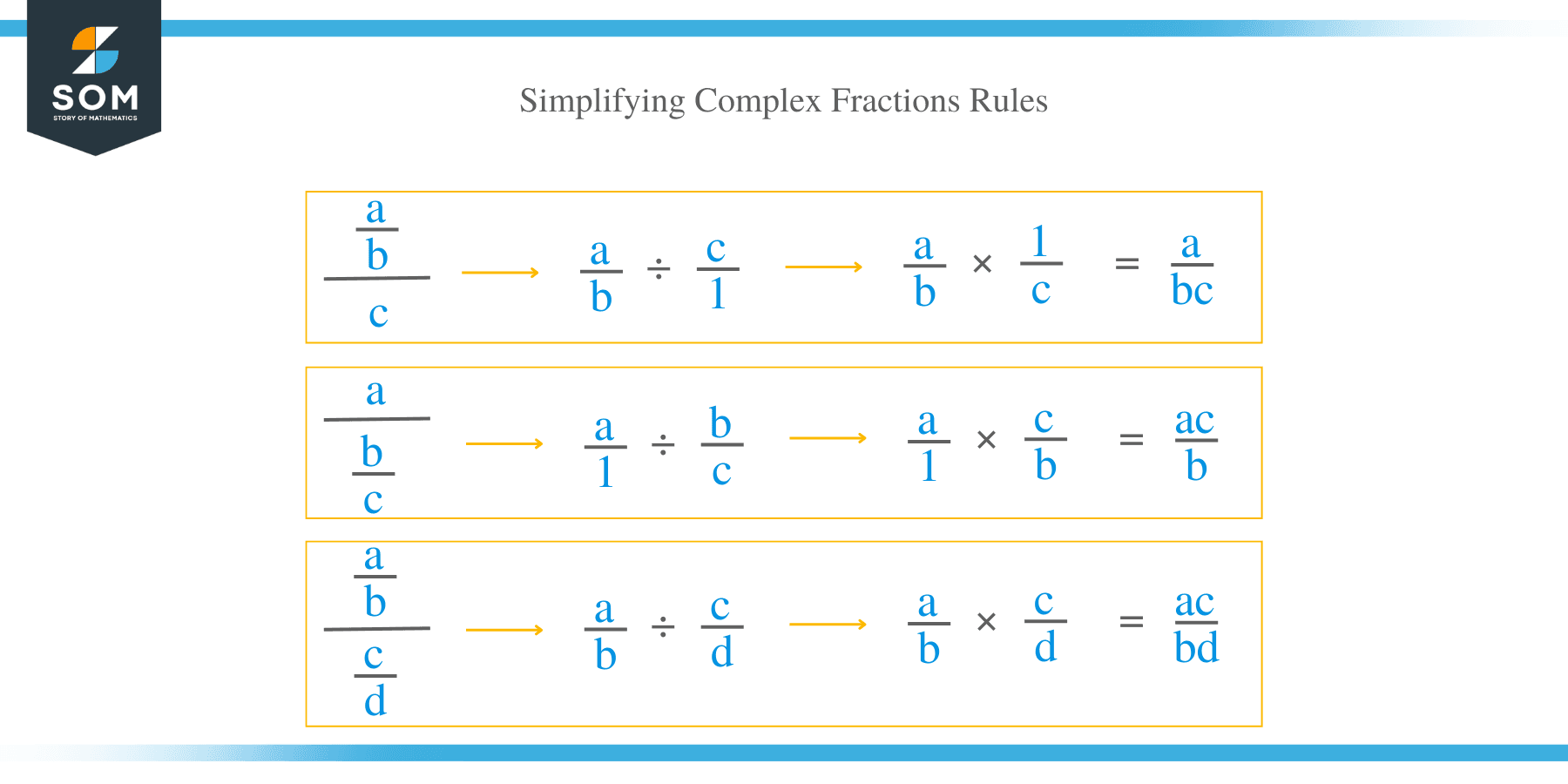
Now, let's see how this plays out with more involved expressions.
Intermediate Algebra Lecture 7.7: Introducing and Simplifying Complex Fractions
Professor Leonard gives an excellent and thorough explanation of this method. He starts with a simple case and then builds up to more realistic problems.
Watch the video in two parts: 0:00 - 08:30: Watch this segment to understand the fundamental concept of rewriting the complex fraction as a division problem. 13:00 - 19:57: This part is crucial. It shows how to handle expressions where you must first combine multiple terms in the numerator and/or denominator into a single fraction before you can perform the main division.
As you saw in the video, the most critical step is often ensuring the numerator and denominator are single fractions first. This brings all your skills of adding and subtracting rational expressions into play.
Let's walk through another example in text format to solidify this process.
7.3 Simplify Complex Rational Expressions
This reading from OpenStax provides a clearly structured example of Method 1. Pay close attention to how the numerator and denominator are simplified independently before the main division occurs.
Read the section 'Simplify a Complex Rational Expression by Writing it as Division'. Focus on Example 7.26, which simplifies the expression \frac{\frac{1}{x}+\frac{1}{y}}{\frac{x}{y}-\frac{y}{x}} Follow the steps showing how the numerator becomes a single fraction and the denominator becomes a single fraction before they are divided.
Test your understanding!
Simplify the following complex rational expression using Method 1 (simplifying by division).
Show answer
-
Simplify the numerator: The numerator is . The LCD is .
-
Simplify the denominator: The denominator is . The LCD is .
-
Rewrite as division: Now we have a single fraction over a single fraction.
-
Multiply by the reciprocal and simplify:
Factor everything before canceling.
Cancel the common factors of and .
3. Method 2: Simplify Using the LCD
The second method can often be faster and more direct, especially for more "complex" complex fractions. It involves "clearing" all the smaller fractions at once.
The strategy is:
- Find the LCD of all the rational expressions that appear in both the main numerator and main denominator.
- Multiply both the main numerator and the main denominator by this LCD. (Remember, you're just multiplying by a clever form of 1, like , so you aren't changing the expression's value).
- Use the distributive property. This will cancel all the denominators of the "mini" fractions.
- Simplify the resulting single rational expression, factoring and canceling if possible.
Let's see this powerful method in action.
Rational Expressions , Adding, Subtracting, Multiplying, Dividing, Simplifying Complex Fractions
The Organic Chemistry Tutor provides a very clear demonstration of this LCD method. Notice how it bypasses the need to simplify the numerator and denominator separately.
Watch from 01:06:06 to 01:09:21. The video shows several examples. Focus on the core technique: identifying the overall LCD and multiplying it through the top and bottom.
To see a direct comparison, let's revisit the same example from the OpenStax reading, but this time simplified using Method 2.
7.3 Simplify Complex Rational Expressions
This section of the same OpenStax resource shows how to solve the exact same problem from before, but with the LCD method. Comparing the two approaches for the same problem is a very effective way to learn.
Read the section 'Simplify a Complex Rational Expression by Using the LCD'. Focus on Example 7.29, which again simplifies \frac{\frac{1}{x}+\frac{1}{y}}{\frac{x}{y}-\frac{y}{x}} Observe how multiplying the numerator and denominator by the overall LCD, which is xy, immediately clears the fractions.
Both methods yield the same correct answer. With practice, you'll develop an intuition for which method is more efficient for a given problem. Often, if there are many terms, the LCD method (Method 2) is less work.
Test your understanding!
Let's simplify the same expression from the last exercise, but this time using Method 2 (the LCD method).
Show answer
-
Find the overall LCD: The small fractions are and . The denominators are and . The LCD of all these fractions is .
-
Multiply numerator and denominator by the LCD:
-
Distribute the LCD:
-
Simplify: The denominators of the inner fractions cancel out.
-
Factor and simplify the final expression:
Cancel the common factor of .
The answer is the same as with Method 1.
Conclusion
Well done. You've now learned the two standard, powerful methods for simplifying complex rational expressions. While they can look messy, they are manageable with a systematic approach.
Key Takeaways:
- A complex rational expression is a fraction containing other fractions.
- Method 1 (Division): Combine terms to get a single fraction over a single fraction, then rewrite as a division problem and multiply by the reciprocal.
- Method 2 (LCD): Find the LCD of all inner fractions, and multiply the main numerator and denominator by it to clear the fractions in one step.
- Factoring is Key: In both methods, the final step is to simplify the resulting fraction, which almost always requires the factoring skills you've been developing.
This lesson concludes our module on the Foundations of Advanced Algebra. You have covered factoring, polynomial division, key theorems connecting roots and factors, and now, operations with complex rational expressions. These are the fundamental tools for manipulating algebraic expressions.
In our next module, we will shift our focus from expressions to equations. We will begin by revisiting quadratic equations and deriving the quadratic formula by "completing the square," a technique that will reappear in many areas of your future mathematical journey.