Hello! Welcome to the third lesson in our algebra series.
In the last lesson, we explored polynomial division. You might have noticed a curious pattern: when we divided a polynomial by a linear term like , the remainder we got was exactly the same value as if we had substituted into the polynomial, . This wasn't a coincidence!
Today, we will formalize this observation by studying two of the most important theorems in elementary algebra:
- The Remainder Theorem, which provides a quick way to find the value of a polynomial at a certain point.
- The Factor Theorem, a direct and powerful consequence of the Remainder Theorem that connects the roots of a polynomial to its factors.
Your goal for this lesson is to understand and apply these theorems to find polynomial factors and roots. Mastering this is like having a key that can unlock the structure of complex polynomials, a skill that is indispensable for the more advanced mathematics you aim to study.
1. The Remainder Theorem
Let's begin by formally stating and proving the connection we observed.
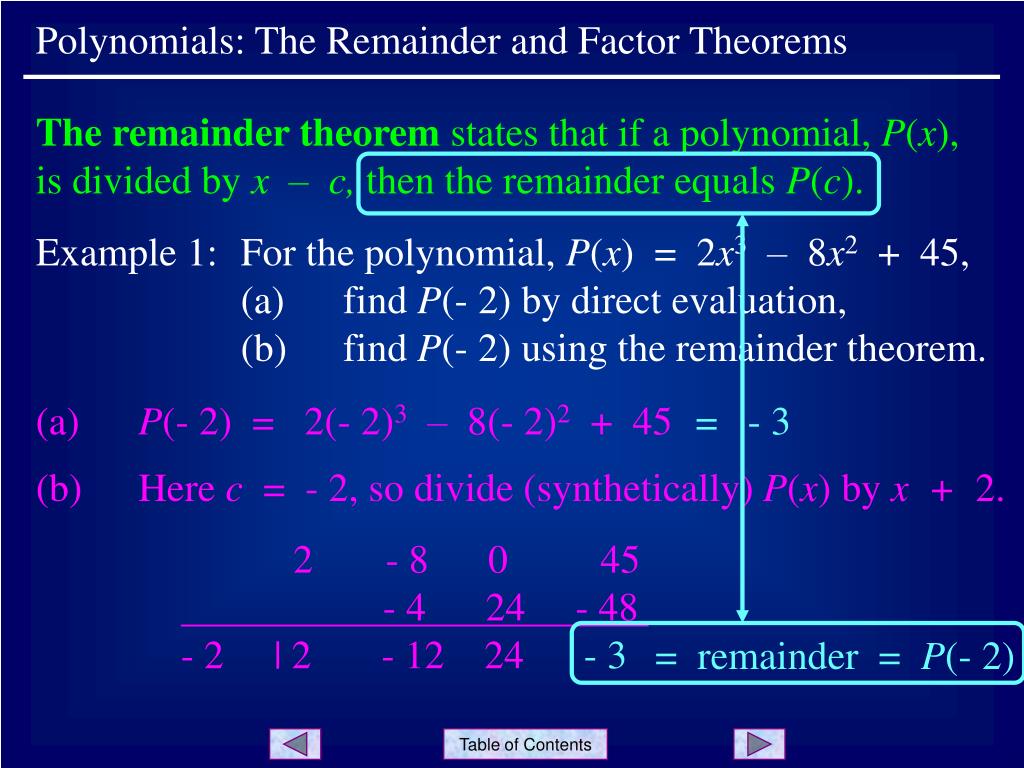
The Remainder Theorem: If a polynomial is divided by , then the remainder is equal to .
The proof for this is surprisingly straightforward and elegant. It stems directly from the Division Algorithm you learned in the previous lesson: .
Polynomial remainder theorem proof | Polynomial and rational functions | Algebra II | Khan Academy
To see the proof laid out, let's watch this short video from Khan Academy. It clearly shows how the Division Algorithm leads directly to this theorem.
Watch from 02:27 to 05:40. The key moment is when the value 'a' is substituted into the general division equation, f(x) = q(x) * (x - a) + r. See how this substitution makes the quotient term disappear, leaving just the remainder.
So, why is this useful? It gives us a very efficient way to evaluate a polynomial. Instead of performing a potentially messy calculation like , we can use synthetic division with . The remainder we get is the value of . This is often much faster, especially when dealing with higher-degree polynomials.
Test your understanding!
Let $P(x) = 3x^4 + x^3 - 10x^2 + 8$. Use synthetic division and the Remainder Theorem to find the value of $P(-2)$.Show answer
We perform synthetic division with $c = -2$. The coefficients of $P(x)$ are 3, 1, -10, 0 (for the missing x-term), and 8.The remainder is 8. Therefore, according to the Remainder Theorem, .
Let's check by direct substitution:
.
The results match.
2. The Factor Theorem
Now we come to the main event. The Remainder Theorem is most powerful in the special case where the remainder is zero. Think about it: if dividing a polynomial by leaves no remainder, what does that tell you about ? It means is a factor of the polynomial. This leads us directly to the Factor Theorem.
Remainder & Factor Theorem (2 of 2: How can we identify factors without dividing?)
The Factor Theorem is really a special case of the Remainder Theorem. This video by Eddie Woo explains the connection perfectly.
Watch from the beginning to 03:16. Focus on his key question: 'What does it mean when you divide through something and your remainder is exactly zero?'. This is the conceptual leap from the Remainder Theorem to the Factor Theorem.
As you just saw, the reasoning is beautifully simple.
The Factor Theorem: is a factor of a polynomial if and only if .
This is an "if and only if" statement, which means it works both ways:
- If , then is a factor of .
- If is a factor of , then .
This theorem gives us a definitive test for whether a given linear expression is a factor of a polynomial.

3. Application: Finding All Factors and Roots
The Factor Theorem is more than just a test; it's the foundation of a strategy to completely factor high-degree polynomials that we can't factor by simple grouping.
Here is the general strategy:
- Guess a root: Start by testing simple integer values for , like 1, -1, 2, -2. A number is a root (or zero) of the polynomial if .
- Test the root: Use synthetic division to divide by .
- Check the remainder: If the remainder is 0, you've found a root () and a factor ().
- Reduce the polynomial: The other numbers in the last row of your synthetic division tableau are the coefficients of the quotient, , which is a polynomial of one degree lower than .
- Repeat or solve: Now you can work with the simpler polynomial . Repeat the process, or if is a quadratic, you can factor it or use the quadratic formula to find the remaining roots.
Let's watch this strategy in action.
Remainder & Factor Theorem (2 of 2: How can we identify factors without dividing?)
Now, let's see how to use this strategy to take a cubic polynomial and break it down into its linear factors.
Watch from 03:16 to 08:50. Notice how Eddie Woo first finds one factor by testing values. He then uses division to get a quadratic factor, which he can then easily factor further to find the complete factorization.
For a slightly more formal presentation and another clear example, the following reading connects all the ideas we've discussed today.
3.2: The Factor Theorem and the Remainder Theorem
This resource from the Stitz-Zeager Precalculus textbook on LibreTexts provides a concise summary of both theorems and a clear, worked example.
First, read 'Theorem 3.5 (The Remainder Theorem)' and 'Theorem 3.6 (The Factor Theorem)' for their formal definitions. Then, carefully study 'Example 3.2.2'. Note how it uses synthetic division for two distinct purposes: first to find p(-2) using the Remainder Theorem, and then to factor p(x) using the given zero x=1.
Now it's your turn to apply the full strategy.
Test your understanding!
Let $P(x) = x^3 - 4x^2 + x + 6$. Given that $x = 2$ is a root of $P(x)$, find all other roots and write the polynomial in its fully factored form.Show answer
-
Use the given root: The Factor Theorem tells us that since is a root, must be a factor. We can use synthetic division to divide by .
The remainder is 0, which confirms that is a factor.
-
Reduce the polynomial: The quotient from the division is .
So, we can write . -
Factor the quadratic: Now we just need to factor the remaining quadratic . We look for two numbers that multiply to -3 and add to -2. These numbers are -3 and 1.
So, . -
Final Answer:
- The fully factored form of the polynomial is .
- The roots are the values of that make , which are , , and . The other roots are 3 and -1.
Conclusion
Excellent work today. You have just learned two theorems that are central to the study of polynomials and form a bridge between the abstract structure of a polynomial and its concrete solutions.
Key Takeaways:
- The Remainder Theorem: A shortcut for evaluating a polynomial at a point . The value is simply the remainder when is divided by .
- The Factor Theorem: Connects roots and factors. is a factor of if and only if is a root of (i.e., ).
- Factoring Strategy: We can use the Factor Theorem combined with synthetic division to test for roots, and each time we find one, we can simplify the polynomial until it's fully factored.
In our next lesson, we will shift gears slightly to work with rational expressions—fractions that have polynomials in the numerator and denominator. You will find that the factoring skills you've been honing over the last few lessons are absolutely essential for simplifying and operating with these expressions.