Hello! Welcome to the third lesson in our module on Strategic Goal Setting.
In our last lesson, we deconstructed large ambitions into a goal hierarchy, distinguishing between the long-term outcome, the measurable performance milestones, and the daily process goals. This structure gives your efforts direction and resilience. We learned that while your outcome goal is your North Star, your daily focus should be on the process goals—the things you can directly control.
But how do you define those process and performance goals in a way that maximizes your chances of success? Simply having a goal isn't enough. A vague intention like "I'll study more" is easily forgotten and difficult to act upon.
Today, we'll learn a powerful and evidence-based method to sharpen your goals into clear, compelling, and actionable targets. Our learning outcome is to: Formulate a personal goal using the SMART (Specific, Measurable, Achievable, Relevant, Time-bound) criteria. This framework is one of the cornerstones of performance psychology, used by elite athletes, successful executives, and high-achievers in every field.
1. The Problem with Vague Goals
Before we learn the SMART framework, let's understand why it's so necessary. Your brain is not wired to effectively pursue fuzzy, ill-defined objectives. Vague goals like "get healthier" or "be more productive" often fail for distinct psychological reasons.
To explore this, please read the following article, which explains the common pitfalls of abstract goals.
Why 'New Year, New Me' is Actually Making you more Anxious – Let's get SMART about our Goals
This article from Prairie View Psychology explains the psychological challenges that vague goals create, providing the 'why' behind the need for a structured framework like SMART.
Read the section titled 'The Problem with Vague Goals'. Focus on understanding the three concepts: Decision Paralysis, Absence of Reinforcement, and Priority Drift.
As the article explains, vague goals sabotage our efforts by:
- Creating Decision Paralysis: With too many options and no clear starting point, we feel overwhelmed and procrastinate.
- Preventing Reinforcement: Without clear milestones, we can't recognize small wins. This deprives our brain of the rewarding dopamine release that fuels motivation.
- Causing Priority Drift: Without a deadline, the goal lacks urgency and gets constantly pushed aside by more immediate, though less important, daily tasks.
The SMART framework is designed to counteract these exact problems by providing structure and clarity.
2. Deconstructing the SMART Framework
SMART is an acronym that stands for Specific, Measurable, Achievable, Relevant, and Time-bound. It acts as a checklist to transform a weak goal into a powerful one.
Let's get a quick overview of each component.
SMART Goals (Explained) - Specific, Measurable, Attainable, Realistic, Time-Bound
This short video from Helpful Professor Explains! offers a clear and concise breakdown of each letter in the SMART acronym.
Watch the entire video (it's less than 3 minutes) to get a foundational understanding of the five SMART criteria.
Now that you have a basic definition of each component, let's dive into the psychology that makes each one effective.
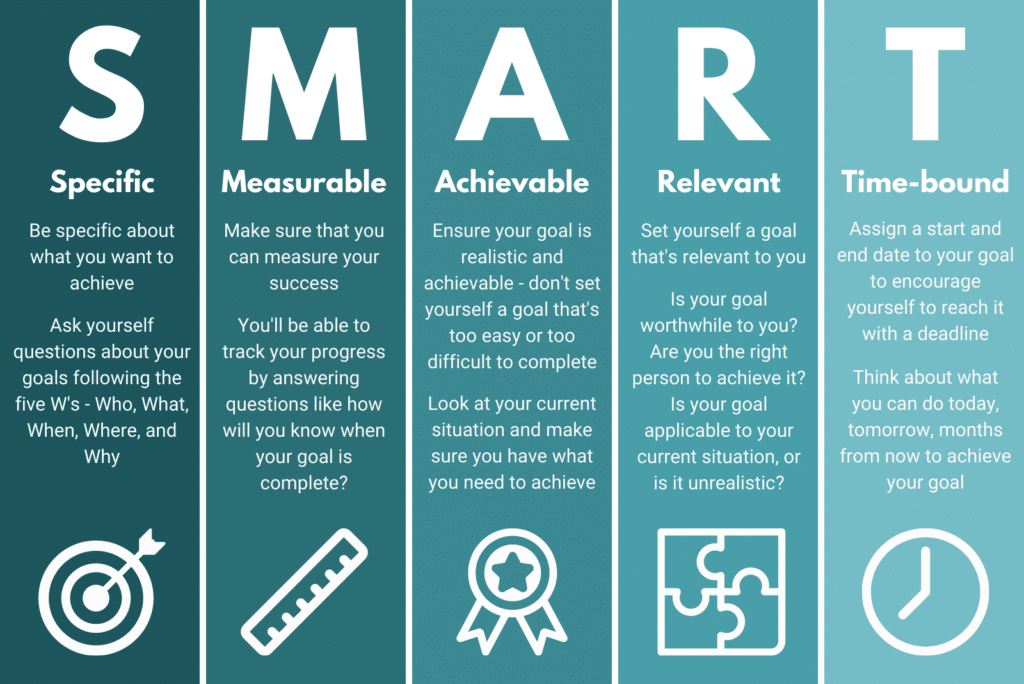
Let's explore the psychological purpose of each element, using insights from the Prairie View Psychology article we looked at earlier.
-
S - Specific: A specific goal answers the "W" questions: Who, What, When, Where, Why. By defining exactly what you want to do, you reduce the cognitive load required to get started. Your brain doesn't have to waste energy deciding what to do next; the path is already laid out.
-
M - Measurable: A measurable goal provides concrete evidence of progress. This creates a crucial feedback loop. Each time you hit a metric (e.g., one more workout completed, one more chapter read), your brain registers a success and releases dopamine. This reinforces the behavior and strengthens your motivation to continue.
-
A - Achievable: An achievable goal is challenging but realistic. This is essential for building self-efficacy—the belief in your ability to succeed. Setting goals that are too easy is unmotivating, but setting goals that are impossible leads to frustration and erodes your confidence. The key is to find the sweet spot that stretches you just beyond your current capabilities.
-
R - Relevant: A relevant goal aligns with your deeper values and long-term aspirations. This connection taps into intrinsic motivation—the drive that comes from within. When a goal is personally meaningful, you're more resilient and willing to push through the difficulties that inevitably arise.
-
T - Time-bound: A time-bound goal has a deadline. This creates a sense of urgency and helps you fight procrastination. A deadline forces you to prioritize and allocate your time and energy effectively, moving the goal from a someday/maybe "wish" to a concrete commitment.
3. The Science Behind Specific and Achievable Goals
Let's add a layer of neuroscience to two of the most critical components: being Specific and Achievable. Neuroscientist Andrew Huberman provides some powerful insights into how your brain responds to these characteristics.
First, let's reinforce the importance of specificity.
The Science of Setting & Achieving Goals
In this clip from his podcast, Andrew Huberman discusses a study that perfectly illustrates how having a concrete, specific plan dramatically increases the likelihood of success.
Please watch the segment from 01:15:36 to 01:19:46. Notice how moving from a vague intention ('recycle more') to a concrete plan led to a massive improvement in behavior.
The recycling study is a perfect example of specificity in action. It's not enough to want to do something; you need a detailed plan for what success looks like in terms of action steps.
Next, let's refine our understanding of "Achievable." It doesn't mean "easy." The science shows that for a goal to be motivating, it needs to be difficult enough to command your attention and engage your body's resources.
The Science of Setting & Achieving Goals
Here, Dr. Huberman explains the research on goal difficulty. He describes a biological 'sweet spot' for setting goals that best recruits our motivational systems.
Watch the segment from 01:07:23 to 01:13:27. Pay close attention to the finding that goals that are either too easy or too lofty fail to engage the autonomic nervous system effectively.
This is a crucial insight for high performance. Your goal should feel like a stretch—something that requires real effort and makes you think, "This is hard, but I think I can do it." That's the zone where motivation thrives.
4. Putting It Into Practice
Now it's time to apply this framework. We'll use a guide from Stanford University that provides excellent examples and a template for you to use.
First, let's look at how to transform a vague goal into a SMART one.
This guide provides practical, step-by-step instructions for writing SMART goals. We'll start by looking at an example.
Read the section titled 'Examples of Creating a SMART Goal.' Focus on the second example, 'I want to improve my performance,' and see how it is broken down by each SMART criterion.
Here is another excellent example of a well-formulated personal development goal.

Your Turn: Formulate a SMART Goal
Now, it's your turn to put this into practice. Think of a meaningful goal you have for yourself—it could be related to your studies, a hobby, or personal health.
Use the template provided in the Stanford guide to turn your initial idea into a fully-formed SMART goal.
This section of the guide provides a template with questions to help you build your SMART goal step-by-step.
Find the 'Template for writing a S.M.A.R.T. Goal' in the Appendix section. On a piece of paper or in a document, answer the questions for each of the five criteria (Specific, Measurable, Achievable, Relevant, Time-bound) for your chosen personal goal. Finally, combine your answers into a single, powerful SMART goal statement.
This exercise is the core of today's lesson. Take the time to think through each question carefully. The more clarity you achieve now, the easier it will be to take action later.
Conclusion
Today, we've added a crucial tool to your performance psychology toolkit. The SMART framework is not just a corporate buzzword; it's a systematic process for structuring your goals in a way that aligns with how your brain is wired for motivation and action. By turning vague wishes into concrete plans, you dramatically increase your likelihood of achieving them.
Key Takeaways:
- Vague goals often fail due to decision paralysis, a lack of reinforcement, and priority drift.
- The SMART framework combats these issues by making goals Specific, Measurable, Achievable, Relevant, and Time-bound.
- Each component serves a psychological purpose: Specificity reduces cognitive load, Measurability creates a dopamine-driven feedback loop, Achievability builds self-efficacy, Relevance fuels intrinsic motivation, and a Time-bound nature creates urgency.
- Effective goals are not easy; they are moderately challenging, hitting a sweet spot that engages your mind and body for sustained effort.
Having a well-defined SMART goal is a massive step forward. However, even with the best-laid plans, obstacles will arise. In our next lesson, we will learn a powerful technique called Mental Contrasting (WOOP) to strengthen your commitment, anticipate those obstacles, and create a plan to overcome them before they ever happen.