Hello! Welcome to the final lesson of our module on "Managing Stress and Building Resilience."
In our previous lessons, we've established a strong scientific foundation. We explored the 'fight-or-flight' response, differentiated between acute and chronic stress, and learned how cognitive reappraisal can turn a threat into a challenge. Most recently, we delved into the neuroscience of sleep, confirming its non-negotiable role in memory, learning, and emotional regulation.
Now, we shift from understanding the "why" to mastering the "how." Your goal to achieve immense results depends not just on how hard you work, but on how intelligently you recover. This lesson is dedicated to building that intelligence into a practical, daily system.
Our learning outcome is to develop a personal 'recovery plan' incorporating evidence-based stress reduction and sleep hygiene practices. We will synthesize the science we've learned into a concrete plan you can use immediately.
A Framework for Recovery
Before we dive into specific techniques, let's establish a mental model. High performers often mistakenly view recovery as passive downtime. It's not. It's an active process of adaptation and regeneration.
The image below, "The Recovery Pyramid," provides an excellent framework. It shows that while things like massage or specific gadgets can help, the entire structure of your performance rests on a foundation of sleep, nutrition, and hydration.
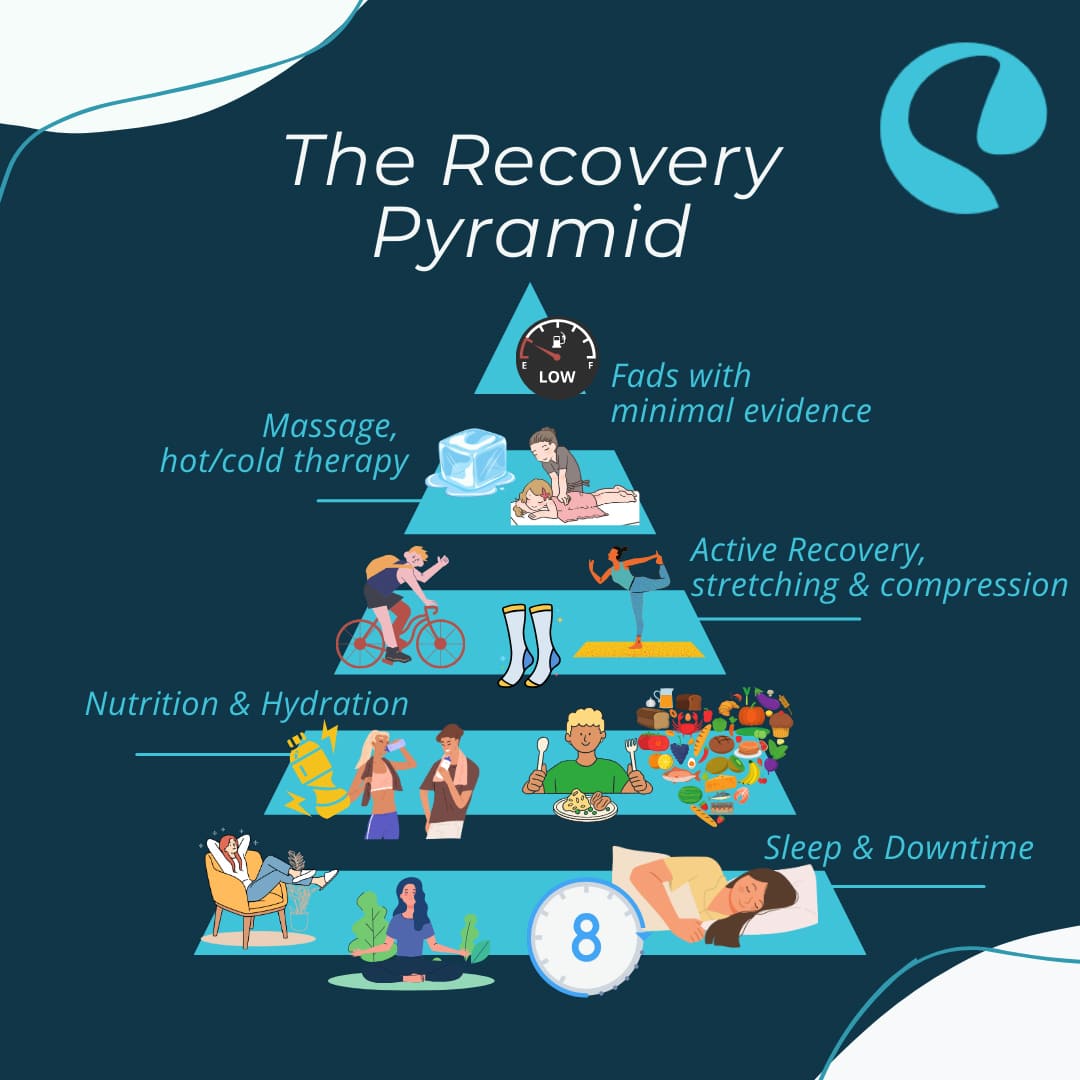
We will use this pyramid to structure your plan, starting from the most critical layer: sleep.
1. The Foundation: Building an Elite Sleep Routine
In the last lesson, you learned why sleep is your superpower. Now, let's build the habits to wield it effectively. While the science can seem complex, the application involves a set of clear, consistent behaviors known as good "sleep hygiene."
My Evidence-Based Sleep Routine
Dr. Ali Abdaal has created a superb summary of evidence-based practices for improving sleep, drawing from experts like Andrew Huberman and Matthew Walker (whom we've already heard from). This video provides a direct, actionable checklist for your recovery plan.
Please watch the following segments. For each one, think about how you could incorporate the principle into your own daily routine: Build a Rhythm (00:15 - 02:36): Understand the importance of consistency and the role of adenosine. Catch the Morning Sun (02:36 - 04:50): Learn how light anchors your circadian rhythm. Time Your Caffeine (07:22 - 09:00): Discover the ideal window for caffeine to avoid sleep disruption. Manage Evening Light (09:00 - 11:15): Understand why dimming your environment is crucial. Keep It Cool (11:31 - 12:25): Learn the role of temperature in initiating and maintaining sleep.
Based on the video and our previous lesson, here is a summary of a world-class sleep hygiene protocol.
Your Sleep Hygiene Checklist:
- Consistency: Go to bed and wake up at the same time every day, even on weekends. This stabilizes your circadian rhythm and regulates the build-up of adenosine.
- Light Exposure:
- Morning: Get 10-30 minutes of direct, natural sunlight within the first hour of waking. This signals your brain to release cortisol and starts the timer for melatonin release later in the evening.
- Evening: Avoid bright lights, especially overhead lights and screens, 2-3 hours before bed. Bright light suppresses melatonin, tricking your brain into thinking it's still daytime.
- Caffeine Cutoff: Avoid caffeine 8-10 hours before your bedtime. Caffeine is an adenosine antagonist, meaning it blocks the receptors for the very chemical that makes you feel sleepy.
- Temperature: Keep your bedroom cool (around 18-20°C or 65-68°F). Your body's core temperature needs to drop to initiate sleep.
- Evening Wind-Down: Develop a relaxing pre-sleep routine (e.g., reading a physical book, light stretching, journaling) to signal to your body that it's time to transition to sleep.
2. The Toolkit: Managing Stress for Optimal Performance
With our sleep foundation in place, we now turn to stress management. As we've discussed, the goal is not to eliminate stress but to keep it in the optimal zone for performance and to recover from it effectively.

Let's build a toolkit with strategies for different timescales, from real-time interventions to long-term resilience.
In the Moment: Real-Time Stress Reduction
When you feel that acute spike of stress or anxiety, you need a tool that works immediately. The Physiological Sigh is arguably the fastest, most effective, evidence-based technique for this.
Tools for Managing Stress & Anxiety | Huberman Lab Essentials
Neuroscientist Dr. Andrew Huberman explains the simple, powerful mechanism behind the physiological sigh. It's a breathing pattern you can use anytime, anywhere to rapidly calm your nervous system.
Watch from 06:41 to 13:23. Focus on understanding the 'why' and 'how': a double inhale through the nose, followed by a long, extended exhale through the mouth. The double inhale re-inflates collapsed air sacs (alveoli) in your lungs, and the long exhale offloads maximum carbon dioxide, which calms the nervous system.
The technique is simple: Two sharp inhales through the nose, one long exhale through the mouth. Just one to three repetitions can significantly reduce feelings of stress in real-time. This is your emergency brake for the 'fight-or-flight' response.
Weekly Practice: Building Stress Resilience
To improve your long-term performance, you can proactively raise your "stress threshold." This involves deliberately putting your body in a state of high arousal and then practicing cognitive calming. It teaches your brain to be comfortable with the physiological signs of stress, uncoupling the physical response from the mental panic.
Dr. Huberman discusses this in the video segment from 20:52 - 25:06. Common methods include:
- Cold Exposure: Ending your shower with 30-60 seconds of cold water.
- High-Intensity Exercise: Pushing yourself during a workout.
During these moments of physical stress, consciously relax your mind. One way is to adopt panoramic vision: soften your gaze and pay attention to your peripheral vision. This signals to your brain that you are not in immediate danger, helping to calm your mental state even while your body is highly activated.
Another powerful weekly practice is active recovery. This involves low-intensity movement that aids recovery without adding significant stress.
Rest & Recovery for Athletes | Improve Performance
The article 'Rest & Recovery for Athletes' outlines several excellent active recovery options. While you're not a professional athlete, the principles are identical for cognitive performance.
Read the section 'Consider Incorporating Active Recovery Techniques into Training.' Pay attention to the types of activities mentioned (walking, cycling, yoga) and their benefits, such as promoting circulation and reducing fatigue.
Daily Habits: Long-Term Mitigation
Your ability to handle stress day-to-day is determined by your foundational habits. These are the non-negotiables that form the base of the recovery pyramid.
Athlete Recovery Techniques to Achieve Peak Performance
The article 'Athlete Recovery Techniques' provides a concise summary of the most critical daily habits for recovery.
Read the short sections 'Drink Water Often' and the 'Conclusion.' The key message is that sleep and hydration are your foundational, non-negotiable recovery tools.
Your key daily habits for long-term stress mitigation are:
- High-Quality Sleep: The foundation you're building with your sleep hygiene protocol.
- Hydration: Your brain is ~75% water. Dehydration impairs cognitive function and your ability to regulate stress.
- Nutrition: Consuming nutrient-dense food provides the building blocks for neurotransmitters and physical repair.
- Regular Movement: Exercise is a potent tool for regulating mood and stress hormones.
- Social Connection: As Dr. Huberman mentions, genuine social connection is a powerful buffer against the long-term effects of stress.
3. Your Task: Develop Your Personal Recovery Plan
Now it's time to integrate these evidence-based strategies into a personalized plan. There is no one-size-fits-all solution; the goal is to choose a few key behaviors you can implement consistently.
Create a simple document or note titled "My Personal Recovery Plan." Structure it with the following sections and prompts. Be specific and realistic.
My Personal Recovery Plan
1. Sleep Hygiene Protocol
Based on the checklist, what are the 2-3 most impactful changes I can make right now?
- My consistent bedtime:
[e.g., 11:00 PM] - My consistent wake-up time:
[e.g., 7:00 AM] - My morning light plan:
[e.g., Go for a 15-minute walk outside before 8:00 AM] - My caffeine cutoff time:
[e.g., 2:00 PM] - My evening wind-down routine:
[e.g., At 10:00 PM, put phone on airplane mode and read a physical book for 30 minutes]
2. Stress Management Toolkit
How will I manage stress across different time scales?
- In-the-Moment Tool (Real-Time):
[e.g., When I feel overwhelmed during a task, I will stop and perform 3 physiological sighs.] - Resilience Practice (Weekly):
[e.g., I will end my showers with 60 seconds of cold water three times this week and practice panoramic vision during the cold.] - Active Recovery (Weekly):
[e.g., I will schedule a 45-minute walk or gentle stretching session on Sunday as my active recovery day.] - Foundational Habit (Daily):
[e.g., I will ensure I drink at least 2 liters of water every day.]
Take about 10 minutes to fill this out. The goal is not to be perfect, but to create a starting point that you can test and refine over time.
Conclusion
In this lesson, you have moved from theory to practice, creating an initial blueprint for one of the most crucial systems in performance psychology: recovery. Intelligent recovery is what transforms effort into results and is the ultimate defense against burnout.
Key Takeaways:
- Recovery is an active skill, not passive rest, built on a foundation of high-quality sleep.
- A robust sleep hygiene protocol involves managing your consistency, light exposure, caffeine intake, and environment.
- A practical stress management toolkit includes real-time tools (like the physiological sigh), resilience-building practices (like cold exposure), and foundational daily habits (like hydration and active recovery).
- Your recovery plan must be personal and iterative. Start small, be consistent, and adjust based on what you notice about your energy, focus, and mood.
Preview of the Next Module:
You have now completed the module on Managing Stress and Building Resilience! This recovery plan is not just an endpoint; it's a critical component of a larger architecture. In our final module, Designing Your Personal Performance System, you will learn to integrate this plan with strategies for goal-setting, habit formation, and deep work to build a comprehensive, personalized system for achieving your ambitions.