Welcome back. In our previous lesson, we demystified deadlocks by breaking them down into the four necessary Coffman conditions. You learned that for a deadlock to occur, a system must exhibit mutual exclusion, hold and wait, no preemption, and circular wait—all at the same time. This diagnostic skill is the foundation for what comes next.
In this lesson, we will move from diagnosis to action. You will learn how to apply deadlock prevention strategies to design systems where deadlocks are not just handled, but are structurally impossible. We will explore how breaking each of the Coffman conditions can serve as a prevention strategy, and we'll focus on the most practical and widely used technique: resource ordering. As an engineering manager, understanding these design-level safeguards is crucial for ensuring the liveness and reliability of the software your teams build.
Approaches to Handling Deadlocks
Before diving into specific techniques, it's useful to understand the broader landscape of how deadlocks are managed in operating systems and applications. There are generally four approaches. The following video provides an excellent high-level overview of these strategies, using a helpful analogy.
Lec21 Deadlock handling methods | Deadlock Prevention | Operating System
This video from Jenny's Lectures CS IT outlines the four main strategies for dealing with deadlocks: prevention, avoidance, detection/recovery, and ignorance.
Please watch the first part of the video, from the beginning to the overview. This will frame our discussion by contextualizing prevention among other possible approaches. Pay attention to the trade-offs mentioned for each strategy.
As the video explains, the main strategies are:
- Prevention: Design the system to structurally eliminate at least one of the four Coffman conditions, making deadlocks impossible from the start. This is our focus today.
- Avoidance: The system makes decisions at runtime to avoid entering an unsafe state that could lead to a deadlock. This requires advance knowledge of resource needs (e.g., Banker's Algorithm).
- Detection & Recovery: Allow deadlocks to happen, detect them when they do (e.g., by finding cycles in a resource graph), and then take action to recover, usually by aborting one or more processes.
- Ignorance: Assume deadlocks are so rare that the cost of preventing or detecting them is not worth it. This is surprisingly common in general-purpose operating systems like Linux and Windows, where a simple reboot is the recovery mechanism.
For critical systems where correctness and uptime are paramount, relying on a reboot is not an option. Prevention becomes the most robust approach.
Deadlock Prevention by Breaking the Conditions
The core idea of deadlock prevention is simple: if you can ensure that at least one of the four Coffman conditions can never be met, you have prevented deadlocks. Let's analyze the feasibility of breaking each one.
Lec21 Deadlock handling methods | Deadlock Prevention | Operating System
The same video continues by detailing how one might try to break each of the four conditions.
Now, continue watching from this section to the end. The video systematically walks through attacking each condition: Removing Mutual Exclusion (link) Negating Hold and Wait (link) Allowing Preemption (link) Breaking Circular Wait (link) Focus on why the first three are often impractical, and why breaking circular wait is a viable strategy.
As you saw in the video, here's a summary of the prevention strategies:
-
Violating Mutual Exclusion: This involves making all resources shareable. This is often impossible. A write lock on a database record, a mutex protecting a critical data structure, or a physical printer are all inherently non-shareable. While some techniques like printer spooling can simulate shareability, it's not a general solution.
-
Violating Hold and Wait: This can be done by forcing a process to request all its required resources at once. If it can't get them all, it gets none. The major downsides are poor resource utilization (holding a resource long before it's needed) and the difficulty of knowing all required resources in advance.
-
Violating No Preemption: This would allow a higher-priority process to forcibly take a resource from a lower-priority process. This adds significant complexity to the system and is typically reserved for specialized, real-time, or critical system processes. It's not a common strategy for general application code.
-
Violating Circular Wait: This is the most practical and widely implemented prevention technique. It involves imposing a global order on all resources and forcing every process to acquire resources according to that order. If every process requests resources in, for example, ascending order of their unique IDs, a circular dependency cannot form.
Because of its practicality and effectiveness, let's focus on this last strategy: Resource Ordering.
Applying Resource Ordering
The principle of resource ordering (or lock ordering) is straightforward:
- Assign a unique, fixed number (or any other sortable identifier) to every resource that requires locking.
- Enforce a rule that all threads/processes must acquire locks on these resources in a globally consistent order (e.g., always from the lower-numbered resource to the higher-numbered one).
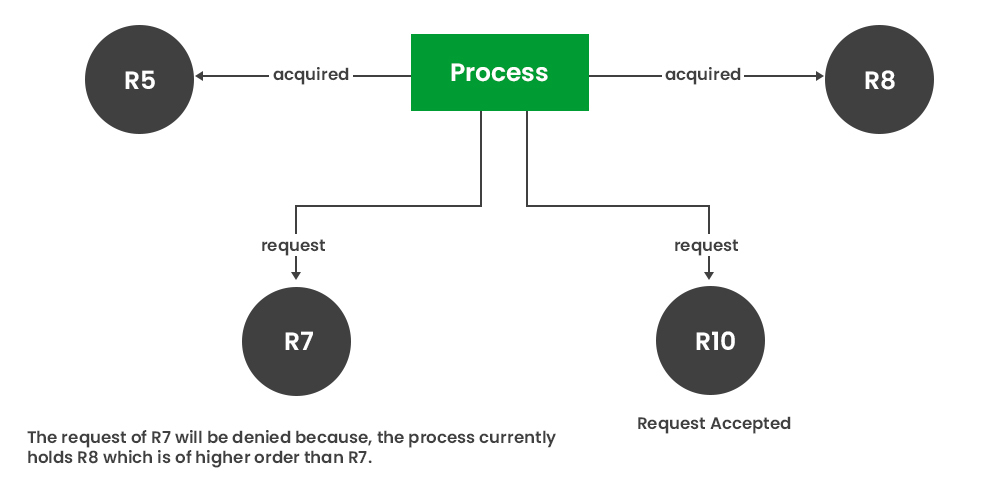
If a process holds a lock on resource R_i and wants to acquire a lock on R_j, it can only do so if j > i. If it needs a lock on R_k where k < i, it must first release R_i (and any other resources R_m where m > k). This rule makes a circular wait impossible.
The diagram below illustrates this. Imagine a system where resources are ordered numerically (R5 < R7 < R8 < R10).
Example 1: Bank Account Transfers in Java
Let's see how this works in practice. A classic deadlock scenario involves transferring money between two bank accounts. Consider two concurrent transfers:
- Thread A:
transferMoney(accountX, accountY, 100) - Thread B:
transferMoney(accountY, accountX, 50)
A naive implementation might lock the fromAccount first, then the toAccount. With unlucky timing:
- Thread A locks
accountX. - Thread B locks
accountY. - Thread A tries to lock
accountY, but it's held by B. Thread A blocks. - Thread B tries to lock
accountX, but it's held by A. Thread B blocks.
We have a deadlock. The following article presents this exact problem and a robust solution using resource ordering.
Deadlock Prevention in Concurrent Programs
This article from The Algorists provides a detailed, code-centric look at lock-ordering deadlocks and their prevention.
First, read from the beginning of the article down to the transferMoney code block. This section, including the deadlock-prone code, clearly sets up the problem. Next, read the Mitigation section and the final code block that demonstrates the fix. Focus on how System.identityHashCode is used to create an arbitrary but consistent lock order. Also, pay attention to the clever use of a tie-breaking lock to handle the rare case of hash code collisions. This level of detail is directly applicable to production systems.
As the article demonstrates, by checking the hash codes of the two Account objects, the code can enforce a consistent locking order: always lock the object with the smaller hash code first. This breaks the circular dependency and prevents the deadlock, regardless of the order in which the accounts are passed to the transferMoney method. Using a natural, unique key like an account ID would be an even better and more reliable way to establish this order.
Example 2: Database Transactions in SQL
The principle of resource ordering isn't limited to application-level locks; it's just as critical in databases. Transactions that update multiple rows or tables can easily deadlock if they don't acquire locks in a consistent order.
This next resource shows how to apply the same strategy to SQL transactions.
How to Implement Deadlock Prevention - OneUptime
This article from OneUptime provides practical deadlock prevention strategies with a focus on databases.
Read the section titled Consistent Lock Ordering. It presents a scenario where two transactions transferring inventory between warehouses deadlock. Then, it shows the corrected code where both transactions lock the warehouse tables in the same alphabetical order, thus preventing the deadlock.
This example powerfully illustrates that whether you are synchronizing Java objects or database rows, enforcing a consistent acquisition order is the key to preventing circular waits.
Complementary Strategies
While resource ordering is a powerful prevention tool, other techniques can supplement it to build even more resilient systems. These often focus on reducing the probability of deadlocks or providing a fallback.
-
Lock Timeouts: Instead of waiting indefinitely for a lock, a thread can be configured to "time out" after a certain period. When a timeout occurs, the thread can release all the locks it currently holds, wait for a random interval (to avoid a "livelock" where threads repeatedly conflict), and then retry the entire operation. This approach effectively breaks the "Hold and Wait" condition by not holding locks indefinitely while waiting. The
tryLock()method in Java'sReentrantLockis a great example of this. -
Reduce Lock Scope and Duration: A simple but highly effective practice is to hold locks for the shortest time possible. The smaller the critical section, the lower the probability of a lock conflict. A key part of this is to never perform slow or unpredictable operations like I/O, network calls, or complex computations while holding a lock. Fetch the data you need, release the lock, perform the slow operation, and then re-acquire a lock if you need to write results back. The
OneUptimearticle touches on this in its section "Keep Transactions Short," andThe Algoristswisely warns against calling unknown "outside methods" while holding a lock.
Conclusion
In this lesson, we transitioned from diagnosing deadlocks to proactively preventing them. You learned that while there are multiple theoretical ways to prevent deadlocks, the most practical and effective strategy for most applications is to break the circular wait condition.
Key Takeaways:
- Deadlock prevention involves designing a system to make one of the four Coffman conditions impossible.
- The most robust and common prevention strategy is resource ordering, where all processes must acquire locks in a globally consistent sequence.
- This principle applies across different contexts, from synchronizing objects in application code (Java) to managing transactions in a database (SQL).
- Complementary techniques like lock timeouts and minimizing lock scope are essential best practices for reducing contention and improving system resilience.
This lesson concludes our module on OS memory and concurrency control. You've built a solid foundation, from understanding processes and threads to managing concurrency with mutexes and semaphores, and finally, to mastering the challenge of deadlocks.
In our next module, we'll move up the system stack to explore the fundamental principles of networking, starting with a journey through the layers of the TCP/IP model to understand how data travels across the internet.