Welcome to the third lesson in our "Data Structures & Algorithms Fundamentals" module. In our previous session, we contrasted the core linear data structures—arrays, linked lists, and hash maps—focusing on how their memory layout dictates their performance trade-offs. We established that the "best" structure is always a function of the problem you're solving.
Today, we transition from the linear world of sequences to the more complex domain of non-linear data structures. This lesson is pivotal because it's about modeling reality more closely. The problems you encounter in large-scale systems often involve hierarchies, priorities, and interconnected networks, not just simple lists. We will compare the trade-offs of three foundational non-linear structures: trees (specifically Binary Search Trees), heaps, and graphs. Your goal is to understand when and why to choose one over the others, a critical skill for making sound architectural decisions.
From Lines to Networks: Introducing Non-Linear Structures
Linear data structures, like the arrays and linked lists we've studied, arrange elements in a sequence. There's a clear "next" element. Non-linear structures break from this single-file line, allowing elements to have multiple neighbors, forming hierarchies or complex networks.
This article frames the choice between linear and non-linear structures as a modeling decision. It provides an excellent high-level introduction to the concepts we'll cover today.
Read the introduction and the section titled "What 'Linear' vs 'Non-linear' Really Means". Focus on the core distinction: topology. The article's subway line vs. city map analogy is a powerful mental model.
As the article suggests, choosing a non-linear structure is about matching its shape to your problem's domain. Let's examine the three key shapes for this lesson:
- Trees: Model strict hierarchies, like a file system or an organization chart. Each element (node) has one parent and can have multiple children.
- Heaps: A specialized, partially-ordered tree structure optimized for one thing: efficiently finding the item with the highest or lowest priority.
- Graphs: Model complex networks where any element can be connected to any other, such as social networks or service dependencies.
Binary Search Trees (BSTs): For Ordered Data and Fast Search
A Binary Search Tree is a cornerstone of computer science, designed for efficient searching, insertion, and deletion in an ordered collection of items.
Its power comes from a simple, elegant rule:
For any given node, all values in its left subtree are smaller than the node's value, and all values in its right subtree are larger.
This property allows you to discard half of the remaining data at each step of a search, leading to an average time complexity of for search, insert, and delete operations.
However, this performance is conditional. A standard BST's efficiency depends entirely on it being balanced. If you insert elements in a sorted order, the tree degenerates into a structure that behaves like a linked list, with performance dropping to .
The following video effectively visualizes this problem and introduces the standard solutions.
Trees Compared and Visualized | BST vs AVL vs Red-Black vs Splay vs Heap | Geekific
This video from Geekific visualizes the difference between a simple BST, self-balancing trees like AVL and Red-Black trees, and heaps.
Watch these three segments to understand the practicalities of using BSTs: BST Recap and Problem: This explains the core BST property and visualizes how it can become unbalanced and inefficient. Self-Balancing Trees: This introduces AVL and Red-Black trees, the practical solutions to the balancing problem. Pay attention to the trade-off: Red-Black trees are less strictly balanced but faster on inserts/deletes, making them a common choice for general-purpose libraries (like Java's TreeMap). Visual Comparison: This shows how BST, AVL, and Red-Black trees look with the same input data, cementing the concept of balance.
As the video makes clear, in a production environment, you would almost never use a "raw" BST. You would use a self-balancing implementation like a Red-Black Tree or an AVL Tree, which are provided by most standard libraries. These structures automatically perform rotations to maintain balance, guaranteeing performance.
When to use a Balanced BST:
- You need to maintain a sorted collection of items.
- You need to perform fast lookups, insertions, and deletions on arbitrary elements (e.g.,
is 'user_xyz' in the set?). - You need to support range queries (e.g.,
find all users with login counts between 100 and 200). An in-order traversal of a BST naturally yields sorted data.
Heaps: For Priority and Efficient Min/Max Extraction
A heap is also a tree-based structure, but it serves a very different purpose. It's not designed for searching for arbitrary elements; it's designed for one thing: providing constant-time access to the minimum or maximum element.
A heap follows a single, simpler rule known as the heap property:
- In a Min-Heap, every parent node is smaller than or equal to its children.
- In a Max-Heap, every parent node is larger than or equal to its children.
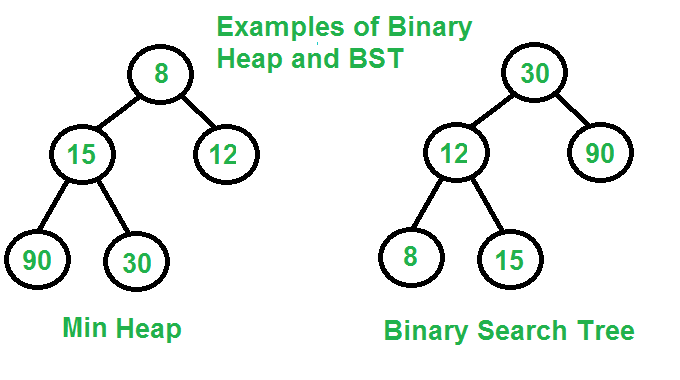
This "partial ordering" is the crucial difference. A heap doesn't keep the entire collection sorted. It only ensures the element with the highest (or lowest) priority is at the root, ready to be plucked off in time. When you remove the root, the heap efficiently reorganizes itself in time to place the next highest-priority item at the top. Inserting a new item also takes .
The critical trade-off is that searching for an arbitrary element in a heap is an operation, as you might have to scan the entire structure.
When to use a Heap:
- You are implementing a Priority Queue. This is the canonical use case.
- You need to repeatedly extract the minimum or maximum element from a collection.
- You are solving problems involving scheduling (e.g., task schedulers), pathfinding (e.g., Dijkstra's algorithm), or finding the "top-K" items in a large dataset.
Head-to-Head: Choosing Between a BST and a Heap
The choice between a balanced BST and a heap is a classic engineering decision. An excellent article from TheLinuxCode breaks down the practical differences.
This article provides a detailed, practical comparison, focusing on the "why" and "when" for choosing each structure.
Please read the following sections to internalize their core trade-offs: Start with the definitions and comparison table to get a quick overview. Read the explanation of total vs. partial ordering. This is the most important conceptual difference. Next, review the section "Practical tasks and which structure wins" for direct guidance. Read the sections "Why heaps win..." and "Why BSTs win..." to see these use cases elaborated. Study the trade-off table for a concise summary of choices. Finally, read about the "hidden cost" of searching in a heap, a common pitfall.
Let's distill the key decision points from that reading:
| If you need to... | Choose a... | Because... |
|---|---|---|
| Iterate through all items in sorted order | Balanced BST | Its in-order traversal is inherently sorted (). A heap would require a full sort (). |
| Find, update, or delete an arbitrary element by its value | Balanced BST | It provides efficient search. A heap requires a linear scan (). |
| Repeatedly get the smallest or largest item | Heap | It provides access to the root and for insertions/removals of the root. |
| Build the structure from a large, unsorted list | Heap | The heapify algorithm is a highly efficient . Building a BST is . |
| Perform range queries (e.g., "all items from X to Y") | Balanced BST | Its sorted nature makes this efficient. This is not feasible on a heap. |
Graphs: For Everything Else
What if your data doesn't fit a neat hierarchy? What if it's a network of dependencies, a social graph, or a map of interconnected cities? This is where graphs come in. A graph is the most general non-linear data structure, consisting of vertices (nodes) and edges (the connections between them).
Unlike trees, graphs can have:
- Cycles: You can follow a path of edges and end up back where you started.
- Disconnected components: The graph might be composed of several separate networks.
- Many-to-many relationships: Any node can connect to any other node.
Because of this complexity, traversing a graph isn't as simple as walking a tree. You need a systematic strategy. The two most common are:
- Breadth-First Search (BFS): Explores the graph layer by layer, like ripples in a pond. It's excellent for finding the shortest path between two nodes in an unweighted graph.
- Depth-First Search (DFS): Explores as far as possible down one path before backtracking. It's useful for tasks like checking for cycles, pathfinding, or solving puzzles like mazes.
Traversal complexity for graphs is typically expressed in terms of the number of vertices and edges , resulting in .
When to use a Graph:
- Your data represents a network (e.g., social networks, computer networks, road maps).
- You need to model dependencies (e.g., build systems, package managers, service call graphs).
- You are solving problems related to reachability, pathfinding, or connectivity.
Making the Final Choice: A Practical Framework
As a manager, your value is in guiding your team to choose the right tool for the job. The choice of data structure is a foundational modeling decision that has lasting consequences on performance, complexity, and maintainability.
The following reading provides a fantastic decision matrix and scenarios to help solidify your thinking.
This article provides a practical framework for choosing the right structure based on the operations you need to perform.
First, study the table under the heading "Choosing the Right Structure". This is a concrete, actionable guide. Then, read through the practical scenarios (Permissions, Autocomplete, Scheduling, and Dependency Resolution) to see this decision-making process in action.
Let's summarize with a few targeted scenarios:
-
Problem: Design a system to manage permissions in a large organization where users belong to groups, and groups can be nested within other groups.
- Analysis: This is a problem of relationships and inheritance. A user's permissions are determined by traversing a hierarchy. The relationships can be many-to-many (a user in multiple groups).
- Choice: Graph (or a Tree if the hierarchy is strictly one-parent). A graph correctly models the complex membership and inheritance rules. Trying to use a flat list would lead to inefficient, repeated scans.
-
Problem: Implement the backend for a "Top Scores" leaderboard in a mobile game. The board should always display the top 100 scores, and new scores are submitted constantly.
- Analysis: The primary operation is always needing the extremes of a set of data (either the top or bottom scores). We don't need to search for a specific score, just maintain the top 100.
- Choice: Min-Heap of size 100. When a new score arrives, if it's larger than the smallest score in the heap (the root), you pop the root and insert the new score. This is far more efficient than constantly re-sorting a list or a BST.
-
Problem: Build an index for a customer database to allow for quick lookups by customer ID and also enable queries for all customers who signed up in a specific month.
- Analysis: You need fast lookups by a key () and the ability to perform range queries on sorted data (by signup date).
- Choice: Balanced BST (like a B-Tree, which is commonly used in databases). A hash map would give you fast lookups but couldn't handle the date-range query efficiently. A heap is completely unsuitable.
Conclusion
Today, we've explored the world of non-linear data structures. The central theme is that these structures are not just containers for data; they are ways of modeling the inherent shape of a problem.
Here are the key takeaways:
- Binary Search Trees are your tool for maintaining ordered data. They excel at searching, range queries, and any task requiring a sorted view of the data. Always use a balanced implementation.
- Heaps are specialized for priority. They provide the fastest possible way to access the minimum or maximum element, making them the foundation of priority queues.
- Graphs are the most general tool for modeling networks and relationships. They are essential when your data has complex, many-to-many connections.
Your primary diagnostic question should always be: "What operations will I perform most often?" Answering that question will naturally lead you to the structure whose trade-offs best align with your needs.
In our next lesson, we will shift focus from data structures to a specific, powerful algorithm: Merge Sort. We will implement it and analyze its performance, applying the complexity analysis skills we've been honing.