In our previous lesson, we explored Merge Sort, an excellent example of the "Divide and Conquer" strategy that guarantees O(n log n) performance but at the cost of O(n) auxiliary space. This laid the groundwork for understanding how recursive algorithms can efficiently solve complex sorting problems.
Today, we will dissect Quicksort, another powerful sorting algorithm that also employs the "Divide and Conquer" paradigm. Quicksort is one of the most widely used sorting algorithms in practice, and for good reason. It's often faster than Merge Sort for in-memory arrays and operates largely in-place. However, this practical speed comes with a trade-off: a potential for O(n^2) performance in its worst-case scenario. Your goal for this lesson is to implement Quicksort and, critically, to analyze the practical trade-offs between it and Merge Sort, a common decision point in software engineering.
The Quicksort Strategy: Partitioning
Like Merge Sort, Quicksort is recursive. But where Merge Sort does its main work in the "Combine" (merge) step, Quicksort's brilliance lies in its "Divide" step, which is called partitioning.
The strategy is elegantly simple:
- Choose a pivot: Select an element from the array. This element is called the pivot.
- Partition: Reorder the array so that all elements with values less than the pivot come before it, while all elements with values greater than the pivot come after it. After this partitioning, the pivot is in its final sorted position.
- Recurse: Recursively apply the above steps to the two sub-arrays of elements with smaller and greater values.
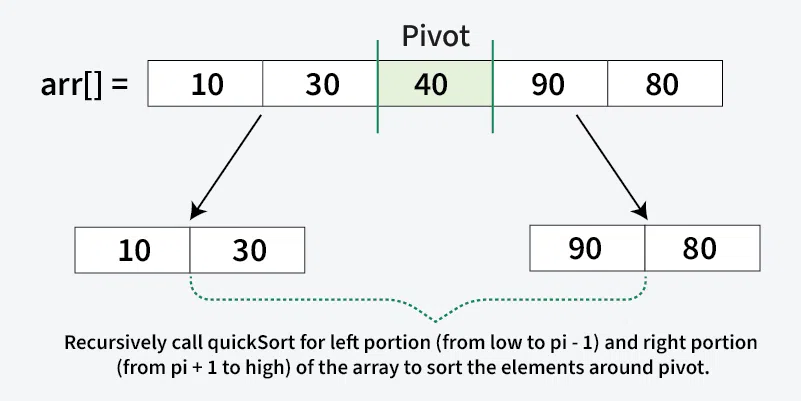
The key to Quicksort's efficiency is that the partitioning is done in-place, meaning it rearranges the elements within the original array without needing to create large auxiliary arrays like Merge Sort does.
Implementing Quicksort
The most intricate part of Quicksort is the partition function. To truly understand how it works, it's best to see a detailed walkthrough. The following video provides an excellent visualization of the algorithm's logic and then translates it directly into code.
Quicksort Sort Algorithm in Java - Full Tutorial With Source
This tutorial from "Coding with John" gives an exceptionally clear, step-by-step guide to both the logic and implementation of Quicksort in Java.
Please watch the following segments: Algorithm Overview: Watch this first to get a strong conceptual model of the pivot, partition, and recurse steps. Partitioning and Swapping: This is the most critical part. Pay close attention to how the leftPointer and rightPointer are used to rearrange elements around the pivot in-place. Recursive Calls and Base Case: This section puts it all together, showing how the partition function is used recursively to sort the entire array.
Now that you've seen a clear demonstration, let's review a concise implementation in text form. This will help solidify the structure of the quickSort driver method and its partition helper.
Quicksort Algorithm Implementation in Java | Baeldung
This Baeldung article provides a clean, standard implementation that's useful to review.
In the "Implementation in Java" section, focus on the code blocks for the two key methods: The recursive quickSort method, which serves as the recursive driver. The partition method, which performs the in-place rearrangement. Note that this partition logic is slightly different from the two-pointer approach in the video (it's a variation of the Lomuto partition scheme), but its goal and outcome are identical.
The Critical Role of the Pivot
As you've seen, the choice of pivot is fundamental to the algorithm's performance. If you consistently pick a "bad" pivot—such as the smallest or largest element—the partitions will be extremely unbalanced. For example, if you partition a sorted array using the last element as the pivot, one sub-array will contain n-1 elements and the other will be empty. This effectively degrades the algorithm's performance to O(n^2).
A simple and highly effective way to mitigate this risk is to choose the pivot randomly. This makes it astronomically unlikely that you will consistently get worst-case partitions, ensuring O(n log n) performance on average.
Quicksort Sort Algorithm in Java - Full Tutorial With Source
Let's revisit the "Coding with John" video to see how a simple change in pivot strategy can dramatically improve the algorithm's robustness.
Watch the segment on improving pivot selection. The video explains why a random pivot helps avoid the worst-case scenario and shows how simple it is to implement this change.
Performance Deep Dive: Quicksort vs. Merge Sort
With a solid understanding of both algorithms, we can now make a detailed comparison, which is essential for making informed engineering decisions.
Quicksort Algorithm Implementation in Java | Baeldung
The Baeldung article you reviewed earlier also contains a concise analysis of Quicksort's performance and a direct comparison with Merge Sort.
Please read two sections: Start with the section on Time Complexity. This formally explains the best, worst, and average cases we've discussed. Next, read the section QuickSort vs MergeSort. This directly contrasts the two, focusing on the crucial difference in space complexity.
Let's consolidate these points into a clear comparison table.
| Feature | Quicksort | Merge Sort |
|---|---|---|
| Time Complexity | Average: O(n log n) Worst: O(n^2) |
O(n log n) in all cases (best, average, worst) |
| Space Complexity | O(log n) on average (for recursion stack). O(n) worst-case. |
O(n) for the auxiliary array. |
| Stability | Not stable. The relative order of equal elements is not preserved. | Stable. The relative order of equal elements is preserved. |
| In-place? | Yes. It sorts the array by swapping elements within it. | No. It requires an external array for the merge step. |
Practical Performance
While both algorithms have an average time complexity of O(n log n), Quicksort is often significantly faster in practice for sorting arrays that fit in memory. This is due to two main factors:
- Cache Locality: Quicksort's in-place nature means it accesses memory locations that are close to each other, which plays well with modern CPU caches. Merge Sort, by copying elements to and from an auxiliary array, can lead to more cache misses.
- Lower Constant Factors: The inner loop of Quicksort involves simple comparisons and swaps, whereas Merge Sort's merge step involves more overhead with data copying.
The following graph visualizes this typical real-world performance difference on random data.

Conclusion
In this lesson, you've delved into Quicksort, a cornerstone algorithm in computer science. We've seen how its in-place partitioning strategy leads to excellent average-case performance, but also carries the risk of a quadratic worst-case if not handled carefully.
Here are the key takeaways for your engineering toolkit:
- Core Mechanism: Quicksort works by partitioning an array around a pivot and then recursively sorting the resulting sub-arrays. This is done in-place.
- Performance Profile: It boasts an average-case time complexity of
O(n log n)withO(log n)space complexity, making it highly efficient. However, its worst-case isO(n^2)time andO(n)space, a risk mitigated by using a random pivot. - Trade-offs vs. Merge Sort:
- Choose Quicksort when average-case speed is paramount, memory is a concern, and stability is not required. This is a common scenario for general-purpose, in-memory array sorting.
- Choose Merge Sort when you need a performance guarantee (
O(n log n)no matter what), when stability is required (e.g., sorting by multiple criteria), or when you are sorting data structures that are not easily accessed by index (like linked lists), where Merge Sort's merging process is more natural.
In our next lesson, we will shift our focus back to data structures and tackle graph traversal algorithms. You will learn to solve problems using Breadth-First Search (BFS) and Depth-First Search (DFS), two fundamental techniques for exploring connected data like networks, hierarchies, and mazes.