Introduction
In our previous lesson, we secured the communication channel by dissecting the TLS handshake. Now that we can establish a secure connection, the next question is what kind of messages we should send over it. This brings us to the application layer, where different architectural styles and protocols govern how services communicate.
This lesson focuses on a critical decision in modern software architecture, directly addressing the learning outcome: Compare REST and gRPC, identifying trade-offs in performance, payload size, and use cases. We will explore REST as the long-standing incumbent for API design and then dive into gRPC, a high-performance alternative. Understanding the architectural, performance, and practical trade-offs between these two is fundamental for designing scalable and efficient distributed systems, particularly in a microservices context.
What is REST? The Ubiquitous Standard
Representational State Transfer (REST) has been the dominant architectural style for web APIs for years. You are likely very familiar with its principles from your experience. It's built on the foundations of the web itself, using standard HTTP methods, URIs to identify resources, and typically human-readable data formats like JSON.
To quickly refresh the core idea, let's review a brief summary.
gRPC vs. REST: Getting Started With the Best API Protocol | Toptal®
This section from a Toptal article provides a concise overview of REST.
Please read the section titled What Is REST. Pay attention to the mapping of HTTP verbs to actions and the example of a JSON payload. Notice the author's point about the trade-off between clarity and efficiency.
The key takeaways for REST are its simplicity, statelessness, and broad compatibility. Any client that can speak HTTP can interact with a REST API, making it the default choice for public-facing APIs and general web applications. Its main drawback, the verbosity of JSON and the overhead of HTTP/1.1, becomes more pronounced in high-performance, internal communication scenarios. This is where gRPC enters the picture.
What is gRPC? A High-Performance Alternative
gRPC (gRPC Remote Procedure Call) is an open-source framework developed by Google. Instead of interacting with resources via URLs (like /users/123), gRPC is built on the older but powerful concept of Remote Procedure Calls (RPC). From a developer's perspective, it feels like calling a local function, while the framework handles the "remote" part under the hood.
gRPC is designed for performance and makes several different technical choices compared to REST:
- Protocol: It is built on HTTP/2, which allows for features like multiplexing (sending multiple requests over a single connection), server push, and header compression.
- Data Format: It uses Protocol Buffers (Protobuf) by default. This is a binary serialization format that is much more compact and faster to parse than text-based JSON.
- API Contract: It enforces a contract-first approach. The API's services, methods, and message structures are strictly defined in a
.protofile. This file acts as a single source of truth from which client and server code can be automatically generated in multiple languages.
The following video provides an excellent introduction to these concepts and contrasts them with REST.
Now I Know Why Most People Don’t Use gRPC
This video from the channel ArjanCodes explains what gRPC is and how its contract-first approach works.
First, watch the segment that introduces the core concepts of RPC and Protocol Buffers. Then, see how these concepts are put into practice in the section explaining how code is generated from .proto files.
This contract-first model provides strong typing and reduces ambiguity, which is a significant advantage in complex microservice architectures where many services, potentially written in different languages, need to communicate reliably.
Core Technical Comparison
Now that we have a foundational understanding of both, let's systematically compare them. The table below offers a high-level overview of the key trade-offs, which we will explore in more detail.
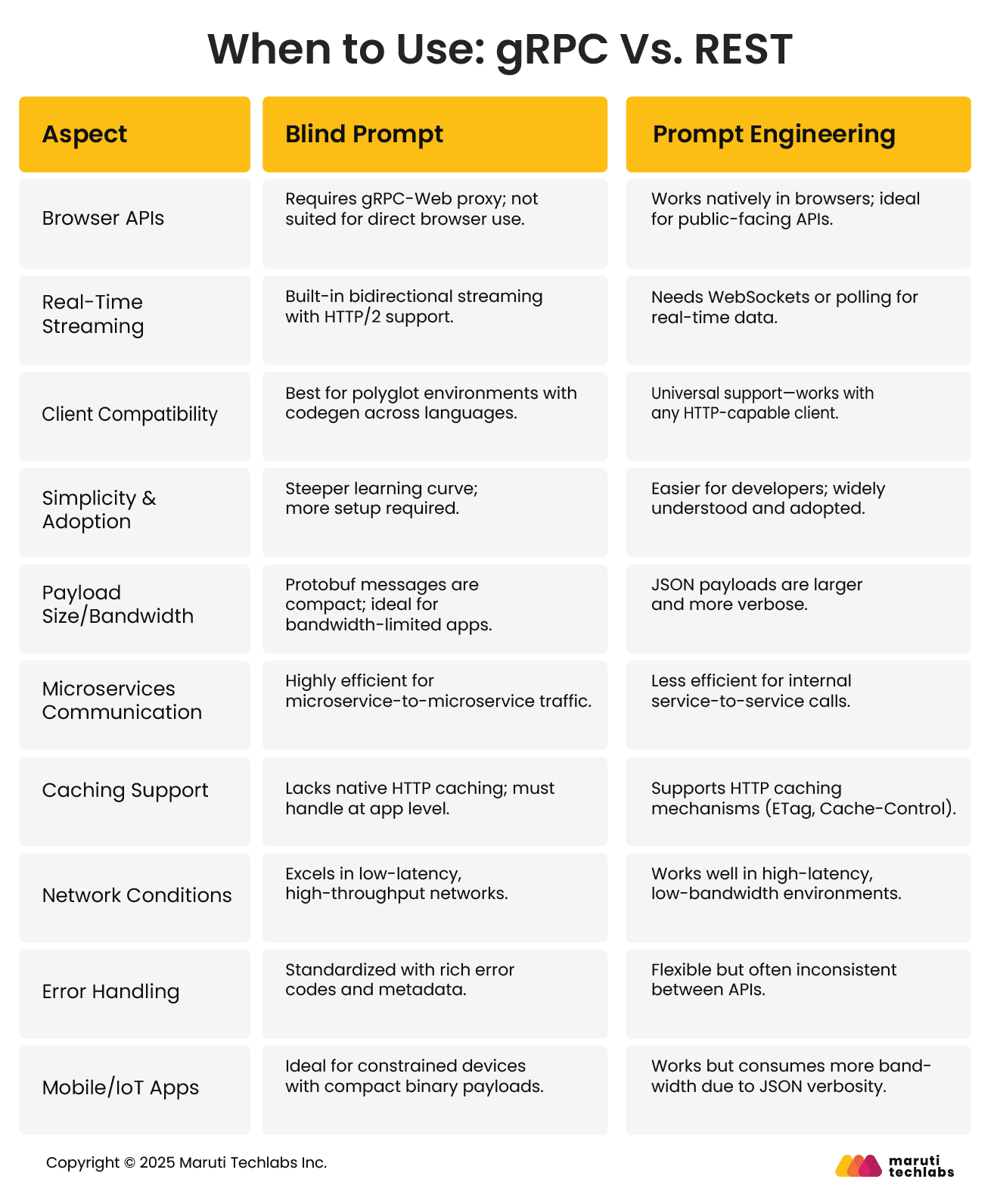
Let's break down the most critical distinctions.
gRPC vs. REST: Getting Started With the Best API Protocol | Toptal®
This article from Toptal provides a detailed technical comparison.
First, read the summary table under the heading Core Technical Differences. Then, read the two following subsections in full: Data Transport and Formats and Communication and Streaming Models. Focus on how the choices of protocol (HTTP/1.1 vs HTTP/2), data format (JSON vs Protobuf), and streaming support create fundamental differences in performance and capability.
To summarize the key points from that reading:
- Protocol & Transport: REST typically uses HTTP/1.1, which involves connection-per-request overhead. gRPC's use of HTTP/2 allows it to reuse a single connection for many concurrent requests, significantly reducing latency.
- Payload (Data Format): REST's human-readable JSON is verbose. gRPC's binary Protobuf format is compact and efficient, leading to smaller payloads and faster serialization/deserialization. This directly impacts bandwidth consumption and CPU usage.
- Communication Style: REST follows a simple request-response model. While real-time updates can be simulated with polling or WebSockets (which is a separate protocol), gRPC has native support for unary (request-response), server-streaming, client-streaming, and bidirectional streaming. This makes it inherently suited for real-time applications.
- API Contract: REST's contract is often documented via an optional OpenAPI/Swagger specification, which can drift from the implementation. gRPC's
.protofile is a mandatory, strongly-typed contract that guarantees consistency between client and server.
Performance Head-to-Head
Theoretical differences are one thing; seeing the real-world impact is another. The performance gains of gRPC are its most cited advantage, stemming directly from its use of HTTP/2 and Protobuf.
Let's first look at a static benchmark.

While static charts are useful, a dynamic load test provides a much clearer picture of how these systems behave under stress. The following video benchmarks REST and gRPC across several metrics.
gRPC vs REST vs GraphQL: Comparison & Performance
This video by Anton Putra presents a load test comparing REST, gRPC, and GraphQL, showing their performance under increasing load.
Watch the following segments to see the performance trade-offs in action: Latency and Network Usage: Observe how latency changes under load and note the significant difference in network bandwidth consumed by gRPC. Throughput Results: This section shows the maximum number of requests per second each technology could handle. Detailed Analysis: Here, the presenter recaps the results for latency stability, CPU usage, and network usage.
The key performance takeaways are:
- Throughput: gRPC can handle significantly more requests per second than REST on the same hardware.
- Latency: While REST may have slightly lower latency for simple requests under no load, gRPC's latency is far more stable as load increases.
- Payload Size & Bandwidth: gRPC's use of Protobuf leads to dramatically lower network bandwidth consumption, which can translate directly to cost savings in cloud environments.
- CPU & Memory: gRPC is generally more efficient in terms of CPU usage and has a smaller memory footprint due to faster serialization and a more optimized transport layer.
Use Cases and The Final Decision
Given these trade-offs, the choice between REST and gRPC becomes a strategic one based on the specific needs of your application. It's not about one being definitively "better," but about which is the right tool for the job.
Choose REST when:
- Public-facing APIs: Simplicity and broad accessibility are paramount. Any developer with any tool can consume a REST API without special libraries.
- Browser-based clients: REST is natively supported in all browsers. While gRPC can be used in browsers via a proxy layer called gRPC-Web, it adds complexity and loses some features like bidirectional streaming.
- Simple CRUD operations: For straightforward resource management where performance is not the primary driver, REST's simplicity is a major advantage.
Choose gRPC when:
- Internal Microservices Communication: This is gRPC's sweet spot. In a polyglot microservices environment, the high performance, low latency, and strict contracts of gRPC ensure efficient and reliable communication.
- Real-time applications: For services like chat, live streaming, or IoT data ingestion, gRPC's native streaming capabilities are far superior to REST-based workarounds.
- Network-constrained environments: In mobile apps or IoT devices where bandwidth is limited and battery life is a concern, gRPC's compact payloads offer a distinct advantage.
Many modern architectures adopt a hybrid approach, using both.
How to Choose Between gRPC and REST for Your API - OneUptime
This blog post from OneUptime provides clear use case guidance and illustrates a common hybrid architecture pattern.
Please read the section Use Case Analysis. Pay close attention to the diagram under "Microservices Communication" and the final diagram under "Hybrid Architecture Pattern." These visualizations show how REST is often used for the external-facing API Gateway, while gRPC handles the high-performance internal traffic between microservices.
Conclusion
In this lesson, we compared two leading approaches for API design, moving from the theory to practical performance and use-case analysis. Your role as an engineering manager often involves making or guiding these foundational architectural decisions, and understanding these trade-offs is key to building scalable, maintainable, and cost-effective systems.
Key Takeaways:
- REST prioritizes simplicity, accessibility, and compatibility. It uses standard HTTP/1.1 and human-readable JSON, making it ideal for public-facing APIs and simple web applications.
- gRPC prioritizes performance, efficiency, and strict contracts. It leverages HTTP/2 and binary Protobufs for low-latency, high-throughput communication, and its contract-first approach ensures reliability between services. It excels in internal microservice architectures and real-time systems.
- Payload size and performance are major differentiators. gRPC's binary payloads are significantly smaller and faster to process than REST's JSON, leading to lower bandwidth costs and higher throughput.
- A hybrid model is a common and effective pattern: use REST for external APIs exposed to the public and third parties, and use gRPC for the demanding communication between your internal backend services.
In our next lesson, we will discuss another critical piece of modern network architecture: the reverse proxy. We'll explore its function and benefits, such as load balancing and SSL termination, which are essential for managing traffic to the very services we've discussed today, whether they speak REST or gRPC.