Hello. Last lesson distinguished an ion channel from a transporter: an open channel gives suitable ions a passage, but does not push them in a particular direction. Today you’ll work out which way ions tend to move through that passage. This is the bridge between membrane proteins and a neuron’s electrical behaviour.
You’ll use two pieces of information in a diagram—the ion’s concentration on each side and the electrical difference between the sides—to predict inward movement, outward movement, or no net movement. Allow about 35 minutes, including time to pause the video and mark up the diagram.
Two influences on one ion
Imagine an open channel that passes a particular ion. Because particles move continually and randomly, more of that ion tends to cross from the side where it is more concentrated to the side where it is less concentrated. This is the concentration gradient. It describes a tendency in the movement of many ions, not a rule that every individual ion travels the same way.
An ion also has an electrical charge. A positive ion is attracted toward a relatively negative side of the membrane; a negative ion is attracted toward a relatively positive side. This is the electrical gradient. The two tendencies together make up the ion’s electrochemical gradient.
Before applying those rules, check the channel. If the diagram says the membrane has no open route for that ion, you cannot predict substantial movement across that membrane merely because a gradient exists. A gradient tells you what would favour movement if a suitable route were available.
The animation below makes the otherwise invisible electrical influence visible. It begins with diffusion, then shows what changes when only potassium ions can cross a barrier.
Watch “Electrochemical Gradient” from Bozeman Science for its animated comparison of concentration-driven movement and charge separation across a selective membrane.
Watch diffusion for the high-to-low concentration tendency. Skip to open pathways to see that particles still cross in both directions. Then watch selective potassium movement. Pause when potassium has begun crossing: identify which ions can pass, which cannot, and how the resulting charge difference opposes further potassium movement. You do not need the numerical particle counts.
The useful distinction is between crossing in a direction and net movement in a direction. Ions may cross both ways through an open channel. “Net movement outward” means more cross outward than inward over a period of time.
Reading a diagram when the influences agree
Start with the ion named in the diagram, not with the overall number of plus and minus signs. Then read the two influences separately:
- Concentration: Which side has more of this ion? Its concentration tendency is toward the side with less.
- Electrical difference: Which side attracts this ion’s charge?
- Combination: Do the tendencies point the same way or oppose one another?
For example, suppose sodium ions are more concentrated outside a cell, and the inside is electrically negative relative to the outside. Sodium is positive. Its concentration tendency is inward, and its electrical tendency is inward. If sodium channels are open, the prediction is net sodium movement inward.
Now suppose instead that a negative ion is more concentrated outside while the inside is negative. Concentration favours movement inward, but the negative inside repels that ion, favouring movement outward. You cannot settle the net direction from those two facts alone: you need to know which influence is stronger.
Read the textbook’s short account of sodium and potassium with this distinction in mind.
5.3 Active Transport - Biology for AP® Courses | OpenStax
Read the “Electrochemical Gradient” subsection of OpenStax’s Biology for AP® Courses. It puts the two influences together for ions commonly shown in neuron diagrams.
In “Electrochemical Gradient,” read the first paragraph, beginning “We have discussed simple concentration gradients” and ending just before “Visual Connection.” The relevant passage is the core explanation. Focus on why the two tendencies agree for sodium but oppose each other for potassium; you can leave the later “Moving Against a Gradient” section for another time.
The reading describes common cellular conditions, not an unchangeable property of sodium or potassium. An ion’s direction depends on the concentrations and voltage shown in the particular diagram, as well as whether it can cross. “Potassium moves out” is not a universal rule.
When the influences oppose one another
Consider the image below as two fluid compartments separated by a membrane that lets potassium ions through. The purple potassium ions are more concentrated on the left. The green negative ions cannot cross in this simplified setup. A voltmeter shows an electrical difference between the compartments.
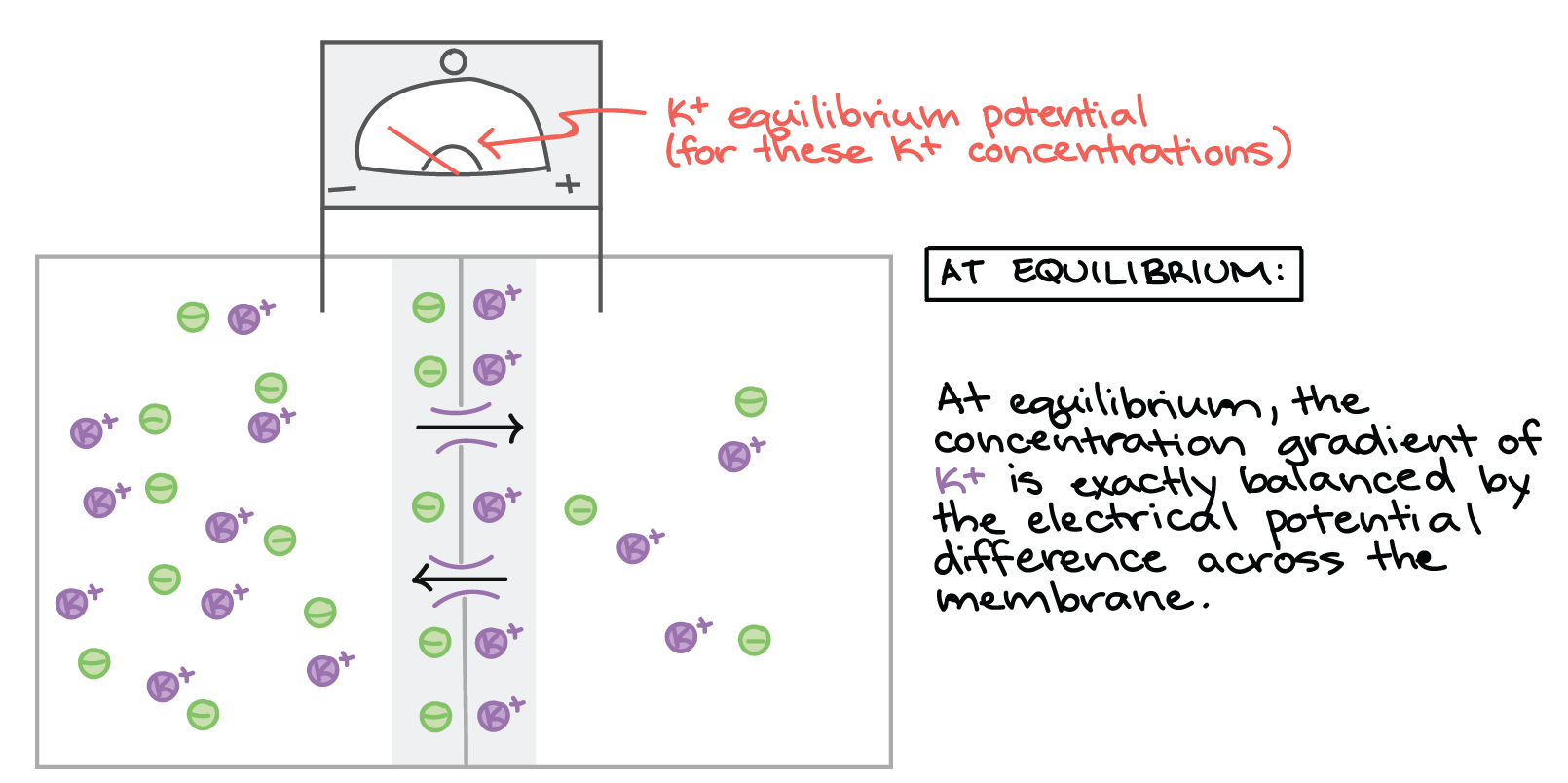
The first prediction is straightforward: potassium’s concentration tendency points right. Potassium is positively charged, so the relatively negative left side attracts it: its electrical tendency points left. The tendencies oppose one another.
How did that electrical difference arise? Initially, potassium could move from the more concentrated side to the less concentrated side. As some positive potassium ions crossed rightward while negative ions remained behind, the left side became relatively negative and the right side relatively positive. That growing electrical difference increasingly opposed further net movement to the right.
In the pictured equilibrium, the opposing tendencies balance. There is no net potassium movement through the open channels. This does not mean that the channel has shut or that every potassium ion has stopped moving. Some cross in either direction, but neither direction wins overall. Nor do the potassium concentrations have to become equal: the electrical difference can balance a persisting concentration difference.
For a quick visual check, cover the explanatory text beside the image and mark the two tendencies in different colours on a sketch of the compartments. The colours should point in opposite directions. The voltmeter tells you that a voltage exists; its needle alone does not tell you how many ions are crossing.
What a diagram can—and cannot—tell you
When both tendencies favour the same direction, the net prediction is clear if a suitable channel is open. When they oppose one another, the stronger tendency determines the net direction. If a diagram gives only the directions, rather than their relative strengths or an explicit equilibrium condition, “not enough information” is the sound conclusion.
| What the diagram shows for an ion with an open channel | Net prediction |
|---|---|
| Concentration and electrical tendencies both inward | Inward |
| Both outward | Outward |
| Opposing tendencies; one labelled stronger | Direction of the stronger tendency |
| Opposing tendencies; stated to be balanced | No net movement |
| Opposing tendencies; no strengths or balance specified | Cannot determine the net direction |
“No net movement” applies to the particular ion whose tendencies balance. It does not say that every ion is at equilibrium or that the whole neuron has no electrical activity. It also differs from “no movement because there is no open channel”: one is a balance of opposing influences through an available route; the other is a lack of a route.
Takeaways
To predict ion movement, first identify a permeable route, then judge the concentration tendency and the electrical tendency for the specified ion. Agreeing tendencies give a clear net direction. Opposing tendencies require information about their relative strength; at balance, ions may still cross both ways, but there is no net movement.
Next, you’ll use these same ideas to explain why a neuron has a resting membrane potential—a stable electrical difference even when it is not sending a signal.